11 Small Finds from ʿAin el-Gedida: Other Categories
This is an online digital edition from ISAW Digital Monographs. The print edition of this work can be consulted at https://isaw.nyu.edu/publications/isaw-monographs/ain-el-gedida
11.1 Textiles
11.1.1 Introduction
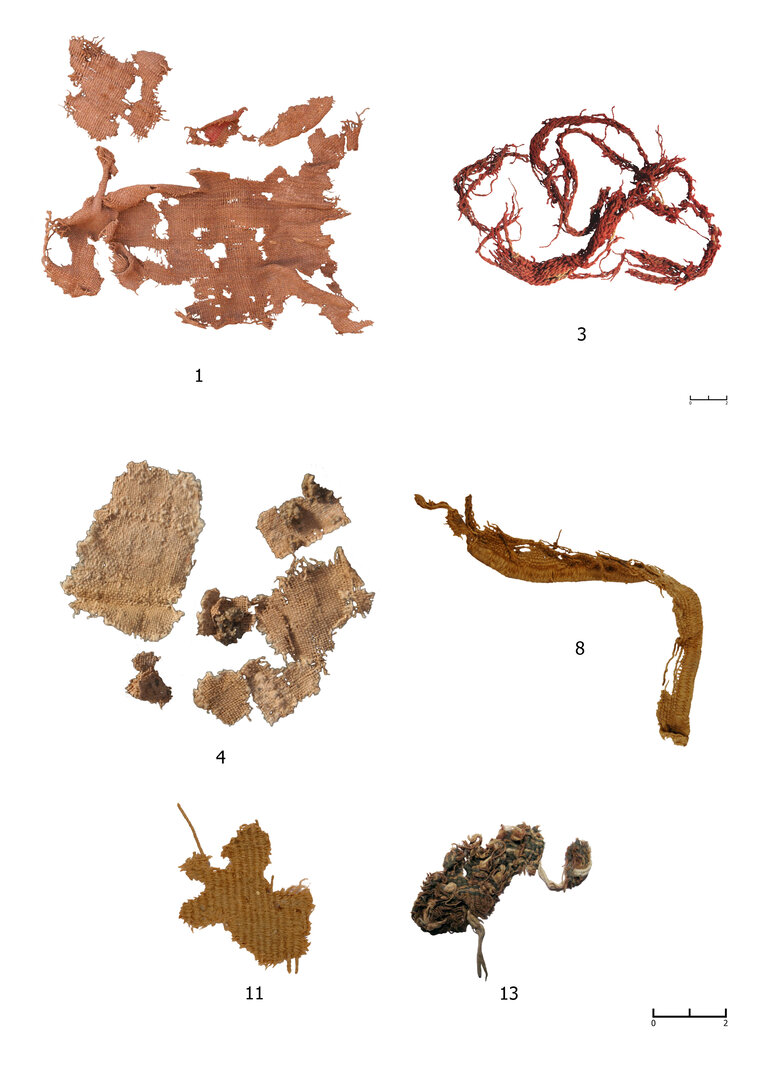
Thirteen fragments of textiles were retrieved during the excavations at ʿAin el-Gedida. They comprise mostly scraps of wool and linen of varying quality, including fabrics with simple decoration. During the study of this group of finds attention was given to the raw material, the thickness and direction of the spin, the thread count per centimeter, the type of weave, and the decoration and technical features.1 A handheld digital microscope was used to investigate the fibers. Nevertheless, the study needs to be expanded to include scientific analysis of the materials, dyes, and mordants. It is hoped that further excavation on the site will bring forth more objects in this category and justify a broader and more in-depth study of the material.
The assemblage consists of lightweight textiles and thicker tapestry-woven pieces, perhaps wall hangings or blankets, but in all cases the state of preservation of the items makes it impossible to determine their original form and function. No intact garments were found, and only a few structural elements are extant: several pieces are sewn with simple running stitches and one fragment preserves a reinforced selvedge. The textiles may have been locally manufactured, possibly even at the site, since spindle whorls and loom weights were recovered at ʿAin el-Gedida (see below). Regardless of the scale and character of textile production in the village, there is ample material evidence of a developed textile industry in nearby Kellis.2
All but two fragments are tabby weaved with thread counts ranging from 6 warp and 18 weft to 10 warp and 37 weft per square centimeter; the weave is always either even or weft-faced, never warp-faced. One of the two remaining pieces (3) is an example of sprang, a netlike fabric made by intertwining groups of threads.3 A large number of Late Antique and Byzantine sprang fabrics, many of them fragments of caps and bags, were found in Egypt, and two unidentified items made using the sprang technique were retrieved in Kellis.4 The piece of sprang fabric from ʿAin el-Gedida is too poorly preserved to reconstruct its appearance and purpose. Similarly, the nature of the one piece made in the basket weave technique (13) defies more detailed description due to the item’s very poor state of preservation.
11 out of 13 textile fragments from ʿAin el-Gedida are made of wool yarn, both natural and dyed. The animal from which the wool was obtained cannot be determined without more sophisticated methods of analysis. The study of faunal remains from ʿAin el-Gedida has indicated the presence of both sheep and goats at the site.5 However, it is noteworthy that samples from Kellis proved to derive from sheep.6 Also documentary evidence indicates that in Kellis sheep were reared to obtain this raw material.7
Three fragments were made of or included linen (Linum sp.) in natural or dyed form. Flax was grown locally in the Dakhla Oasis; botanical remains (flax capsules) were recovered at Kellis,8 and flaxseed is attested, albeit as pigeon feed, in Trimithis (O.Trim. 261.2; 272.2; 276.2). Linen weavers are mentioned in the KAB (P.Kell. 4 G. 96.292) and in a Kellis ostrakon (O.Kell. 102.8), as well as in Trimithis ostraka (O.Trim. 20.2; 21.5; 34.6). According to a conjectural reading of P.Kell. 1 G. 12.19-20 (see comm. ad loc.) the linen-weaving trade was taught at a monastery in the vicinity, possibly at Tineida.9
The fibers for the yarns are invariably s-spun, regardless of the material, and the thicker, 2 ply threads are z-plied. The yarns used for weaving are all 1-ply except for a tapestry-woven fragment with a warp composed of double Z2s threads, possibly because the textile was heavier and its warp needed to withstand greater tensions. Several thicknesses of yarn were identified, ranging from 0.04 to 0.1 cm. All the yarns used for stitching are 2-ply.
Both linen and wool are attested in dyed and natural form. The natural fibers ranged in color from off-white to brown, and further analysis is needed to determine if any of these shades were obtained as a result of a dyeing process. Among the dyed fibers, the colors represented are rose pink, red, purple, blue, and black. In two cases (1, 8) only bands of color (red, black) adorned an otherwise undyed piece of textile. Dyed woolen fabrics always consisted of natural warp and colored weft. The attested weft colors in such cases were rose pink, light blue, and purple. The sprang fragment consists of 2-ply threads dyed red with a few intermixed blue and cream-colored (undyed) yarns. One of the two linen fragments is dyed blue. The dyes and mordants could be obtained locally. Analyses of three fabric samples from Kellis have demonstrated that the dyes used on them were vegetable-based and derived from plants that may well have grown in the area. The study also indicated the use of alum, also a locally available resource, as a mordant.10 Furthermore, references to purple dye in Kellis papyri indicate that it was not only available, but possibly manufactured there.11
11.1.2 Catalouge
1
Inventory Number 3
Findspot area B, room B4, DSU 4
Dimensions 4 fragments; largest fr. 15 x 11 cm; thickness 0.1 cm
Yarn s-spun; th. 0.05 cm
Material wool; undyed (light brown); one band of weft dyed red
Weave loom made tight weave tabby, density 8 warps/cm, 18 wefts/cm
Remarks the largest fragment has a straight stitch made using a beige 2-ply yarn (Z2s, th. 0.1 cm); the smallest fragment has a red band 0.8 cm wide
2
Inventory Number 11
Findspot area B, room B4, DSU 4
Dimensions 4 fragments; largest fr. 12 x 9.5 cm, th. 0.05 cm
Yarn s-spun; th. 0.045 cm
Material wool; warp undyed (light brown) / weft rose pink
Weave loom made tight weave tabby, density 9 warps/cm, 19 wefts/cm
3
Inventory Number 12
Findspot area B, room B4, DSU 4
Dimensions 3 fragments; largest fr. 43 x 2.5 cm; th. 0.1 cm
Yarn 2-ply, s-spun, z-plied (Z2s), red: th. 0.09 cm; blue, yellow: 0.075 cm
Material wool; red, some yarns dyed blue and some undyed (cream-colored)
Weave sprang
Remarks some blue and undyed yarns are interwoven into the largest fragment
4
Inventory Number 21
Findspot area B, room B4, DSU 8
Dimensions 4 fragments, largest fr. 5.2 x 3.5 cm; th. 0.05 cm
Yarn s-spun; th. 0.04 cm
Material linen; unbleached (beige)
Weave loom made tight weave tabby, density 18 warps/cm, 19 wefts/cm
5
Inventory Number 37
Findspot area B, room B5, DSU 25
Dimensions many fragments, very badly preserved; no measurements possible
Yarn s-spun, th. 0.1 cm; stitching: Z2s, 0.125 cm
Material linen; unbleached (yellowish) and blue
Weave loom made tabby, density cannot be determined
Remarks the textile consists of two different-colored pieces sewn together using a thicker yarn
6
Inventory Number 536
Findspot area B, room B5, DSU 28
Dimensions 9.3 x 3.2 cm; th 0.1 cm
Yarn s-spun; th. 0.04 cm
Material wool; undyed (brown)
Weave loom made tight weave weft-faced tabby, density 11 warps/cm, 24 wefts/cm
Remarks the textile is folded and has perforations forming an oval, possibly from stitching
7
Inventory Number 537
Findspot area B, room B5, DSU 28
Dimensions 7.6 x 1.7 cm, th. 0.15 cm
Yarn s-spun; th. 0.06 cm
Material wool; undyed (light brown)
Weave loom made tight weave weft-faced tabby, density 10 warps/cm, 37 wefts/cm
8
Inventory Number 538
Findspot area B, room B5, DSU 28
Dimensions 13.8 x 1.3 cm; th. 0.15 cm
Yarn s-spun; th. 0.05 cm; stitching: 2-ply, s-spun, z-plied (Z2s), th. 0.1 cm
Material wool; undyed (beige)/ black
Weave loom made tight weave weft-faced tabby, density 12 warps/cm, 26 wefts/cm
Remarks a fragment of a reinforced selvedge over two warp bundles (3 threads each). A small fragment of the same textile with a black band 0.3 cm wide is attached to the selvedge by means of a straight stitch made using a 2-ply yarn
9
Inventory Number 539
Findspot area B, room B5, DSU 28
Dimensions 3 x 1.2 cm, th. 0.1 cm
Yarn s-spun; th. 0.045 cm
Material wool; undyed (beige)
Weave loom made weft-faced tapestry weave, density 10 warps/cm, 30 wefts/cm
Remarks textile fragment folded, refolded (4 layers) and sewn together with a running stitch (perforations present, stitching not preserved)
10
Inventory Number 541
Findspot area B, room B5, DSU 28
Dimensions 3.4 x 2.2 cm; textile th. 0.1 cm
Yarn s-spun; th. 0.05 cm
Material wool; warp: undyed (dark beige), weft: light blue
Weave loom made tight weave weft-faced tabby, density 14 warps/cm, 30 wefts/cm
Remarks the textile is folded and the two layers are sewn together with a yarn that resembles the warp threads
11
Inventory Number 542
Findspot area B, room B5, DSU 28
Dimensions 4 x 3.6 cm, th 0.15 cm
Yarn warp 2-ply, s-spun, z-plied (Z2s), th. 0.1 cm; weft s-spun, th. ca. 0.05 cm
Material wool; undyed (yellowish beige)
Weave loom made tight weave weft-faced tabby; density: 6 warps/cm, 18 wefts/cm
Remarks possibly fragment of wall hanging or blanket
12
Inventory Number 543
Findspot area B, room B5, DSU 30
Dimensions 3 fragments, largest fr. 9.3 x 4.2 cm; th. 0.1 cm
Yarn s-spun, th. 0.05 cm
Material wool; undyed (dark beige)
Weave loom made tight weave tabby, density: 13 warps/cm, 17 wefts/cm
Remarks the textile is folded with aligned holes, possibly from stitching
13
Inventory Number 544
Findspot area B, room B5, DSU 30
Dimensions 8.2 x 2.1 cm; th 0.1 cm
Yarn textile: s-spun, th. 0.06 cm; stitching: 2-ply yarn, z-plied, s-spun (Z2s), th. 0.25 cm
Material textile: wool; warp undyed (light brown), weft purple (currently reddish-brown), black and off-white (natural?) Stitching: linen; unbleached (cream)
Weave loom made basket (panama) weave, density: 18 warps/cm, 18 wefts/cm
Remarks the textile has a running stitch fixed with a knot. Severe damage prevents a more detailed description
11.2 Glass Vessels
11.2.1 Introduction
At ʿAin el-Gedida, fragments of glass vessels were found primarily among street-level debris, as well as in dump layers that accumulated in rooms after their abandonment. The non-diagnostic pieces were counted and weighed prior to discarding.12 Fifty-three fragments of glass vessels—diagnostic and decorated pieces—were selected for study.
The terminology used in this paper is mainly derived from Harden’s publication of glass from Karanis.13 Since the material was not subjected to chemical analyses of the composition, the descriptions concern only the observable properties, such as color (as seen against a white background in natural light), weathering, and the presence of bubbles. Thicknesses were measured on wall fragments and diameters at the maximum extent of the rim or base.
The forms attested at ʿAin el-Gedida belong to a repertoire typical for Late Antiquity and are not distinguished for their completeness or originality. Nonetheless, because of the relatively narrow chronological span of the site and the secure dating of their contexts to the fourth century CE, they can be useful as parallels for finds from other sites. Analogies to the glass vessels from ʿAin el-Gedida can be found primarily in nearby Kellis and Trimithis, but also on other Egyptian sites, i.e., in Late Antique strata of Karanis and Alexandria.
The assemblage consists primarily of vessels for everyday use, represented by a variety of fragments, mostly rims and bases. Among the recovered forms are small bowls and deep plates, as well as other open forms that may have been goblets and beakers or conical lamps typical for this period. The finds also included bottom fragments of the latter. Closed forms are represented by fragments of flasks and other small vessels.
Most of the vessels are made of blown glass and bear no traces of decoration. When present, the decorative motifs are limited to applied coils and impressed ribs, or incised lines: wheelmade, as well as straight intersecting cuts. Mosaic glass is represented by several non-diagnostic pieces and one rim fragment.
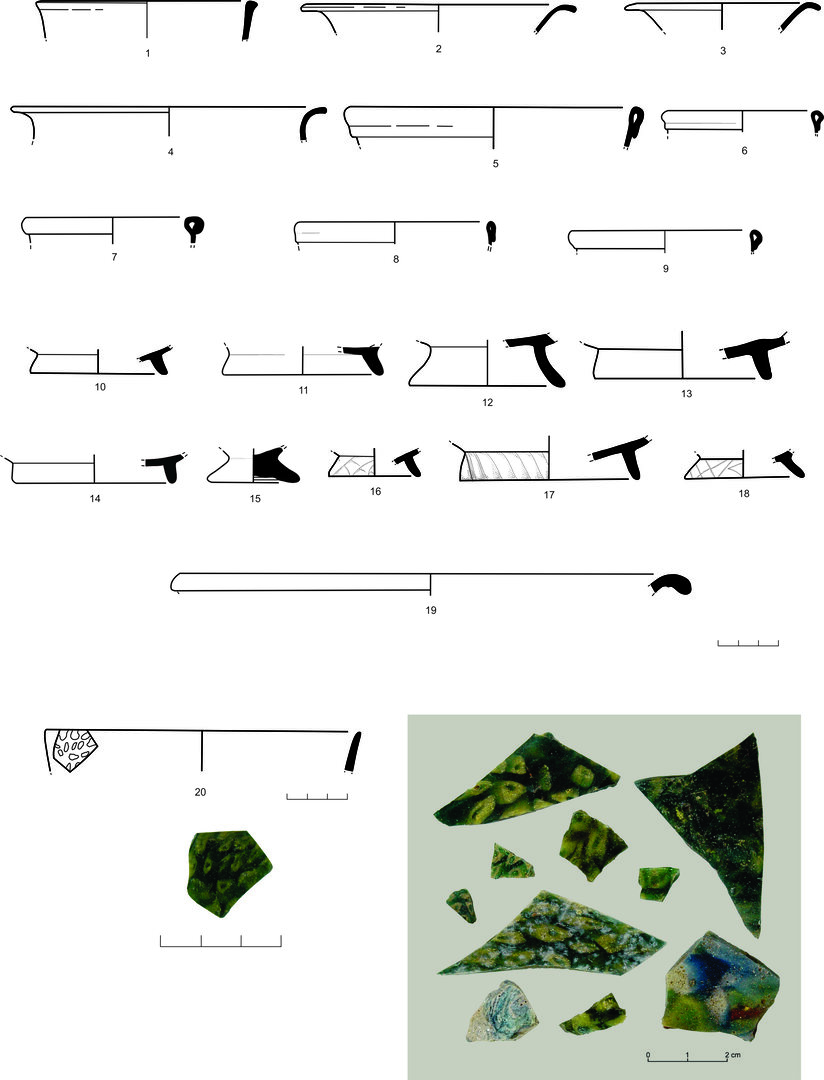
The best-represented group consists of footed bowls and deep plates with diameters ranging from 8 to 16 cm. Their rims are either flared or rolled, and the ring bases are plain or bear decorative patterns in the form of oblique or crisscrossing ribs made by impressing a straight edge into the hot glass. Footed vessels of this type are very common in Egypt in the Roman period, and they are considered local products.14 The glass from which these bowls were made is usually light green, olive-green, more rarely colorless, yellow, or honey-yellow. There are also three violet-colored, almost black base fragments.15
A fragment of interest is a rim of a bowl, 16 cm in diameter, made of pressed mosaic glass (20). Other, non-diagnostic mosaic glass fragments found on site most likely belonged to several other vessels of this type. Mosaic glass is not uncommon in the Great Oasis. Similar pieces have been found in contemporary contexts at Kellis, Amheida, Douch, Bagawat, and ʿAin Turba.16
Shallow plates are represented only by a single large fragment of a folded rim (19). The vessel measured 26 cm in diameter and was made of colorless glass.
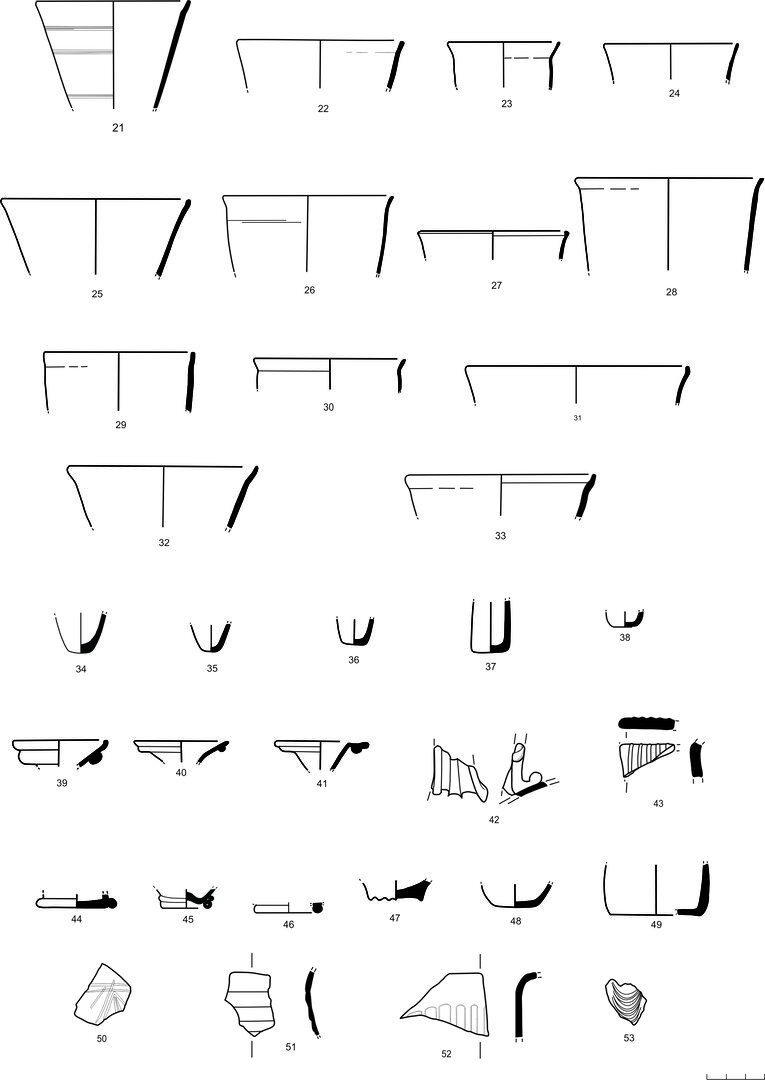
The assemblage includes conical bases of lamps, all of which are made of light-green or nearly colorless glass. They represent a type that was the most common in Late Antiquity: they are conical or U-shaped in section and bear no pontil marks, which renders them classifiable as Type A.2 according to Crowfoot and Harden’s typology for Karanis.17 Conical vessels found in the Eastern Mediterranean were used primarily as lamps, as indicated by soot-covered fragments from Karanis.18 While the bottom fragments can be attributed to the category of conical lamps without any doubt, the rims with diameters ranging from 6 to 10 cm can be identified as parts of lamps, but also as fragments of beakers or goblets. Such vessels, conical or with rounded bases, are attested in Egypt and throughout the Middle East from the midfourth century onwards.19 The rims assigned to the lamps/beakers category have various shapes (turned up, s-shaped, inverted, or flared) and are cut off and ground smooth, sometimes firerounded.
Most diagnostic fragments of lamps/beakers were undecorated. One fragment of a rim and body that was most likely part of a lamp (21) has shallow, tightly spaced horizontal lines incised into the surface with the help of a turning wheel. Similar marks seem to be visible on another fragment (26), but the horizontal lines below the rim are faint enough to be signs of wear. Analogous forms found in the auditoria at Kom el-Dikka, Alexandria, bore horizontal scratches in places where the glass presumably had rubbed against metal rings holding the lamps.20 However, also in the case of (26) the intentional character of the lines cannot be ruled out.
Some non-diagnostic fragments of colorless or light-green glass bear applied cobalt-blue dots. Such decoration is attested in Egypt both on conical lamps and on beakers.21 This simple manner of decorating glass vessels emerged in the mid-third century CE and remained popular in the eastern Mediterranean and in the Black Sea region through the fourth century.22
Among the fragments of closed forms there are rims of three flasks (39, 40, 41). They were made of light-green glass and have coils of glass in the same color attached below the splayed rims. One of the rims (41) was found with fragments of handles. There were also two other handle fragments, decorated with applied glass threads (42 and 43). The rim decoration and shape of handles of the flask no (41) echoes a miniature glass spatheion found in Douch,23 although in the case of the ʿAin el-Gedida find the form of the base is unknown.
Several bottom fragments of small vessels may also belong to closed forms. They are a concave base with an applied double thread (45), a flat ringed base (44), and a “toe” base of light-green glass (47). The latter, made by pulling “toes” from the basal part of the vessel, finds parallels in material from Karanis and Alexandria.24
Also worthy of note are several decorated non-diagnostic vessel fragments. One fragment (50) exhibits an incised pattern of straight intersecting lines. This kind of decoration is infrequent in the Great Oasis, but is attested in Douch, where a shallow hemispherical bowl was adorned with an incised pattern and inscription.25 Two fragments with commonly attested ribbed decoration were most likely part of bottles or jars of mold-blown glass (51 and 52).
Fragments of glass vessels found at ʿAin el-Gedida represent mostly table wares for everyday use. The assemblage is not rich in luxury items; the forms are rather simple but elegant and well made. The vessels were produced mainly of light-green glass, which was inexpensive but good-quality material, as indicated by the vessels’ thin walls with usually small, rare air bubbles. Occasional specimens of better-quality colorless glass also occur. The presence of decorated “luxury” wares (mosaic glass, incised and mold-blown vessels) at ʿAin el-Gedida supports the notion put forward by Marie-Dominique Nenna that such objects were not uncommon in the Egyptian countryside.26 Their presence on the site should be viewed within the context of the proximity of Kellis, which has yielded fine painted and mold-blown vessels of high quality and artistic value.27
Little can be said about the origin of the glass finds. It would be tempting to suggest an Oasitic origin for most of the vessels. No evidence of glassmaking has been found at ʿAin el-Gedida itself, but several glass ingots have been recovered at Kellis, providing indirect testimony of glassworking on the site.28
11.2.2 Catalogue
[All measurements are given in centimeters. Abbreviations: rD – rim diameter; bD – base diameter; h – height; th – thickness. For abbreviated references see bibliography.]
Open Forms
Bowls
1 – Rim and wall of a bowl/beaker
Inventory Number 1018
Findspot area B, room B15, DSU 86
Dimensions rD: 10; h: +1.85; th: 0.25
Material transparent dark honey-yellow blown glass; bubbles: few small and medium globular and elongated
2 – Rim of a shallow bowl or plate
Inventory Number 1025
Findspot area B, room B11, DSU 115
Dimensions rD: 14; h: +1.1; th: 0.20
Material transparent light aquamarine blown glass; bubbles: few small and medium elongated
3 – Everted rim of a shallow bowl or plate
Inventory Number 1024
Findspot area B, room B13, DSU 105
Dimensions rD: 10; h: +1.15; th: 0.20
Material transparent light green blown glass; bubbles: many small globular and elongated and few medium elongated
4 – Everted rim and wall of a deep, possibly footed bowl
Inventory Number 591
Findspot area B, room B9, DSU 82
Dimensions rD: 16; h: +1.1; th: 0.20
Material transparent light green blown glass, bubbles: few small elongated, rare small and medium globular
Parallels Marchini 1999: figs. 1f, type Harden III A III (a)
5 – Hollow rim and wall of bowl
Inventory Number 1079
Findspot area B, room B13, DSU 110
Dimensions rD: 15; h: +1.9; th: 0.10; th. of rim: 0.8
Material transparent light green blown glass; bubbles: few small and rare medium globular and elongated. Two medium dark inclusions
Type Harden III A IV (a)?
6 – Outward-folded rim of a small bowl
Inventory Number 1211
Findspot area B, room B15, DSU 137
Dimensions rD: 8; h: +1.25; th: 0.10
Material transparent aquamarine blown glass; bubbles: many small globular, few medium elongated
Parallels Marchini 1999: figs. 3c, type Harden III A I
7 – Outward-folded rim of a bowl
Inventory Number 1212
Findspot area B, room B13, DSU 94
Dimensions rD: 9; h: +1.30; th: 0.20
Material transparent light green blown glass; bubbles: many small globular and medium elongated, rare big elongated
Parallels Marchini 1999: figs. 3c, type Harden III A I
8 – Outward-folded rim of a small bowl
Inventory Number 1206
Findspot area B, room B12, DSU 124
Dimensions rD: 10; h: +1.10; th: 0.40
Material transparent light green blown glass, rare small, globular bubbles
9 – Outward-folded rim of a small bowl
Inventory Number 1208
Findspot area B, room B12, DSU 96
Dimensions rD: 9.50; h: +1.05
Material transparent light green blown glass; bubbles: many small globular, few small elongated
Parallels Marchini 1999: figs. 3c, type Harden III A I
10 – Bottom of a bowl with foot-ring in the shape of a truncated cone
Inventory Number 1032
Findspot area B, room B14, DSU 127
Dimensions bD: 7; h: +1.6; th: 0.25
Material transparent dark violet blown glass; few small globular bubbles present
Parallels Marchini 1999: fig. 3a
11 – Plain foot-ring of an open form, possibly a small bowl
Inventory Number 1213
Findspot area B, room B13, DSU 110
Dimensions bD: 8; h: +1.40; th: n/a
Material transparent light green blown glass; bubbles: few small globular
12 – Bottom of a bowl with foot in the shape of a truncated cone
Inventory Number 1027
Findspot area B, room B15, DSU 132
Dimensions bD: 7.8; h: 2.75; th: 0.50
Material transparent light green blown glass; bubbles: few small globular and elongated, rare medium
Parallels Marchini 1999 [{fig. 1f; type Harden III A III (a)}]
Decoration oblique ribs on the inner surface of the foot
Remarks the inside of the base is concave, the underside convex
13 – Bottom of a bowl with a foot-ring
Inventory Number 1030
Findspot area B, room B14, DSU 127
Dimensions bD: 9; h: 2.2; th: 0.40
Material transparent dark violet blown glass; bubbles: many small, few medium globular
Parallels Marchini 1999: figs. 1f, type Harden III A III (a)
14 – Plain foot-ring of an open form, probably a small bowl
Inventory Number 1207
Findspot area B, room B12, DSU 124
Dimensions bD: 8.20; h: +1.40
Material transparent light green blown glass; few small, rare medium globular bubbles; rare medium elongated bubbles
15 – Base with complete foot-ring in the shape of a truncated cone
Inventory Number 6
Findspot area B, room B2, DSU 9
Dimensions rD: 4.60; h: +1.15; th: 0.40
Material transparent honey-yellow blown glass; bubbles: few small globular; rare fine dark inclusions
Remarks the inside of the base is slightly concave; iridescent patina
Parallels Marchini 1999: figs. 3k, type Harden III A I (a)
16 – Base of a vessel with a foot-ring in the shape of a truncated cone
Inventory Number 1031
Findspot area B, room B15, DSU 129
Dimensions bD: 4.5; h: +1.9; th: 0.25
Material transparent dark violet blown glass; bubbles: few small globular
Decoration oblique ribs on the external surface
Parallels Marchini 1999: figs. 3e, type Harden III A III (b)
17 – Wall and conical ring base of a bowl
Inventory Number 663
Findspot area B, room B11, DSU 94
Dimensions bD: 9; h: +2.2; th: 0.30
Material transparent yellow blown glass; bubbles: many very small, many small and rare big globular
Decoration oblique ribs on the external surface
18 – Base and foot of a bowl in the shape of a truncated cone
Inventory Number 816
Findspot area B, room B13, DSU 94
Dimensions bD: 6; h: 1.5; th: 0.40
Material transparent honey-yellow blown glass; bubbles: few small globular
Parallels Marchini 1999: figs. 3e, type Harden III A III (b)
Decoration oblique ribs on the external surface
19 – Everted rim of a large plate or shallow bowl
Inventory Number 584
Findspot area B, room B7, DSU 45
Dimensions rD: 26; h: +0.8; th: 0.35
Material transparent colorless blown glass
Decoration under the rim two coils of spiral applied thread on body
Remarks partial white patina and iridescence
20 – Rim and wall of a bowl
Inventory Number 1070
Findspot area B, room B11, DSU 115
Material mosaic glass; transparent dark green with yellow dull glass inclusions
Dimensions rD: 16; h: 2; th: 0.30
Lamps / Beakers
21 – Rim and wall of a lamp or beaker
Inventory Number 35
Findspot area B, room B5, DSU 20
Dimensions rD: 8; h: +5.6; th: 0.25
Material transparent honey-yellow blown glass, rare small globular and rare small elongated bubbles. Three series of wheel-incisions on the walls
Remarks white patina on the surface
22 – Slightly s-shaped rim and wall of a thin-walled lamp or beaker
Inventory Number 534
Findspot area B, room B5, DSU 28
Dimensions rD: 9; h: +2.7; th: 0.30
Material transparent light green blown glass; bubbles: many very small globular, few small and medium
Parallels Marchini 1999: figs. 2j, type Harden VII A I (a)
23 – S-shaped rim and wall of a lamp or beaker
Inventory Number 535
Findspot area B, room B5, DSU 32
Dimensions rD: 6; h: +3.7; th: 0.10
Material transparent colorless blown glass; bubbles: few very small globular, rare small and medium
Remarks white patina and iridescence
24 – Rim and wall of a lamp or beaker
Inventory Number 582
Findspot area B, room B5, DSU 28
Dimensions rD: 7; h: +2.1; th: 0.20
Material transparent light yellow blown glass; bubbles: few very small globular
25 – Rim and wall of a lamp or beaker
Inventory Number 814
Findspot area B, room B13, DSU 94
Dimensions rD: 10; h: +3.7; th: 0.25
Material transparent light green blown glass; bubbles: few small elongated, rare medium
26 – S-shaped rim and wall of a lamp or beaker
Inventory Number 1029
Findspot area B, room B12, DSU 121
Dimensions rD: 9; h: +4.3; th: 0.15
Material transparent light green blown glass; bubbles: few small globular
Remarks wheel-incisions (?) below rim
27 – Rim and wall of a lamp or beaker
Inventory Number 1057
Findspot area B, room B19, DSU 154
Dimensions rD: 8; h: +1.3; th: 0.10
Material transparent colorless blown glass; bubbles: few small globular
28 – Rim and wall of a lamp or beaker
Inventory Number 1067
Findspot area B, B12, DSU 124
Dimensions rD: 10; h: +5.5; th: 0.30
Material transparent green blown glass; bubbles: few very small and rare medium globular
29 – Rim and wall of a lamp or beaker
Inventory Number 1068
Findspot area B, room B19, DSU 165
Dimensions rD: 8; h: +2.75; th: 0.25
Material transparent light green blown glass; bubbles: rare small globular
Parallels Marchini 1999: fig. 4e?
30 – Rim and wall of a lamp or beaker
Inventory Number 1069
Findspot area B, room B12, DSU 124
Dimensions rD: 8; h: +1.15; th: 0.15
Material transparent green blown glass; bubbles: few very small globular
31 – Rim and wall of a lamp or beaker
Inventory Number 583
Findspot area B, room B6, DSU 59
Dimensions rD: 12; h: +2; th: 0.15
Material transparent light aquamarine blown glass; bubbles: many small elongated
Remarks partial white patina and iridescence
32 – Rim and wall of a lamp or beaker
Inventory Number 596
Findspot area B, room B9, DSU 75
Dimensions rD: 10; h: +3.20; th: 0.20
Material transparent green blown glass; bubbles: few small, rare medium globular, few small, rare medium and big elongated
33 – Rim and wall of a lamp or beaker
Inventory Number 817
Findspot area B, room B11, DSU 94
Dimensions rD: 10; h: +2; th: 0.30
Material transparent light green blown glass; bubbles: few small globular, rare elongated
34 – Fragment of wall and bottom of a lamp
Inventory Number 597
Findspot area B, room B9, DSU 75
Dimensions bD: n/a; h: +2.30; th: 0.50
Material transparent very light green blown glass; bubbles: few very small globular
Remarks white patina
Type Crowfoot, Harden A.2
35 – Wall and bottom of a lamp
Inventory Number 598
Findspot area B, room B9, DSU 75
Dimensions bD: n/a; h: +1.8; th 0.30
Material transparent light green blown glass; bubbles: few very small, rare medium globular
Type Crowfoot, Harden A.2
36 – Wall and flat circular base of a lamp
Inventory Number 1019
Findspot area B, room B14, DSU 130
Dimensions bD: n/a; h: +1.50; th: 0.20
Material transparent green blown glass; bubbles: many small globular, rare medium
Type Crowfoot, Harden A.2
37 – Wall and bottom of a lamp?
Inventory Number 1037
Findspot area B, room B12, DSU 124
Dimensions bD: 2; h: +2.75; th: 0.25
Material transparent green blown glass; bubbles: rare small globular
38 – Bottom of a lamp
Inventory Number 1210
Findspot area B, room B14, DSU 127
Dimensions h: +0.80; th: 1.75
Material transparent light green blown glass; bubbles: very rare, very small globular
Type Crowfoot, Harden A.2
Closed forms
Flasks
39 – Profiled rim and neck of a flask
Inventory Number 815
Findspot area B, room B13, DSU 94
Dimensions rD: 5; h: +1.35; th: 0.20
Material transparent light green blown glass; few small globular bubbles, rare medium elongated
Parallels Marchini 1999: figs. 1c., type Harden IX
40 – Fragment of bolster-shaped rim of a flask
Inventory Number 1204
Findspot area B, room B11, DSU 90
Dimensions rD: 5; h: +1.15; th 0.15
Material transparent light yellow blown glass; bubbles: rare small globular, few small elongated
Remarks light brown patina on the surfaces and on the breaks
Parallels Marchini 1999: figs. 1g., type Harden IX
41 – Everted rim and neck of a flask
Inventory Number 1058
Findspot area B, room B14, DSU 127
Dimensions rD: 5; h: +1.3; th: 0.15
Material transparent light green blown glass; bubbles: few small globular and few medium elongated
Decoration one coil on the under-side of the rim
Remarks found together with detached handles. See 36
42 – Body sherd with incomplete tape-shaped handle
Inventory Number 1080
Findspot area B, room B12, DSU 124
Dimensions x: 2.50; y: 2.90; th. 1.55
Material transparent aquamarine blown glass; bubbles: many small and medium globular and elongated; few small and medium dark inclusions
Decoration 3 thick ribs
Remarks handle probably bent at a right angle
43 – Handle
Findspot area B, room B12, DSU 124
Material colorless glass
Decoration ribbed
Other Closed Form Vessels
44 – Fragment of wall and flat pad base of a closed form vessel
Inventory Number 813
Findspot area B, room B12, DSU 91
Dimensions bD: 3.5; h: +1; th: 0.30
Material transparent light aquamarine blown glass; bubbles: few small globular, many small and elongated in the ring
Decoration ring applied on the external surface
Remarks the inner part of the base is slightly convex
Parallels Harden 1936: pl. XIX, no. 704
45 – Concave bottom of a closed form vessel with applied base-ring consisting of two threads of glass
Inventory Number 1209
Findspot area B, room B11, DSU 108
Dimensions bD: 2.50; h: +1
Material transparent green blown glass; bubbles: rare medium globular
Parallels Kucharczyk 2010a: fig. 1.11
46 – Ring base of a vessel
Inventory Number 1205
Findspot area B, room B15, DSU 132
Dimensions bD: 3.50; h: +0.50; th: 0.10
Material transparent aquamarine blown glass; bubbles: few small globular, and few medium elongated
Parallels Harden 1936: pl. XVIII, no. 641
47 – Wall and “toe” base of vessel (may also be open form)
Inventory Number 818
Findspot area B, room B11, DSU 100
Dimensions bD: 3.5; h: 1.3; th: 0.25
Material transparent light green blown glass; bubbles: few small, rare big globular
Decoration small “toes” pulled down from basal edge
Parallels Kucharczyk 2010a: figs. 1.14–16
48 – Wall and flat base of a small closed form vessel
Inventory Number 1026
Findspot area B, room B20, DSU 143
Dimensions bD: n/a; h: +1; th: 0.20
Material transparent light turquoise blown glass; bubbles: rare small globular
Parallels Marchini 1999: figs. 4f, type Harden III (b)
49 – Wall and bottom of a closed form
Inventory Number 1059
Findspot area B, room B14, DSU 127
Dimensions bD: 7; h: +2.75; th: 0.30
Material transparent light green blown glass; bubbles: many small and medium globular
Remarks the inside of the base is slightly convex, the under-side slightly concave
Parallels Marchini 1999: figs. 1i, type Harden V (a)
Decorated Non-Diagnostic Fragments
50 – Body sherd
Findspot area B, room B5, DSU 22
Decoration incised lines
51 – Body sherd
Findspot area B, room B13, DSU 109
Material mold-blown honey-yellow transparent glass
52 – Body sherd
Findspot area B, room B14, DSU 127
Material mold-blown green transparent glass
Decoration fluted
53 – Body sherd
Findspot area B, room B12, DSU 124
Material transparent light green blown glass
Decoration applied fused-in white dull glass garlands
11.3 Personal Adornment
11.3.1 Introduction
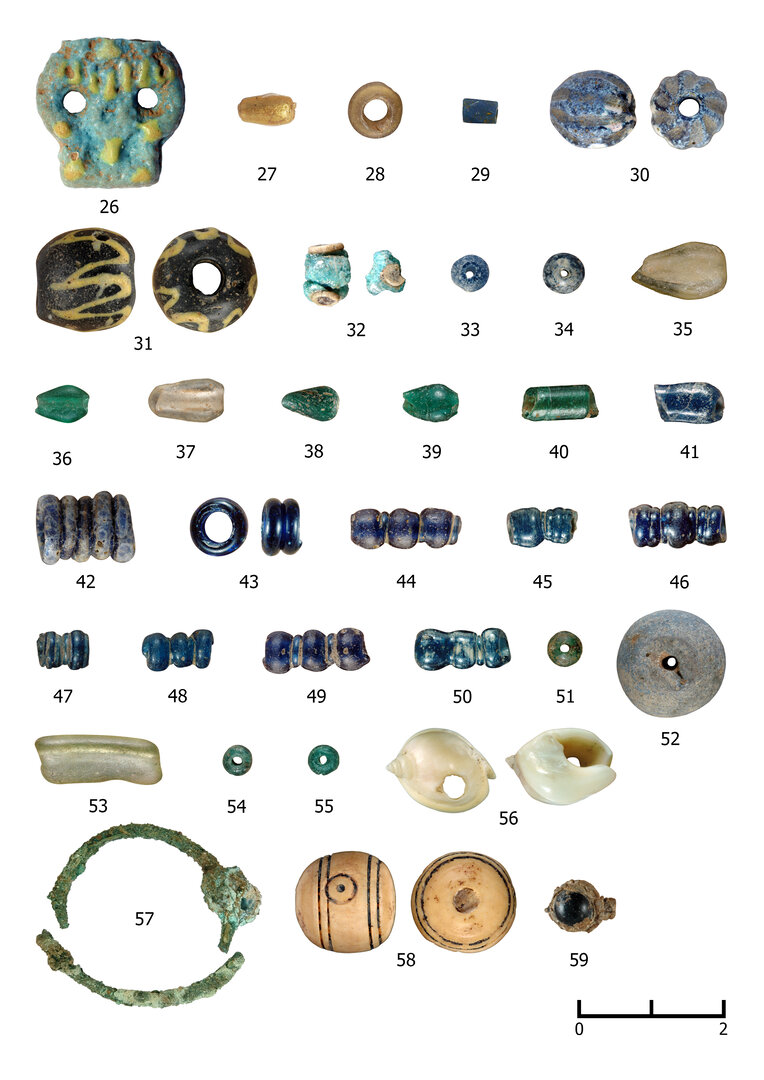
Objects of adornment found at ʿAin el-Gedida belong to two main categories: bracelets and beads. They were found among street-level debris, but also in dump layers and room fills.29 An overwhelming majority of these objects are made of glass. They most likely arrived in the Dakhla Oasis from the Nile Valley, and some may be of Alexandrian origin. Oasis production cannot be excluded, but no evidence of such activity has been found on site, nor were there kilns for glass working at nearby Kellis (however, see above, p. 551).
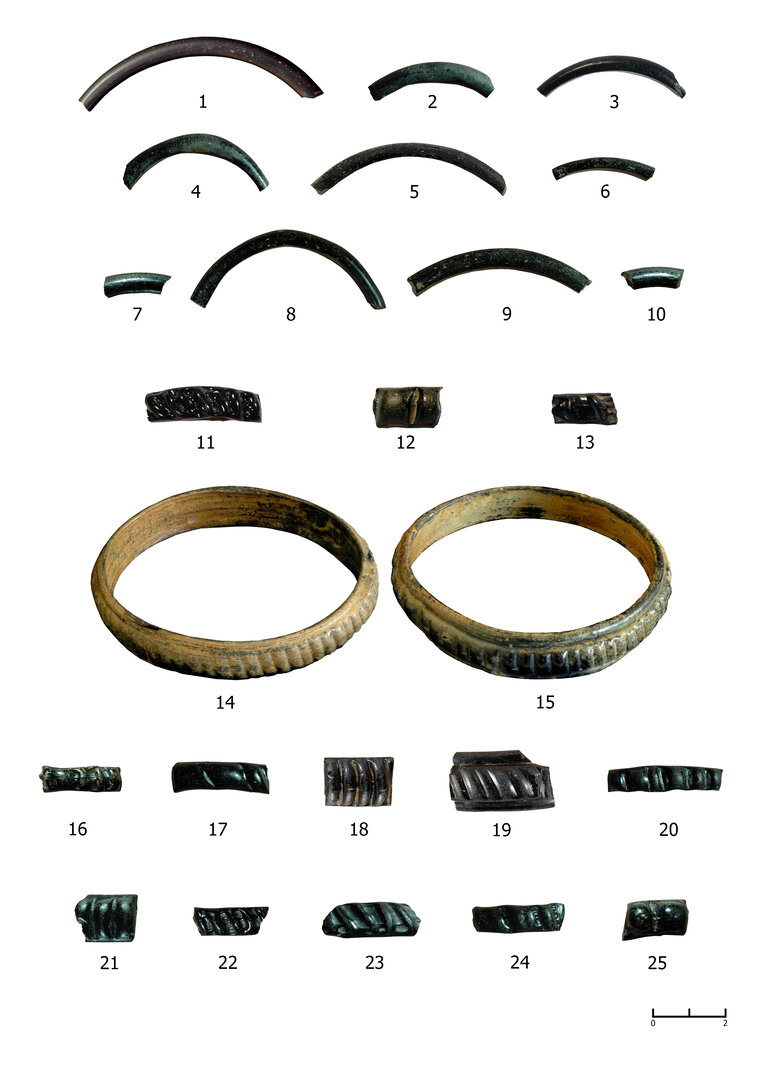
The bracelets came in different sizes, their inner diameter ranging from 5 to 8 cm. They were all made of opaque black glass drawn out and wound around a cylinder to set. All have flat, smooth inner surfaces where the glass rested against the cylinder, and on one of the finds (24) it is possible to see where the two ends of the glass rod were joined.
Only two intact bracelets have been found at ʿAin el-Gedida (14, 15), while the rest are represented by fragments of different sizes. Roughly half of the bracelets (1-10) were undecorated, with semicircular section and outer surfaces convex and smooth. These plain specimens can be assigned to Type A2a according to Maud Spaer’s typology.30 The rest were wider and ribbed using a straight edge to produce V-shaped indentations or with a rod to obtain a wavy pattern (Spaer’s Types B2b and B331). The ribs are either oblique or perpendicular to the band (vertical) and in some specimens the ribbed central zones were additionally flanked by two cordons (14, 15, 19). The latter type, which slightly diverges from Spaer’s typology, finds parallels at Amheida.32
Beads form a large and varied category among the finds from ʿAin el-Gedida. Most were made by winding a glass thread or folding a piece of glass around a mandrel. Among these, the most commonly occurring category consists of wound segmented beads of dark blue transparent glass (42-50). These beads were broken up into individual beads after the glass had cooled or left as clusters of several beads still attached. They may have mimicked drawn segmented beads (54- 55), popular in this period and made using a mold.33 Though not commonplace, beads of the wound segmented type find parallels on several Late Antique Egyptian and Nubian sites.34
Some wound specimens were shaped further before removal from the mandrel: rolled (40–41), ribbed to form a “melon bead” (30) or flattened on two or more sides (33–39). Worthy of attention is a distinctive bead paddled into the shape of a cornerless cuboid (29), representing a type that occurs consistently in Late Antique contexts.35
Several beads were made using more elaborate techniques. Prime examples among them are two gold-in-glass beads (27, 28) produced by inserting gold foil between two layers of colorless glass.36 A trail bead (31) was made by applying yellow thread to form a zig-zag pattern on the bead’s black surface37 and an “eye” bead (32) has three red-and-white “eye” cane sections of glass attached on the sides.
Lastly, a Bes amulet (26) in the form of a double-sided faience pendant coated with turquoise and yellow glaze was found on the site. The head and crown are not preserved, but the god’s other characteristic traits make identification unmistakable: the frontally depicted nude figure has bandy legs and a beard that conceals the neck. Amulets of this type occur throughout Egypt; similar objects have been found at the site of Amheida.38
11.3.2 Catalogue
[Abbreviations: D – diameter (for bracelets, measured on the inner surface); hD – hole diameter; th – thickness. For abbreviated references, see bibliography.]
Bracelets
1 – Glass bracelet
Inventory Number 24
Findspot area B, room B4, DSU 15
Dimensions D: 7.5; 6.8 x 0.7
Material black opaque glass
Technology drawn
Description semicircular section, plain.
2 – Glass bracelet
Inventory Number 531
Findspot area B, room B5, DSU 28
Dimensions D: 5; th: 0.6; 3.4 x 0.7
Material black opaque glass; rare small and medium elongated bubbles
Technology drawn
Description semicircular section, plain.
3 – Glass bracelet
Inventory Number 532
Findspot area B, room B5, DSU 28
Dimensions D: 5.5; th: 0.5; 4 x 0.6
Material black opaque glass; few small elongated bubbles, rare medium
Technology drawn
Description semicircular section, plain, weathered.
4 – Glass bracelet
Inventory Number 565
Findspot area B, room B9, DSU 79
Dimensions D: ca. 4; th: 0.5; 3.9 x 0.65
Material black opaque glass; few small elongated bubbles
Technology drawn
Description semicircular section, plain, weathered, iridescent surface.
5 – Glass bracelet
Inventory Number 649
Findspot area B, room B11, DSU 90
Dimensions D: n/a; th: 0.4; 5.3 x 0.6
Material black opaque glass; rare small globular bubbles
Technology drawn
Description semicircular section; weathered.
6 – Glass bracelet
Inventory Number 843
Findspot area B, room B11, DSU 108
Dimensions D: 6; th: 0.4; 2.8 x 0.5
Material black opaque glass
Technology drawn
Description semicircular section.
7 – Glass bracelet
Inventory Number 844
Findspot area B, room B14, DSU 130
Dimensions D: 6; th: 0.45; 1.7 x 0.7
Material black opaque glass
Technology drawn
Description semicircular section.
8 – Glass bracelet
Inventory Number 845
Findspot area B, room B12, DSU 124
Dimensions D: 4.6; th: 0.4; 5.35 x 0.6
Material black opaque glass
Technology drawn
Description semicircular section; slightly deformed when made (bend in center of fragment).
9 – Glass bracelet
Inventory Number 846
Findspot area B, room B12, DSU 124
Dimensions D: 7; th: 0.5; 5.05 x 0.75
Material black opaque glass
Technology drawn
Description semicircular section.
10 – Glass bracelet
Inventory Number 1020
Findspot area B, room B14, DSU 130
Dimensions D: n/a; th: 0.5; 1.7 x 0.8
Material black opaque glass; few small elongated bubbles
Technology drawn
Description semicircular section; weathered.
11 – Glass bracelet, ribbed
Inventory Number 530
Findspot area B, room B5, DSU 28
Dimensions D: 5.5; th: 0.5; 3.1 x 0.9
Material black opaque glass; few very small elongated bubbles
Technology drawn, tooled
Description uneven semicircular section; oblique ribs on external surface.
12 – Glass bracelet, ribbed
Inventory Number 18
Findspot area B, room B4, DSU 15
Dimensions D: n/a; th: 0.75; 1.9 x 1.15
Material black opaque glass; rare small globular, rare medium elongated bubbles
Technology drawn, tooled
Description semicircular section; ribs on external surface.
13 – Glass bracelet, ribbed
Inventory Number 23
Findspot area B, room B4, DSU 15
Dimensions D: 7; th: 0.45; 1.75 x 0.9
Material black opaque glass
Technology drawn, tooled
Description semicircular section; oblique ribs on external surface.
14 – Glass bracelet, ribbed
Inventory Number 559
Findspot area A, DSU 0
Dimensions D: 8; 1.3 x 0.6
Material black opaque glass; many small elongated bubbles, few medium, rare big
Technology drawn, tooled
Description complete; uneven semicircular section; on external surface oblique ribs bordered by two cordons; weathered, reddish-green patina on surface.
15 – Glass bracelet, ribbed
Inventory Number 560
Findspot area A, DSU 0
Dimensions D: 8; 1.35 x 0.55
Material black opaque glass; very many small elongated bubbles, few small and medium
Technology drawn, tooled
Description complete; uneven semicircular section; on external surface horizontal and oblique ribs bordered by two cordons; weathered, reddish-green patina on surface.
16 – Glass bracelet, ribbed
Inventory Number 594
Findspot area B, room B10, DSU 80
Dimensions D: 5; 2.2 x 0.35
Material black opaque glass
Technology drawn, tooled
Description uneven semicircular section; ribs on external surface.
17 – Glass bracelet, ribbed
Inventory Number 595
Findspot area B, room B9, DSU 79
Dimensions D: 6; th: 0.5; 2.15 x 0.8
Material black opaque glass; few small elongated bubbles
Technology drawn, tooled
Description uneven semicircular section; oblique ribs on external surface; weathered.
18 – Glass bracelet, ribbed
Inventory Number 650
Findspot area B, room B12, DSU 91
Dimensions D: n/a; th: 0.65; 1.9 x 1.3
Material black opaque glass
Technology drawn, tooled
Description uneven semicircular section; horizontal ribs on external surface.
19 – Glass bracelet, ribbed
Inventory Number 551
Findspot area B, room B12, DSU 91
Dimensions D: n/a; th: 0.7; 2.75 x 1.7
Material black opaque glass; many small, rare medium, rare big globular bubbles; rare medium and rare big elongated bubbles
Technology drawn, tooled
Description uneven semicircular section; on external surface oblique ribs bordered by two cordons; slightly weathered.
20 – Glass bracelet, ribbed
Inventory Number 806
Findspot area B, room B13, DSU 94
Dimensions D: ca. 5; th: 0.45; 3.1 x 0.7
Material black opaque glass; few small elongated bubbles
Technology drawn, tooled
Description uneven semicircular section; on external surface horizontal ribs; weathered.
21 – Glass bracelet, ribbed
Inventory Number 833
Findspot area B, room B11, DSU 97
Dimensions D: n/a; th: 0.6; 1.65 x 1.3
Material black opaque glass; many small globular, rare small elongated bubbles
Technology drawn, tooled
Description semicircular section; on external surface horizontal ribs; slightly weathered.
22 – Glass bracelet, ribbed
Inventory Number 834
Findspot area B, room B13, DSU 118
Dimensions D: ca 5; th: 0.4; 2.1 x 0.8
Material black opaque glass; few small globular voids
Technology drawn, tooled
Description uneven semicircular section; on external surface oblique ribs.
23 – Glass bracelet, ribbed
Inventory Number 842
Findspot area B, room B11, DSU 108
Dimensions D: ca 7; th: 0.45; 2.6 x 0.9
Material black opaque glass
Technology drawn, tooled
Description uneven semicircular section; on external surface horizontal ribs.
24 – Glass bracelet, ribbed
Inventory Number 847
Findspot area B, room B12, DSU 124
Dimensions D: 4.5; th: 0.45; 2.5 x 0.8
Material black opaque glass
Technology drawn, tooled
Description uneven semicircular section; on external surface horizontal ribs; join visible on inner side.
25 – Glass bracelet, ribbed
Inventory Number 1055
Findspot area B, room B23, DSU 147
Dimensions D: n/a; th: 0.8; 1.2 x 1
Material black opaque glass; many small elongated bubbles, few medium
Technology drawn, tooled
Description uneven semicircular section; on external surface deep horizontal ribs made using a blunt tool or rod; fragmentary, weathered.
Beads and pendants
26 – Bes amulet
Inventory Number 5
Findspot area B, room B4, DSU 8
Dimensions 2.05 x 2.10; th 0.8; hD: 0.2
Material faience with light blue and yellow glaze
Technology mold-made; seam visible on sides
Description double-faced pendant (both sides the same); head missing; beard and nose or mouth, hands, penis and feet marked with yellow glaze - circular perforation lengthwise through neck; broken along axis of perforation.
Parallels Cervi 2015b: nos. 11.10, fig. 11.5; Amheida inv nos. 3233; 11260; 11262; 11601
27 – Bead
Inventory Number 19
Findspot area B, room B4, DSU 15
Dimensions 0.8 x 0.4; hD: 0.1
Material two layers of transparent colorless glass with gold leaf in between
Technology drawn, segmented; sandwich glass
Description cylindrical with circular perforation; slightly tapered on one end; complete.
28 – Bead
Inventory Number 1016
Findspot area B, room B13, F153
Dimensions D: 0.75; l. 0.45; hD: 0.3
Material two layers of colorless transparent glass with gold leaf inserted in between
Technology wound or folded around mandrel
Description biconical with circular perforation; chipped at ends; cracked; weathered.
29 – Bead
Inventory Number 20
Findspot area B, room B4, DSU 15
Dimensions 0.5 x 0.3; hD: 0.1
Material blue opaque glass
Technology drawn, tooled
Description elongated cornerless cuboid with circular perforation; 4 rhomboidal faces; complete.
ParallelsCervi 2015b: 11.6, fig. 11.2; Then–Obłuska 2016: P 3029
30 – Bead
Inventory Number 1023
Findspot area B, room B17, DSU 160
Dimensions D: 1.05; l: 1.1; hD: 0.25
Material cobalt blue opaque glass
Technology wound, tooled
Description globular, ribbed (“melon” bead) with circular perforation; complete; weathered; white patina and iridescence.
31 – Bead
Inventory Number 812
Findspot area B, room B13, DSU 110 ƒs-piun Dimensions D: 1.4; l: 1.3; th: 0.4; hD: 0.4
Material black and yellow opaque glass
Technology wound and subsequently reworked on rod
Description large, spherical with circular perforation; applied fused-in thread of yellow glass in zig-zag pattern on surface; complete; weathered.
32 – Bead
Inventory Number 1090
Findspot area B, room B11, DSU 90
Dimensions D: 0.85; l. 0.6; hD: 0.3; disk D: 0.3-0.5
Material turquoise opaque glass with applied red and white opaque glass paste “eyes”
Technology wound with applied decoration
Description globular, slightly flattened at both ends; three disks of red and white glass attached along girth; circular perforation; incomplete; 4 joining fragments; weathered.
ParallelsPetrie Museum inv. no. UC22261
33 – Bead
Inventory Number 661
Findspot area B, room B11, DSU 94
Dimensions 0.3 x 0.5; hD: 0.1
Material light blue opaque glass
Technology folded around rod
Description biconical with circular perforation; complete; one end chipped; weathered, white patina.
34 – Bead
Inventory Number 1022
Findspot area B, room B24, DSU 180
Dimensions D: 0.6; l. 0.4; hD: 0.1
Material dark blue transparent glass
Technology wound?
Description biconical with circular perforation; complete; weathered; white patina.
35 – Bead
Inventory Number 664
Findspot area B, room B11, DSU 90
Dimensions 0.7 x 1.3; hD: 0.2
Material light green transparent glass
Technology folded around rod; flattened by placing on flat surface before cooling
Description drop-shaped with circular perforation; chipped; complete; weathered; uneven surface.
36 – Bead
Inventory Number 810
Findspot area B, room B13, DSU 110
Dimensions 0.75 x 0.5; th: 0.3; hD: 0.1
Material green transparent glass
Technology folded around rod, flattened
Description drop-shaped with circular perforation; complete; the extremities are chipped; weathered.
37 – Bead
Inventory Number 811
Findspot area B, room B12, DSU 91
Dimensions 1 x 0.6; th: 0.4; hD: 0.2
Material colorless transparent glass
Technology folded around rod, flattened by placing against flat surface before cooling
Description drop-shaped with circular perforation; complete; weathered; iridescence in places.
38 – Bead
Inventory Number 819
Findspot area B, room B12, DSU 107
Dimensions 0.8 x 0.5; th: 0.35; hD: 0.1
Material dark green opaque glass
Technology folded around rod
Description drop-shaped, slightly flattened on two sides, with circular perforation; complete; weathered.
39 – Bead
Inventory Number 1013
Findspot area B, room B12, DSU 128
Dimensions D: 0.5; l. 0.8; hD: 0.1
Material dark green transparent glass
Technology folded around rod
Description drop-shaped with circular perforation; complete; chipped on ends; weathered.
40 – Bead
Inventory Number 831
Findspot area B, room B15, DSU 137
Dimensions D: 0.5; l: 1.05; hD: 0.25
Material green transparent glass; many medium elongated bubbles
Technology wound
Description tubular bead with circular perforation; chipped; weathered.
Parallels Amheida inv. no. 16056
41 – Bead
Inventory Number 832
Findspot area B, room B15, DSU 137
Dimensions D: 0.5; l: 0.9; hD: 0.25
Material blue transparent glass; many small globular bubbles
Technology wound
Description tubular bead with circular perforation; incomplete; 2 fragments; weathered.
42 – Bead
Inventory Number 807
Findspot area B, room B13, DSU 94
Dimensions D. 0.95; l: 1.2; th. segments: 0.25; hD: 0.5
Material blue opaque glass
Technology wound, segmented
Description two joining fragments of bead consisting of 5 segments; circular perforation; complete; weathered; white patina.
Parallels Then–Obłuska 2016: P 3039
43 – Bead
Inventory Number 808
Findspot area B, room B13, DSU 94
Dimensions D. 0.8; l: 0.5; th. segments: 0.25; hD: 0.4
Material blue opaque glass
Technology wound, segmented
Description consists of 2 segments; circular perforation.
Parallels Then–Obłuska 2016: P 3039
44 – Bead
Inventory Number 1010
Findspot area B, room B12, DSU 124
Dimensions D: 0.55; l: 1.5; hD: 0.2
Material dark blue transparent glass
Technology wound, segmented
Description consists of 3 segments; circular perforation; complete; weathered.
Parallels Then–Obłuska 2016: P 3041
45 – Bead
Inventory Number 1011
Findspot area B, room B15, DSU 132
Dimensions D: 0.5; l: 0.95; hD: 0.2
Material dark blue transparent glass
Technology wound, segmented
Description consists of 2 segments; circular perforation; chipped; incomplete; weathered.
Parallels Then–Obłuska 2016: P 3041
46 – Bead
Inventory Number 1012
Findspot area B, room B19, DSU 146
Dimensions D: 0.6; l: 1.3; hD: 0.25
Material dark blue transparent glass
Technology wound, segmented
Description consists of 3 segments; circular perforation; complete; weathered.
Parallels Then–Obłuska 2016: P 3041
47 – Bead
Inventory Number 1014
Findspot area B, room B15, DSU 129
Dimensions D: 0.5; l: 0.7; hD: 0.25
Material dark blue transparent glass
Technology wound, segmented
Description consists of 2 segments; circular perforation; complete; weathered.
Parallels Then–Obłuska 2016: P 3041
48 – Bead
Inventory Number 1015
Findspot area B, room B12, DSU 124
Dimensions D: 0.5; l. 0.9; hD: 0.2
Material dark blue transparent glass
Technology wound, segmented
Description consists of 3 segments; circular perforation; complete; weathered.
Parallels Then–Obłuska 2016: P 3041
49 – Bead
Inventory Number 1017
Findspot area B, room B15, DSU 86
Dimensions D: 0.6; l: 1.4; hD: 0.2
Material dark blue transparent glass
Technology wound, segmented
Description consists of 3 segments; circular perforation; complete; weathered.
Parallels Then–Obłuska 2016: P 3041
50 – Bead
Inventory Number 1054
Findspot area B, room B19, DSU 173
Dimensions D: 0.55; l: 1.3; hD: 0.25
Material dark blue transparent glass
Technology wound, segmented
Description consists of 3 segments; circular perforation; complete; weathered.
Parallels Then–Obłuska 2016: P 3041
51 – Bead
Inventory Number 809
Findspot area B, room B13, DSU 94
Dimensions D. 0.5; l: 0.3; hD: 0.15
Material green transparent glass
Technology wound
Description spherical, slightly flattened on both ends; circular perforation; complete; weathered.
52 – Bead
Inventory Number 1028
Findspot area B, room B19, DSU 188
Dimensions D: 1.45; l: 1.25; hD: 0.25
Material light blue glass
Technology wound
Description spherical, flattened at both ends; complete; weathered; iridescent.
53 – Bead
Inventory Number 1214
Findspot area B, room B12, DSU 91
Dimensions 1.7 x 0.7 x 0.4; hD: 0.15
Material light green transparent glass; rare medium elongated bubbles
Technology drawn, slumped by reheating?
Description circular, flattened on two sides; circular perforation; complete; weathered.
54 – Bead
Inventory Number 662
Findspot area B, room B11, DSU 90
Dimensions 0.4 x 0.3; hD: 0.1
Material light blue opaque glass
Technology drawn, segmented
Description spherical, slightly flattened on both ends with circular perforation; complete; weathered.
55 – Bead
Inventory Number 835
Findspot area B, room B14, DSU 122
Dimensions 0.3 x 0.4; hD: 0.1
Material aquamarine green transparent glass
Technology drawn, segmented
Description flattened spherical bead with circular perforation; complete.
56 – Bead?
Inventory Number 1036
Findspot area B, room B15, DSU 129
Dimensions 1.5 x 1.1; th: 0.8
Material shell, Nassarius gibbosulus (L.)
Technology drilled / punctured
Description perforation intentionally made; complete. The species is common in the Eastern Mediterranean.
Parallels Then–Obłuska 2015: 739, fig. 1.17
Other
57 – Ring or earring
Inventory Number 567
Findspot area B, room B6, DSU 61
Dimensions th: 0.2; D: 3; bezel D: 0.8; bezel th: 0.6
Material copper alloy
Technology hand-wrought
Description two joining fragments of incomplete ring or earring with circular bezel; oxidized; corroded.
58 – Hairpin fragment
Inventory Number 1021
Findspot area B, room B15, DSU 129
Dimensions D: 1.35
Material bone
Technology wheel-worked; tooled
Description globular head of a hairpin decorated along girth with 3 incised circles with dot inside, bordered on top and bottom by pairs of parallel incised lines; incised decoration filled with black substance (pitch?); incomplete, shank missing.
Parallels Petrie 1927: pl. XIX
59 – Ring
Inventory Number 1050
Findspot area B, room B13, DSU 115
Dimensions 0.95 x 0.65; th: 0.6; collet D: 0.65
Material copper alloy
Technology hand-wrought
Description collet with dark blue opaque glass bezel; only a small part of the wire, probably of a finger-ring, remains; oxidized; corroded.
11.4 Miscellaneous Objects
11.4.1 Introduction
The finds belonging to categories included in this section, personal belongings and elements of dress, furnishings of houses, tools and accessories, provide important data on several aspects of life in ʿAin el-Gedida. Other pieces may give a glimpse of the community’s funerary customs.
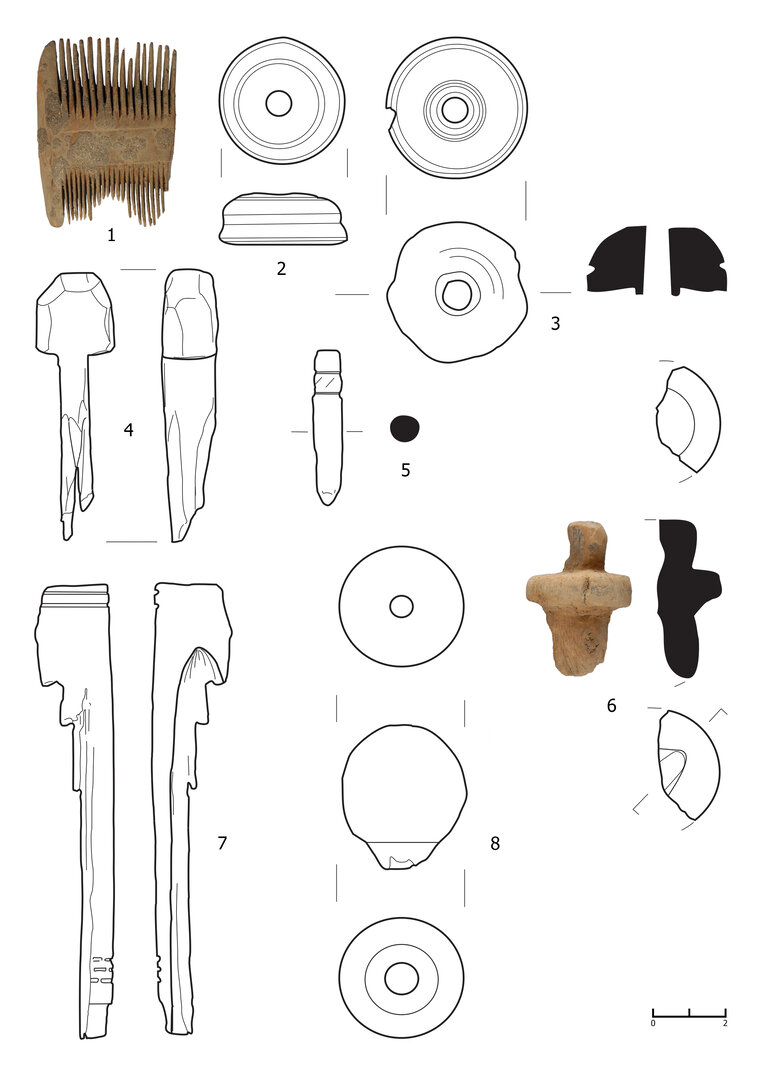
Aside from the objects of personal adornment and textiles presented in previous sections, personal effects are few. Worthy of mention is a wooden comb (1), a leather belt decorated with an incised pattern (31),39 and a fragmentary sole of a shoe (20) woven of plant fiber ropes. Such shoes are common at Kellis, where they appear in all sizes in third- and fourth-century contexts.40
Household furnishings include pieces of wooden furniture – decorative finials and knobs (6,7,8).41 Some iron nails, no doubt used to assemble elements of wooden objects, were also found. Other finds testify to various household activities on site, for instance yarn spinning. Among the wooden objects are two spindle whorls (2–3), and it is in their context that we should perhaps view two pegs (4, 5), similar to finds interpreted as accessories for loom weaving.42 Particularly the evidence for spinning, an activity usually performed by women, provides indication of a female presence at the settlement.43 Other household objects are ropes (11–19), iron blades (24,25,26), a weight (38) and a grinding stone (37).
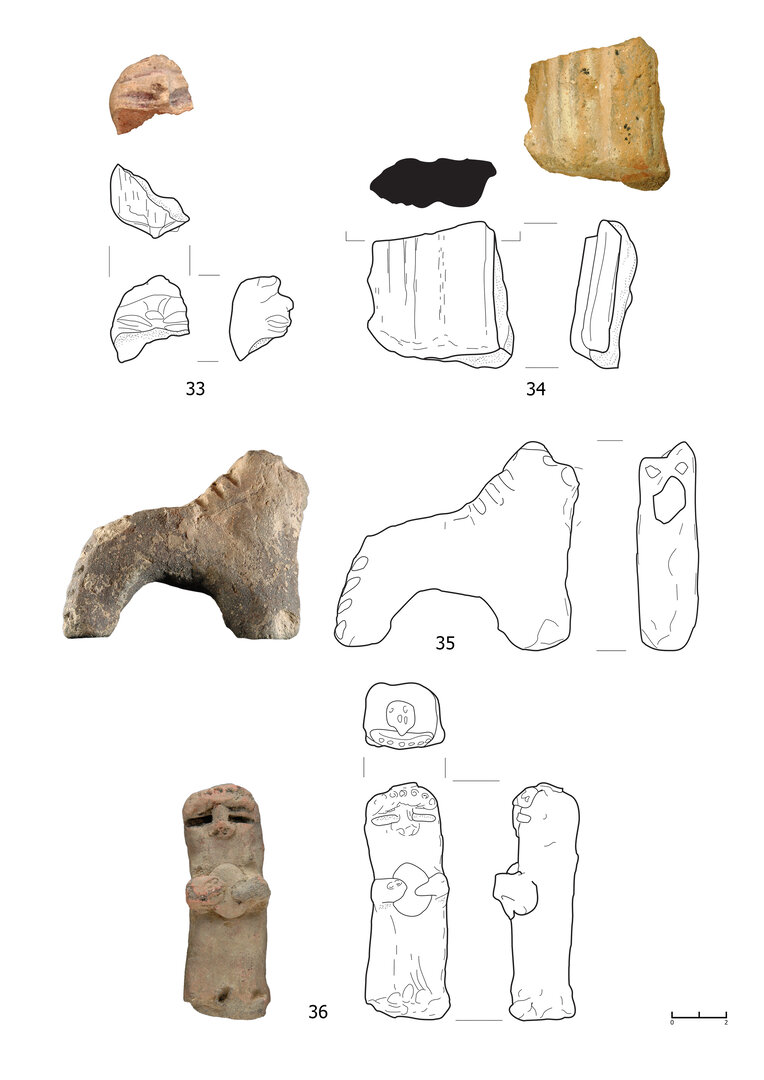
The terracotta figurines (33,34,35,36) from ʿAin el-Gedida are few but worthy of attention, and two objects (35, 36) are especially important owing to their good state of preservation. Kellis provides the closest parallels for all of these artifacts,44 but, since they were mostly handmodelled, no exact parallels can be expected. It seems that the figurines were manufactured locally, within the Great Oasis. Three are formed by hand, though one seems to have been mold-made.
Late Roman figurines are thought to have had a range of functions, both secular and religious.45 They formed an important part of private religious practices and were donated as votive offerings to temples. Some pieces may have been used as toys or kept for ornamental purposes. The function of figurines from ʿAin el-Gedida is difficult to assess. A well-preserved anthropomorphic figurine (36) represents a standing woman holding a circular object that may be interpreted as a tambourine.46 This figure, clothed in a long robe and showing details of coiffure but devoid of sexual traits, is typical for Late Antiquity.47 It is difficult to determine whether the figurine had religious significance or a purely secular function, but no attributes permit us to associate it with any type of cult. It may be understood also in a Christian context, as similar objects found at Abu Mina seem to have had a votive function.48
Another nearly complete figurine is a representation of a horse (35).49 Traces of attachment on the back indicate that it originally had a saddle or cargo load, but there are no traces of a rider. In this case a religious or votive function cannot be ascribed and the figurine might have simply been a toy.
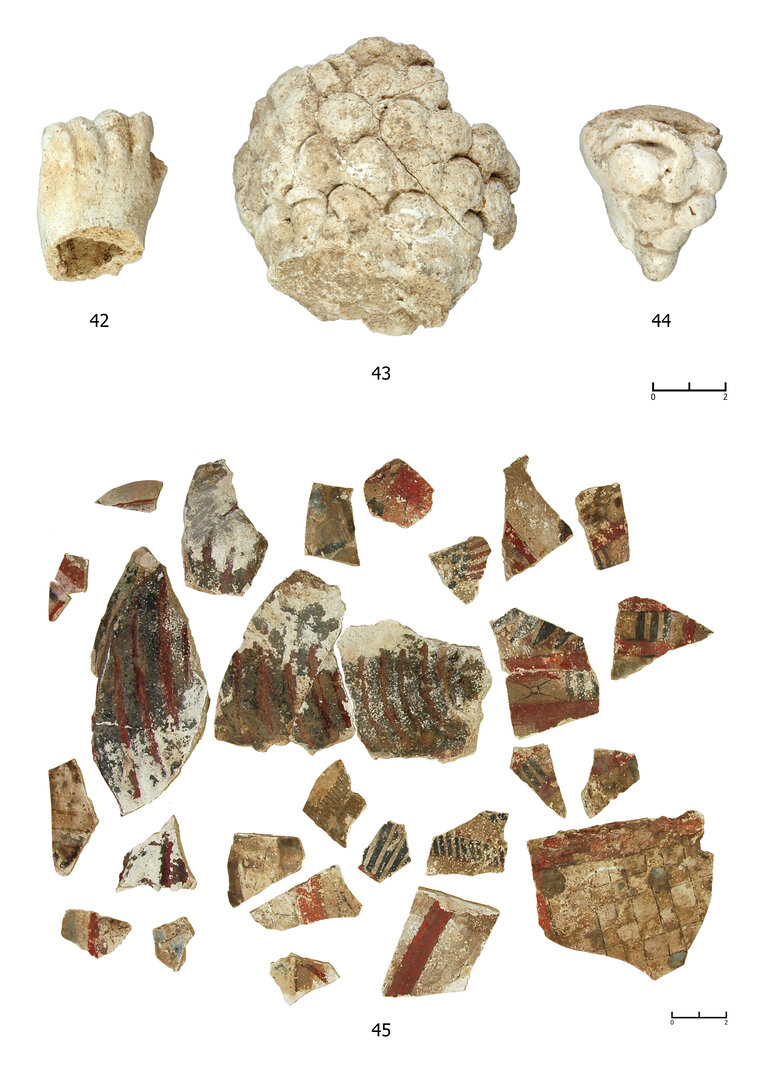
The fragments of mummy cartonnage (45) seem to belong to the chest, with fragments of the wig and collar with geometrical decoration.50 This find should probably be associated with a cemetery at ʿAin el-Gedida, located in a different part of the site and not investigated to date. Their deposition in a subsurface layer of room B20 was likely secondary and may perhaps be attributed to the activity of robbers, who left behind pieces of broken cartonnage after dismantling a burial retrieved from the cemetery.51
Pieces of gypsum plaster from statuary (42,43,44) representing a head with curly hair, a hand, and a bunch of grapes are difficult to interpret because of their fragmentary nature. However, they may also be viewed in a funerary context. The fragments may have belonged to one object, for instance a funerary stela with a representation of a male figure holding a bunch of grapes, similar to those known, e.g., from Oxyrhynchos and dated to the fourth–fifth century.52 If this interpretation is correct, then in the case of the object from ʿAin el-Gedida the finer details such as the hair, hand, and grapes would have been rendered in a coat of plaster applied on the surface of a stone stela. However, with these small, scattered fragments any attempt at a hypothetical reconstruction is mere speculation.
11.4.2 Catalogue
Plate 11.6, Plate 11.7, Plate 11.8, Plate 11.9, Plate 11.10
[Abbreviations: D – diameter; hD – hole diameter; h: height; l: length; th – thickness. For abbreviated references, see bibliography. All measurements are in centimeters.]
Wood
1 – Comb
Inventory Number 36
Findspot area B, room B4, DSU 15
Dimensions 3.7 x 5; th: 0.7
Material wood
Technology carved
Description double-sided comb. One side is fine-toothed; the other has larger teeth. One edge is missing. Incomplete.
Parallels Petrie 1927: pl. XX–XXI
2 – Spindle whorl
Inventory Number 573
Findspot area B, room B10, DSU 80
Dimensions D: 3.6; hD: 0.6; th: 1.5
Material soft wood
Technology carved; wheel-worked
Description upper surface slightly convex and decorated with 2 concentric incised lines. Lower surface flat. One deep groove closer to the flat side and two incised lines along the circumference. Complete.
Parallels Hope 2003: 263, fig. 18n
3 – Spindle whorl
Inventory Number 1048
Findspot area B, room B15, DSU 129
Dimensions D: 3.9; hD: 0.6; h: 1.9
Material wood
Technology carved; wheel-worked
Description spindle whorl with semicircular section. Circular hole through center. Horizontal parallel lines incised on convex surface. Pale surface finish. Incomplete, weathered, cracked.
Parallels Hope 2003: 263, fig. 18n
4 – Peg
Inventory Number 572
Findspot area B, room B6, DSU 58
Dimensions 7.4 x 2.3, th: 1.5; shank: l: 5.1, w: 0.9, th: 1.5
Material wood
Technology carved
Description rectangular section; head rounded; point missing. Incomplete, weathered.
Parallels Winlock and Crum 1926: vol. 1pl. XX, b
5 – Peg
Inventory Number 575
Findspot area B, room B9, DSU 75
Dimensions D: 0.4-0.8; l: 4.3
Material wood
Technology carved
Description small peg with circular section. Two small parallel grooves around the circumference of the head. Complete, weathered.
Parallels Winlock and Crum 1926: vol. 1pl. XX, b
6 – Finial
Inventory Number 1047
Findspot area B, room B12, DSU 101
Dimensions 2.7 x 1.55 x 4.15
Material wood
Technology carved, wheel-worked
Description fragment of a round decorative element of furniture. Nearly half is preserved with part of a tenon. Incomplete, weathered.
Parallels Winlock and Crum 1926: vol. 1pl. XV, c
7 – Piece of furniture
Inventory Number 586
Findspot area B, room B9, DSU 79
Dimensions D: 2; h: 12.4
Material wood
Technology carved, wheel-worked
Description object in the shape of a cylinder. Almost half is preserved. On both ends incised lines around the circumference. Fragmentary; weathered.
8 – Knob?
Inventory Number 588
Findspot area B, room B10, DSU 80
Dimensions D: 3.6; hD: 0.6; h: 4.1
Material wood
Technology carved; wheel-worked
Description globular object with circular hole, possibly a knob broken where it was attached. Perforated along the axis. Incomplete, weathered.
9 – Wedge or board
Inventory Number 585
Findspot area B, room B9, DSU 79
Dimensions 19.5 x 8.5; th: 1.8
Material wood
Technology carved
Description board, one end carved into a point, probably a wedge. Fragmentary; weathered.
10 – Stopper?
Inventory Number 587
Findspot area B, room B10, DSU 80
Dimensions D: 4.8; h: 3.8
Material wood
Technology carved
Description probably a stopper in the shape of a cylinder slightly tapering to one end. Incomplete.
Parallels Cervi 2015c: cat. no. 18.4
Cordage
11 – Rope
Inventory Number 13
Findspot area B, room B4, DSU 11
Dimensions l: 10; th. 0.4; single strand th: 0.4
Material light brown vegetal fibers
Technology hand-rolled
Description 2-ply, z-spun, s-plied (S2z). Fragmentary, frayed.
12 – Rope
Inventory Number 14
Findspot area B, room B3, DSU 7
Dimensions l: 10; th: 0.4; single strand th: 0.3
Material light brown vegetal fibers
Technology hand rolled
Description 2-ply, z-spun, s-plied (S2z). Fragmentary, frayed.
13 – Rope
Inventory Number 15
Findspot area B, room B3, DSU 7
Dimensions l: 23; th: 0.4, single strand th: 0.3
Material light brown vegetal fibers
Technology hand-rolled
Description 2-ply, z-spun, s-plied (S2z). Fragmentary, frayed.
14 – Rope
Inventory Number 16
Findspot area B, room B3, DSU 10
Dimensions l: 15.5; th: 0.4; single strand th: 0.2
Material light brown vegetal fibers
Technology hand-rolled
Description 2-ply, z-spun, s-plied (S2z). Fragmentary, frayed.
15 – Rope
Inventory Number 592
Findspot area B, room B9, DSU 79
Dimensions l: 6.9, th: 0.65; single strand th: 0.2; slip knot th: 2.1
Material light brown vegetal fibers
Technology hand-rolled
Description folded, 2-ply, z-spun, s-plied (S2z). Incomplete.
16 – Rope
Inventory Number 820
Findspot area B, room B12, DSU 95
Dimensions l: 5.6; th: 0.4; single strand th: 0.2
Material dark brown plant fiber
Technology hand-rolled
Description 2-ply, z-spun, s-plied (S2z). Fragmentary, frayed.
17 – Rope
Inventory Number 836
Findspot area B, room B11, DSU 97
Dimensions l: 16; th. 0.8; single strand th: 0.3
Material brown plant fiber
Technology hand-rolled
Description 2-ply, z-spun, s-plied (S2z). Incomplete, slightly frayed.
18 – Rope
Inventory Number 837
Findspot area B, room B11, DSU 97
Dimensions l: 27, th: 0.5; single strand th: 0.4
Material brown plant fiber
Technology hand-rolled
Description 2-ply, z-spun, s-plied (S2z). Incomplete, one end slightly frayed.
19 – Rope
Inventory Number 838
Findspot area B, room B11, DSU 97
Dimensions l: 8.7; th: 0.6; single strand th: 0.4
Material brown plant fiber
Technology hand-rolled
Description 2-ply, z-spun, s-plied (S2z). Fragmentary.
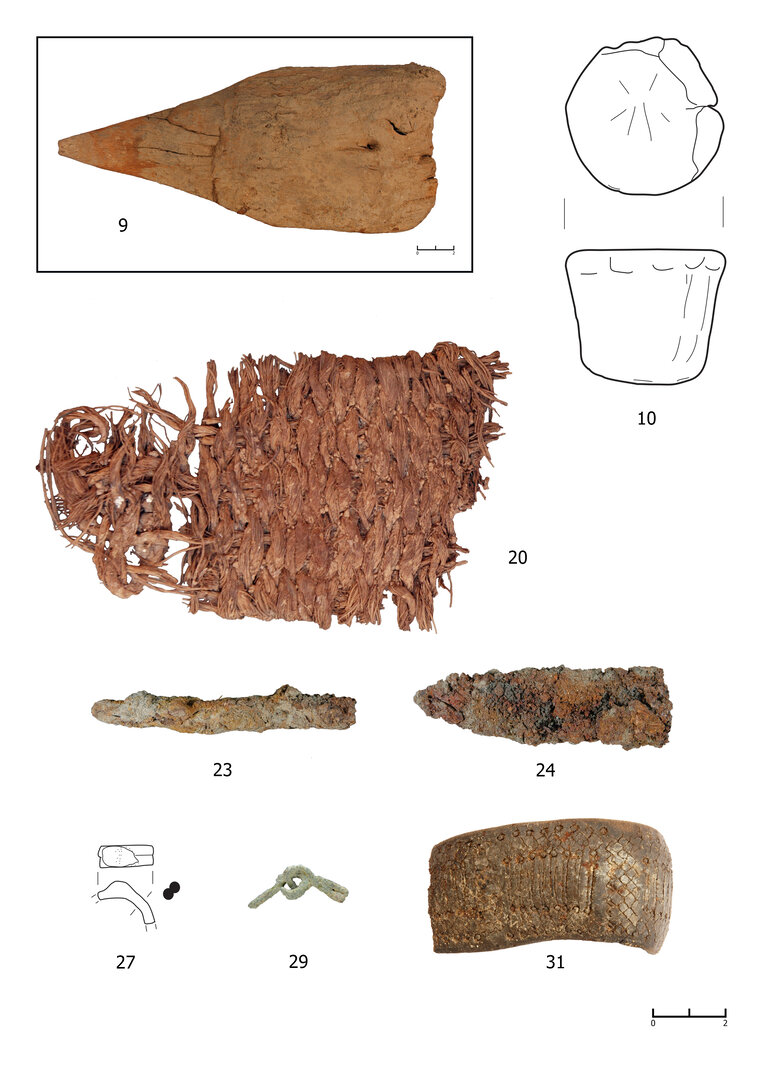
20 – Shoe sole (Plate 11.7)
Inventory Number 22
Findspot area B, room B4, DSU 15
Dimensions 12.6 x 7.4; th: 0.75; rope th: 0.4; single strand th: 0.2
Material plant fiber
Technology hand-rolled, woven
Description shoe sole, end missing. Adult size. Warp and weft of 2-ply rope. Comprises 5 warps at the widest point. The rope is 2-ply, z-spun, s-plied (S2z). Incomplete, frayed.
Parallels Bowen 2002a: pls. 16–17
Metal
21 – Nail
Inventory Number 574
Findspot area B, room B5, DSU 28
Dimensions l: 4.5, D: 2.1; shank l: 3.3; th: 1.1 x 1
Material iron
Technology hand wrought
Description nail with circular (?) head and rectangular shank. Head fragmentary, point missing. Incomplete, oxidized, and corroded.
22 – Nail
Inventory Number 581
Findspot area B, room B7, DSU 45
Dimensions 2.9 x 1; th: 1
Material iron
Technology hand wrought
Description shank of a nail with rectangular section. Fragmentary; oxidized, and corroded.
23 – Nail
Inventory Number 1088
Findspot area B, room B11, DSU 94
Dimensions l: 7.1; D: 0.9
Material iron
Technology hand wrought
Description shank of a nail probably with circular section, tapering to a point. Head missing. Incomplete; oxidized, and corroded.
24 – Blade
Inventory Number 1084
Findspot area B, room B15, DSU 129
Dimensions 7 x 2.2; th: 1.3
Material iron
Technology hand wrought
Description flat elongated object tapering to a point; the other end is fragmentary. Incomplete, oxidized, and corroded.
25 – Blade?
Inventory Number 1085
Findspot area B, room B15, DSU 132
Dimensions 5.4 x 2.2; th: 1
Material iron
Technology hand wrought
Description flat elongated object tapering to a point; the other end is fragmentary. Incomplete, oxidized, and corroded.
26 – Blade?
Inventory Number 1087
Findspot area B, room B15, DSU 132
Dimensions 5.4 x 2.2; th: 1
Material iron
Technology hand wrought
Description flat elongated object, both ends fragmentary. Incomplete, oxidized, corroded.
27 – Handle
Inventory Number 551
Findspot area B, room B5, DSU 35
Dimensions 1.75 x 0.7; th: 0.35
Material copper alloy
Technology smelted
Description handle of a bronze vessel. Incomplete, oxidized, and corroded.
28 – Metal object
Inventory Number 533
Findspot area B, room B5, DSU 28
Dimensions 1.3 x 1; th: 0.2
Material copper alloy
Technology smelted, hand wrought
Description fragment of a hook or clasp (?). Fragmentary, oxidized, and corroded.
29 – Metal object
Inventory Number 1051
Findspot area B, room B15, DSU 129
Dimensions 2.7 x 0.9; th: 0.5; wire D: 0.2; rings D: 0.7
Material copper alloy
Technology hand wrought
Description two wires, bent and twisted, forming two interlocked rings. Incomplete.
30 – Metal object
Inventory Number 1089
Findspot area B, room B11, DSU 90
Dimensions 3.5 x 1.3; wire D: 0.3
Material copper alloy
Technology hand wrought
Description Two joining fragments of wire, bent. Complete? Oxidized.
Leather
31 – Belt (Plate 11.7)
Inventory Number 564
Findspot area B, room B6, DSU 39
Dimensions 6.7 x 3.3; th: 0.25
Material leather
Technology hand-made; incised
Description probably a belt. The external surface is decorated with a series of parallel lines incised crosswise on the surface and bordered by two lengthwise rows of small circles. A single row of small incised circles also runs along both edges of the belt. Fragmentary.
Parallels Winlock and Crum 1926: vol. 1pl. XXVI, b
32 – Leather object
Inventory Number 1083
Findspot area B, room B18, DSU 149
Dimensions largest fragment: 2.3 x 1.7; th: 0.1
Material leather
Technology hand-made
Description 10 fragments of leather object, some of them joining. Along the preserved edge there is a seam stitched with a leather thong.
Terracottas
33 – Head of figurine
Inventory Number 27
Findspot area B, room B4, DSU 15
Dimensions 2.9 x 2.5; th: 1.6
Material Beige-gray clay with light brown core
Technology hand made, fired
Description head molded around a pit. Eyes, mouth and hair incised and painted red. Elaborate hairstyle or headdress with tripartite division above forehead. Hair modeled with incised horizontal and vertical lines. A protrusion on forehead. Right eye and part of left eye preserved. Incomplete.
34 – Figurine fragment
Inventory Number 568
Findspot area B, room B5, DSU 26
Dimensions 5.3 x 5.1; th. 2.2
Material clay, fabric A2b
Technology mold-made, fired
Description Only part of the front is preserved with two raised elongated elements with semicircular section. Vertical grooves on the elements. Fragmentary; weathered.
35 – Horse figurine
Inventory Number 1003
Findspot area B, room B15, DSU 129
Dimensions 9.2 x 2.95 x 7.7
Material fired clay, fabric A2b, remains of beige slip, possibly traces of reddish paint on head and neck
Technology hand modeled, solid; fired
Description the figurine is nearly complete, with only the protruding tip of the head broken off. The front and hind legs are modeled as two solid stumps. The long tail is formed as a projection from the back of the figure, adjoining the hind legs. The ears are marked protrusions at the top of the head. The mane and tail are marked with incised, diagonal grooves. The eyes are impressed dots in the front of the head. Two shallow indentations on the animal’s back indicate that something was attached to it, possibly a saddle or cargo load. The missing element was also of clay and fired together with the horse figurine, but was poorly attached and fell away. There are no such marks on the animal’s flanks, but it cannot be excluded that it carried a rider. Right ear and muzzle broken off. Incomplete, weathered and chipped.
Parallels Stevens 2002: 286–88, nos. 20–29; figs. 2–5, p. 282
11.5 p. 588
36 – Woman holding tambourine (?)
Inventory Number 1004
Findspot area B, room B19, DSU 146
Dimensions 3.1 x 2.6 x 8.6
Material clay, fabric A1b with white and reddish slip
Technology hand modeled, solid; fired
Description standing female figure. The body has the form of a roughly formed cylinder. Traces of paint or slip, red on the head and arms, white on the garment. Rough, uneven surface. The figurine shows a woman wearing an elaborate late Antonine-era hairstyle. Tight curls above the forehead are represented by applying a lump of clay and decorating it with a row of circular impressions. There is a small bun at the top of the head, adorned with further dots. The eyes are two horizontal slits made using a stick. The nose is plastically rendered. The figure is represented dressed in a long robe. The arms are attached in the front at mid-height and folded round a circular object, perhaps a tambourine or possibly a mirror or vessel. The feet are cursorily marked with two indentations. Complete; right foot chipped off, weathered.
Parallels Kaufmann 1910: pl. 73.1, 3, 5
Stone and Plaster
37 – Grinding stone
Inventory Number 26
Findspot area B, room B5, DSU 20
Dimensions 40 x 24 x 12
Material sandstone
Technology hewn, smoothed
Description lower part (passive element) of a grinding stone. The upper surface is concave and smoothed. The lower part is flat and roughly worked. Complete.
38 – Weight
Inventory Number 590
Findspot area B, room B9, DSU 79
Dimensions 5.5 x 4.3; th: 4; hD: 1.3
Material sandstone
Technology worked
Description probably weight with uneven cylindrical shape and circular hole drilled lengthwise. Complete; weathered.
39 – Stopper
Inventory Number 593
Findspot area B, room B9, DSU 79
Dimensions 3.4 x 3; th: 0.8
Material gypsum
Technology hand made
Description R: convex surface with textile impressions and grooves possibly from wrinkles of the textile. V: impression probably of rim and wall of a lid. Fragmentary; weathered.
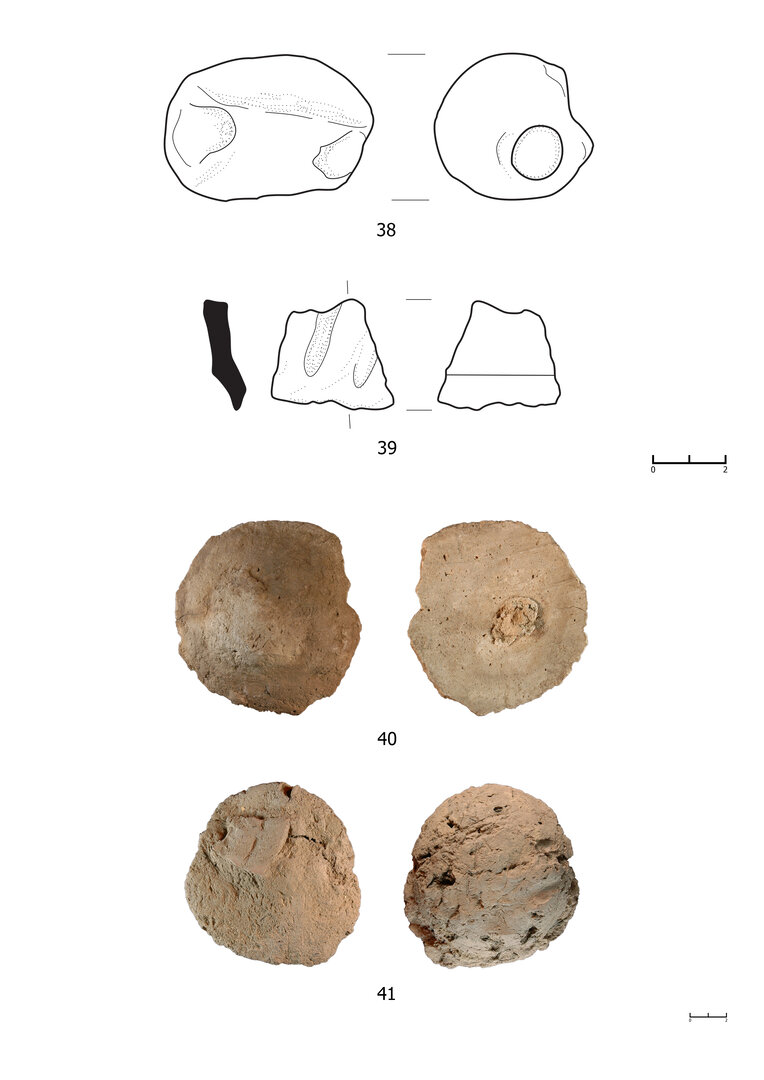
40 – Stopper?
Inventory Number 599
Findspot area B, room B10, DSU 80
Dimensions 10.7 x 10.3 x 3.2; th: 1.2
Material gypsum mortar
Technology hand made
Description circular object, possibly a stopper to close a spout or hole in the body of a vessel. The upper surface is convex; the bottom surface is concave with the impression of wheel marks of the vessel and in the middle a lump of mortar. Incomplete.
41 – Stopper
Inventory Number 1052
Findspot area B, room B19, DSU 171
Dimensions 10.2 x 9.2 x 4.6
Material light brown clay; medium texture, very many fine and medium vegetal inclusions, few big, many fine sand inclusions, many fine voids, few medium, rare big
Technology hand made
Description circular stopper. Upper surface: slightly convex with pottery sherd embedded (tag?); bottom surface: convex with the impression of the inner rim of the vessel. Incomplete, cracked.
Parallels Davoli 2016: cat. no. 9.3
42 – Statue
Inventory Number 1039
Findspot area B, room B21, DSU 141
Dimensions 4.4 x 2.3 x 3.5; th: 0.8
Material gypsum
Technology mold-made, hollow
Description part of a small statue. Hand clenched into a fist with the index finger extended; thumb and index finger fragmentary; wrist not preserved. The same context yielded other gypsum fragments that may have been part of the same statue. Fragmentary.
43 – Statue
Inventory Number 1040
Findspot area B, room B21, DSU 141
Dimensions 7.5 x 4 x 6.5; th: 0.9
Material gypsum
Technology mold-made, hollow
Description part of a small statue, probably of a man. 4 joining fragments of a head with curly hair; only the back of the head is preserved. The same context yielded other gypsum fragments, including curls, that may have been part of the same statue. Fragmentary.
44 – Statue?
Inventory Number 1043
Findspot area B, room B20, DSU 143
Dimensions 3.5 x 4.1 x 4.3
Material gypsum plaster
Technology mold-made
Description a cluster of 7 circular grapes with stem. On the back, possibly in the place of attachment, a textile impression. May have also been an architectural molding, a capital of a small column decorated with a bunch of grapes. Lower part fragmentary. Incomplete.
45 – Cartonnage
Inventory Number 1053
Findspot area B, room B20, DSU 143
Dimensions largest fragment: 9.5 x 6.2; th: 0.8
Material gypsum, painted beige, black, red, pink and light blue
Technology hand formed
Description many fragments of cartonnage made of gypsum plaster on textile. Recognizable fragments are part of the wig and chest. The wig is decorated with parallel ribs (black and brown), the collar in Egyptian style with geometric patterns: checkerboard, cornices and feathers, probably from wings. On the back the fragments preserve impressions of textile from wrappings. Fragmentary.
11.6 Notes
I am grateful to Barbara Czaja, textile conservator (Museum of King Jan III’s Palace at Wilanów, Poland), for her valuable help in the study of the textile fragments.↩︎
Bowen 2002a: 87–97. See also Bowen 1999: 7–12 and Bowen 2001a: 18–28.↩︎
See Crabtree, Chapter 12.↩︎
For discussion of the evidence, see Bowen 2002a: 89. Wool is mentioned in several documents from Kellis: P.Kellis 1 G. 66.10; 72.38; 73.30; O.Kellis 95.4—uncertain; P.Kellis 5 C. 12.8; 19.36; 44.6 and 23; 47; 48.↩︎
Coombs, Woodhead, and Church 2002: n. 6. For alum in the Dakhla Oasis, see Lucas and Harris 1999: 258.↩︎
During fieldwork seasons, the finds were processed and recorded by Angela Cervi; the data on non-diagnostic material is found in the project database. Drawings in this section are by Dorota Dzierzbicka and Ashraf Senussi.↩︎
Footed bowls of violet glass also occur in fourth century contexts at Amheida; see Cervi 2015a: 319, n. 2. Marchini 1999: 76 and Nenna 2003a: 94 indicate their relatively common presence in the Great Oasis.↩︎
For Douch, see Nenna 2003a: 93–94 and references. For ʿAin et-Turba and Bagawat, see Hill and Nenna 2003: 88. For Amheida, see Cervi 2015a: 319, n. 2. For Kellis, see Hope and Whitehouse 2003: 291, n. 2. For other attestations of mosaic glass vessels in Egypt see Nenna 2002.↩︎
See Crowfoot and Harden 1931. See also type 1 in Mossakowska-Gaubert 2000: 345–50.↩︎
Harden 1936: 155, 163.↩︎
E.g., in Alexandria (Kucharczyk 2007: 47), Karanis (Harden 1936: 160), and Naqlun (Mossakowska-Gaubert 2000: 346).↩︎
Nenna 2003a: 96, fig. 4.4.↩︎
Nenna 2003b: 369.↩︎
During fieldwork seasons, the finds were processed and recorded by Angela Cervi, Marina Nuovo, and Jennifer Thum.↩︎
Spaer 1988: 54. Numerous parallels are available, e.g., at Karanis (Harden 1936: 282–83, pl. XXI, no. 846) and at Marina el-Alamein (Kucharczyk 2010b: 124–25).↩︎
Spaer 1988: 55; for parallels from Egypt, see Petrie 1927: 8, pl. VII, 100–101. For Karanis, see Harden 1936: 282–83, pl. XXI, no. 850–51; for the Fayyum, see Tait (1991, 60-61); for Elephantine, see Rodziewicz 2005: 94, pl. 8, 166, 179; for Alexandria, see Kucharczyk 2010a: 65; for Berenike, see Francis 2000: 220, pl. 9–7.↩︎
Online database of the Amheida project, www.amheida.com, e.g., Inv. nos. 302; 304; 3549.↩︎
Molds for segmenting tubes of drawn glass have been found in Alexandria: see Kucharczyk 2011: 64–66.↩︎
Wadi Qitna: see Then–Obłuska 2016: 43–45, fig. 6, no. P 3039, and fig. 7, no. P 3041. Berenike: see Then–Obłuska 2015: 756, figs. 5.7 and 5.9. See also Arveiller-Dulong and Nenna 2011: 175, no. 214; Lankton 2003: figs. 7.0, 636.↩︎
Amheida: see Cervi 2015b: cat. no. 11.6, fig. 11.2; ʿAin el-Labakha: see Ibrahim et al. 2008: 131, Inv. 3405; Dabashiya: see Dunand, Ibrahim, and Lichtenberg 2012: 74, Inv. 3633; Berenike: see Then–Obłuska 2015: 759, fig. 5.32; Francis 2000: 224. See also Petrie Museum of Egyptian Archaeology, London, for Lahun: UC 6781 and Qau: UC 26330 and 26347.↩︎
For manufacturing technique see Spaer 2001: 130–39; for widespread occurrence of gold-in-glass beads see Boon 1977. For a recent discussion and bibliography, see Then–Obłuska and Dussubieux 2016: 86.↩︎
Spaer 2001: 102–3.↩︎
Amheida: see Cervi 2015b: cat. no. 11.10, fig. 11.5; Dabashiya: see Dunand, Ibrahim, and Lichtenberg 2012: 71 (Inv. 3585), fig. 139–141; Quseir el-Qadim: see Meyer 1982: 226, pl. 59g (glass); Mons Porphyrites: see Peacock and Maxfield 2007: 301, n. 11, fig. 12.3. See also Petrie Museum of Egyptian Archaeology, London, UC 52808 and UC 52809.↩︎
Winlock and Crum 1926: 1:77, fig. 31b, pl. XXVI B.↩︎
Shoes with a similar sole: Kellis: see Hope 2003: pl. 70, fig. 24.b; Bowen 2002a, pls. 16–17. Also Douch: see Dunand et al. 1992: T. 8, Inv. 406, pl. 90.2–4, T. 53, Inv. 1408, pl. 91.2.↩︎
Sankiewicz 2008: fig. 1.3; Winlock and Crum 1926: 1:55–56, fig. 16–17, pl. XV C, D.↩︎
Winlock and Crum 1926: 1:70.↩︎
Gällnö 2013; Bagnall and Worp 2011. Weaving, in turn is attested for both sexes. For the involvement of women and men in textile production in the Dakhla Oasis, see Gardner 2000 and Gardner, Alcock, and Funk 1999: 46.↩︎
Dunand 1979: 1–161; for domestic cult in general, see Frankfurter 1998: 132–42.↩︎
Kellis: see Stevens 2002: 283, no. 11. For figures holding tambourines, such as Harpocrates, Isis and the so-called servants of Isis, see Dunand 1979: cat. nos. 80–94; Dunand 1990: nos. 59, 251, 404–6, 522–31; Fisher 1994: nos. 1 and 887; Fjeldhagen 1995: no. 105; for figures holding round mirrors, see Fisher 1994: no. 669; Fjeldhagen 1995: no. 137.↩︎
For figurines of standing females holding circular objects, see Kaufmann 1910: pl. 73.1, 3, 5.↩︎
Stevens 2002: 282; Dunand 1990: nos. 840, 842, 844–59; Fisher 1994: nos. 1001–14; Fjeldhagen 1995: nos. 179–80; Török 1995: nos. 269–74.↩︎
See Section 6.4 in this volume, particularly p. 247.↩︎