9 Coins from the 2006–2008 Excavations
This is an online digital edition from ISAW Digital Monographs. The print edition of this work can be consulted at https://isaw.nyu.edu/publications/isaw-monographs/ain-el-gedida
9.1 Introduction
p. 447
152 objects recorded as coins were recovered over three seasons at ʿAin el-Gedida. Six were recovered from area A (1–6), which was excavated by the SCA between 1993 and 1995 (Section 1.4). These coins were discovered by Nicola Aravecchia and his team during their survey and mapping of the area in 2006 and 2007. Area B was systematically excavated by Aravecchia from 2006 to 2008, yielding 146 coins from four distinct contexts: B1–B3 (likely domestic); B4 (also domestic); B17–B24 (west complex); B5–B15 (church complex and surrounding area).
This chapter consists of a numismatic analysis of the coin finds at ʿAin el-Gedida, followed by a complete catalogue organized by room and stratigraphic unit. My work proceeded largely on the basis of images and field notes from the ʿAin el-Gedida database. It is worth noting from the outset that the analysis and catalogue offered here is necessarily provisional, since a little more than a quarter of the coins have yet to be comprehensively cleaned, while many others would no doubt yield improved readings with autopsy. Also, several coins were photographed at different stages in their cleaning and conservation, and in many cases I have based readings on earlier images or a combination of the two.
The coin finds at ʿAin el-Gedida are typical for the Dakhla Oasis, in that they are comprised almost entirely of low-value, late Roman bronzes, with many pieces too worn or corroded to be legible. With the exception of a few variants of minor numismatic interest (6, 27, and 151), their value is entirely archaeological. Beyond the immediate aim of helping to establish the absolute chronology of the site, the analysis below seeks to characterize the relationship of the coin finds at ʿAin el-Gedida to similar archaeological assemblages in Egypt with respect to the contemporary coin pool, circulation patterns, and patterns of coin use and loss.
p. 448
9.2 Periods
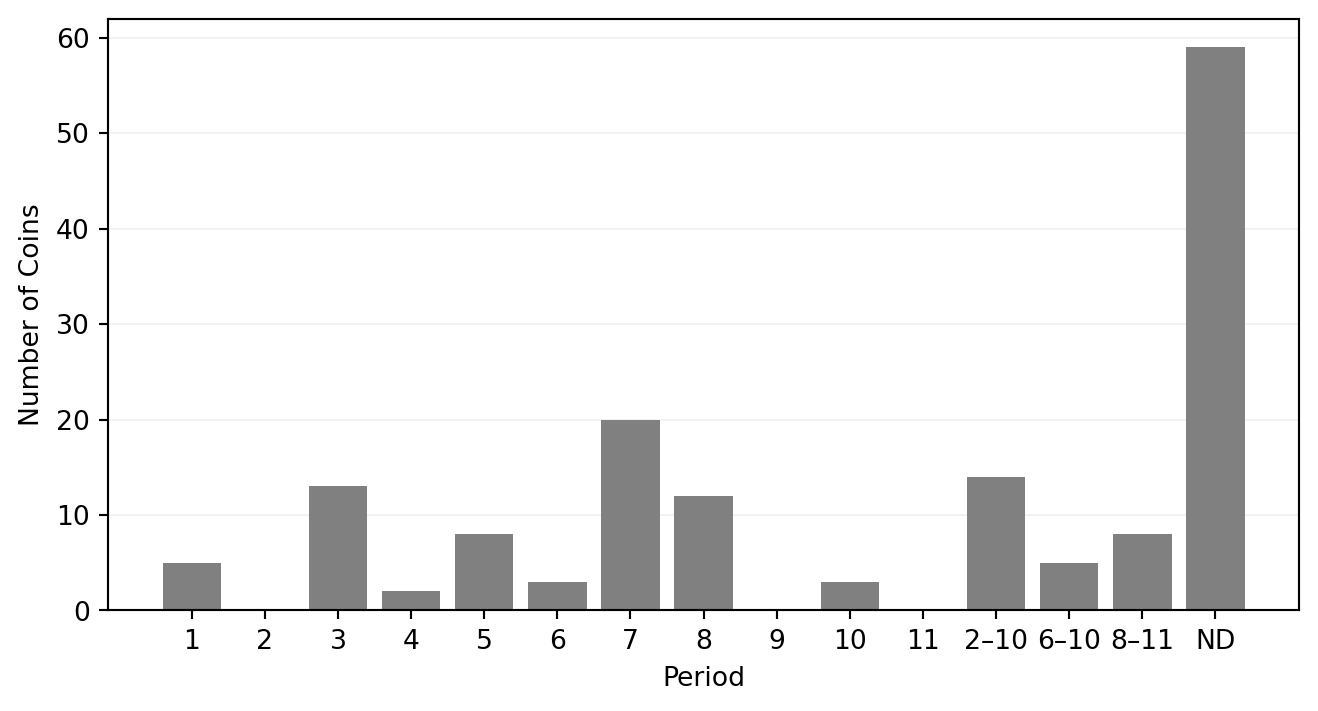
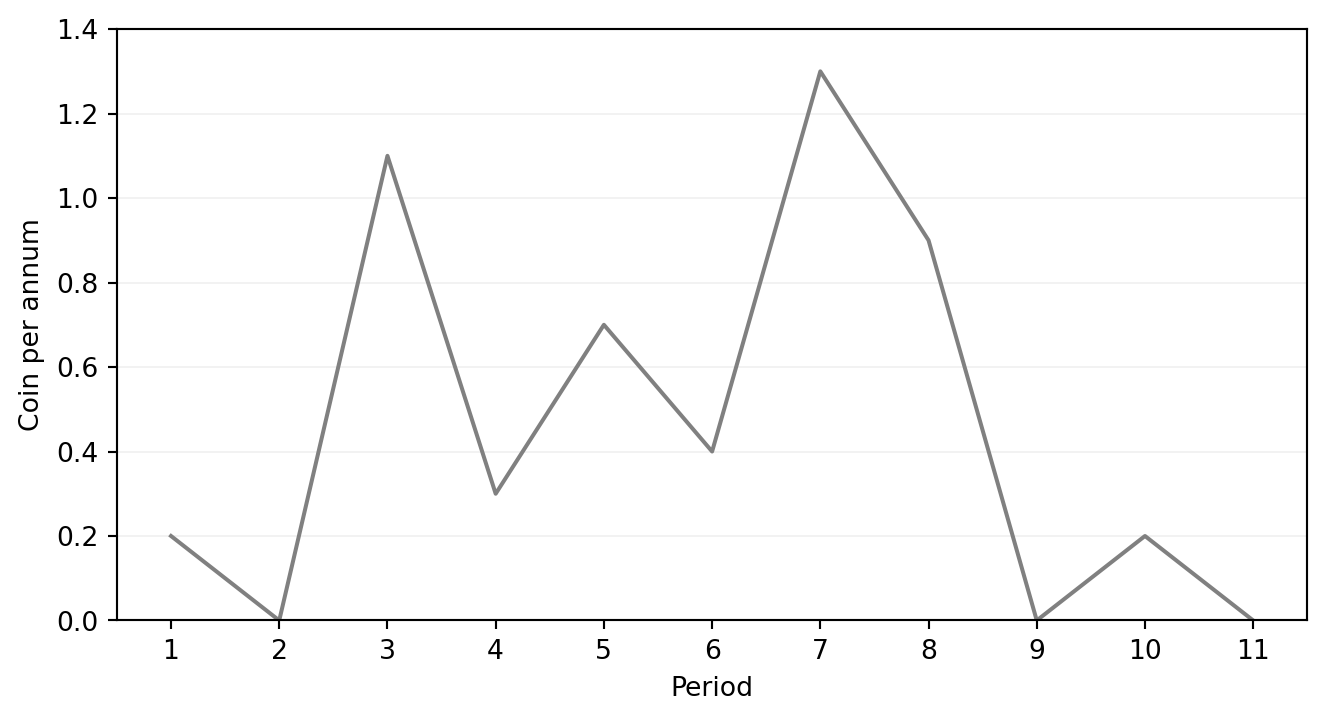
In order to facilitate the analysis and comparison of the numismatic evidence from ʿAin el-Gedida with that published elsewhere, and in particular the excavations of the Centre d’Études Alexandrines by Marie-Christine Marcellesi, I have grouped the finds into conventional periods, adding an initial period of 270–296 (see Figure 9.1).1 Many coins, however, could not be assigned to a single period. Of these, fourteen could be dated to the fourth century (Periods 2–10) on the basis of the remaining traces; another five should most likely be assigned to the second half of the fourth century (Periods 6–10); and eight on the basis of module and surviving traces to the late fourth or early fifth century (Periods 8–11). While these twenty-seven coins retained some diagnostic traces, fifty-nine others were either so effaced or insufficiently cleaned as to render any dating, other than on the basis of module and material, impossible. There is, of course, no reason to doubt that they are all, or nearly all, bronze coins from the fourth and early fifth centuries; but that is a conclusion based entirely on archaeological inference. Since one of the chief aims of this chapter is to describe the numismatic evidence in service of the archaeology of the site, I have assigned no date or period (ND) to these fifty-nine coins in the catalogue. As the periods correspond to imperial minting patterns, they are not of equal length. It is therefore useful to calculate a relative frequency by taking the average number of coins per year per period (Figure 9.2).
Period 1: 270–296
Coins: 5
Coins per year: 0.2
Period 2: 296–312
No coins recovered at ʿAin el-Gedida could be securely attributed to this period.
p. 449
Period 3: 312–324
Coins: 13
Coins per year: 1.1
Types:
- Iovi conservatori (313–324): 1 example: 1 (Thessalonica, Licinius)
- Soli invicto comiti (312–318): 6 examples: 2, 5, 6, 32, 150, 151
- Mints: 1 Lyons; 5 Rome
- Emperors: 1 Licinius; 5 Constantine
- Beata tranquillitas (320–324): 1 example: 27 (London, Constantine)
- D N Constantini (320–324): 3 examples: 3, 12, 63
- Mints: 1 Ticinum; 2 Heraclea
- Providentiae Caess (317–320): 2 examples: 41, 114 (both Heraclea, Constantine)
Period 4: 324–330
Coins: 2
Coins per year: 0.3
Types:
Period 5: 330–341
Coins: 8
Coins per year: 0.7
Period 6: 341–348
Coins: 3
Coins per year: 0.4
Types:
- Victoriae DD Auggq NN (341–348): 1 example: 97
- Vota of Constantine’s sons (341–348): 2 examples: 21 (Constantius), 138 (Constans)
p. 450
Period 7: 348–364
Coins: 20
Coins per year: 1.3
Types:
- Fel temp reparatio, falling horseman (348–361): 16 examples of which as many as 10 may be cast or imitations; almost all are AE3: 8, 13, 18, 19, 22, 24, 25, 31, 44, 48, 65, 80, 85, 89, 93, 135
- Mints: 2 Antioch, Thessalonica or Alexandria
- Emperors: 7 Constantius; 1 Gallus or Julian
- Spes reipublice (355–363): 1 example: 106 (Heraclea, Nicomedia or Cyzicus; cast)
- Vota of Julian (361–363): 2 examples: 45, 81 (Sirmium; Antioch or Alexandria)
- Vota of Jovian (363–364): 1 example: 83 (Alexandria)
Period 8: 364–378
Coins: 12
Coins per year: 0.9
Types:
- Securitas reipublicae (364–378): 10 examples: 46, 52, 68, 71, 76, 77, 118, 123, 151, 152, of which as many as 6 may be cast or imitations.
- Mints: 2 Alexandria
- Emperors: 1 Valens; 1 Gratian
- Mints: 2 Alexandria
- Gloria Romanorum (364–378): 2 examples: 73 (cast?), 87
p. 451
Period 9: 378–383
No coins recovered at ʿAin el-Gedida could be securely attributed to this period.
Period 10: 383–403
Coins: 3
Coins per year: 0.2
Types:
Period 11: 404–457
No coins recovered at ʿAin el-Gedida could be securely attributed to this period.
p. 452
Theoretically, changes in frequency will reflect some combination of: changes in space use or loss habits over time, underlying changes in the coin pool itself, and, potentially, differences in excavation technique and recording.5 Moreover, the fact that over half of the coins at ʿAin el-Gedida cannot be assigned to a single period somewhat vitiates the usefulness of this index. This, however, is not an unusual proportion of illegible coins discovered in Egyptian archaeological contexts, including Alexandria, which makes for a useful comparison (Figure 9.3).6
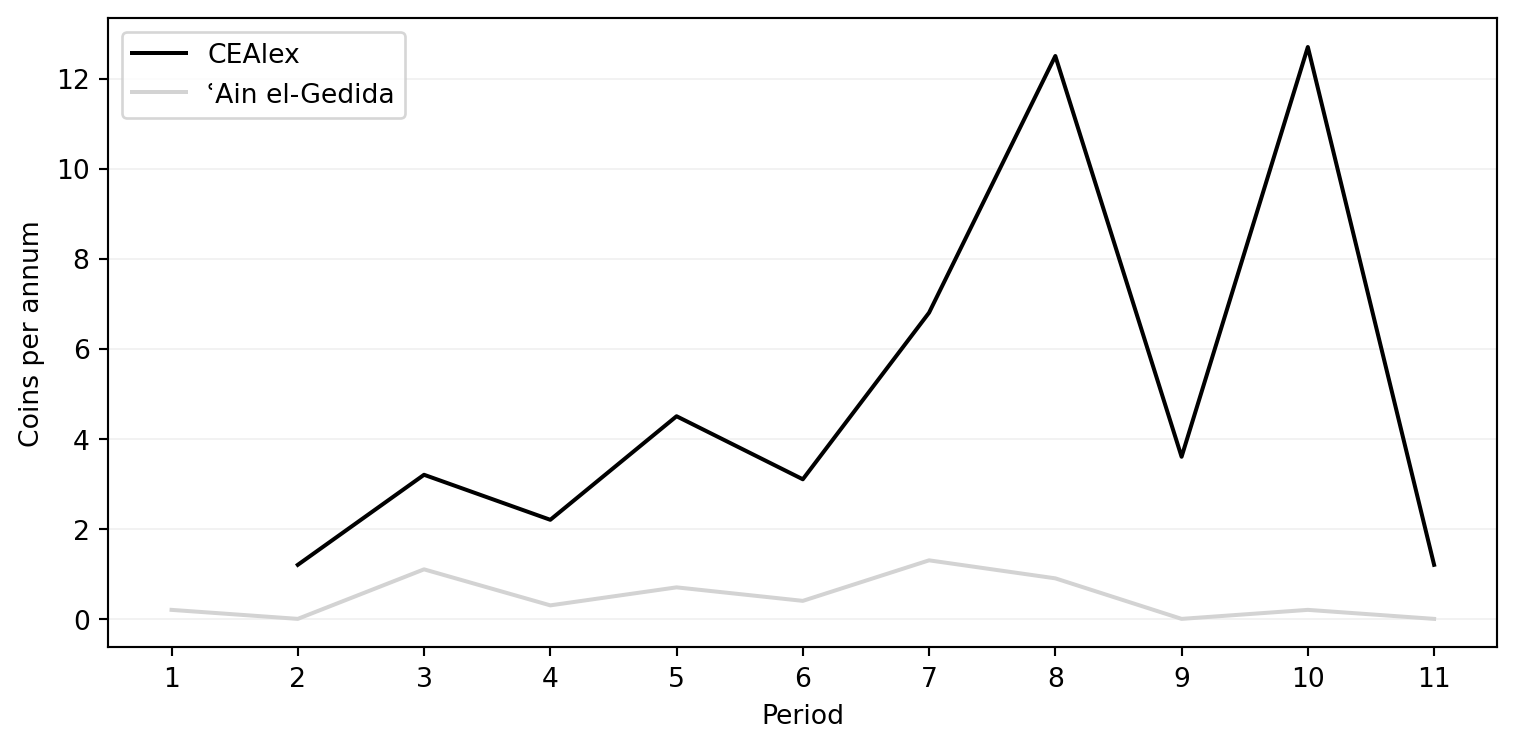
As shown above, the frequency pattern at ʿAin el-Gedida broadly follows that at the Centre d’Études Alexandrines excavations, although at a much lower volume of circulation and loss. This is to be expected, not only because the population (and so amount of coin) was undoubtedly lower at ʿAin el-Gedida, but the total volume excavated was also substantially less. The divergence between the two frequency trends after Period 7 is noteworthy and significant: whereas Period 7 (348–364) is the highpoint at ʿAin el-Gedida, it is Periods 8 (364–378) and 10 (383–403) in Alexandria.8 Variations on the Alexandrian pattern are seen elsewhere in the Nile Valley and at Abu Mina, yet sites in Dakhla, Bahariya, and parts of the Fayyum all appear to tail off at the end of the fourth century.9 Indeed, no coin from ʿAin el-Gedida could be securely assigned to the fifth century.10 While there is little doubt that minting all over the Eastern Empire, including Egypt, declined in the fifth century,11 the pattern at ʿAin el-Gedida more likely reflects a change in coin use (and loss) there and in the Dakhla Oasis more broadly at the end of the fourth century, perhaps due to abandonment or “ruralization” (or both). This interpretation is supported by the evidence of the ceramics, ostraka, and papyri recovered at ʿAin el-Gedida, Amheida, and Kellis (Section 7.1; Chapter 8; Chapter 10).
p. 453
9.3 Mints
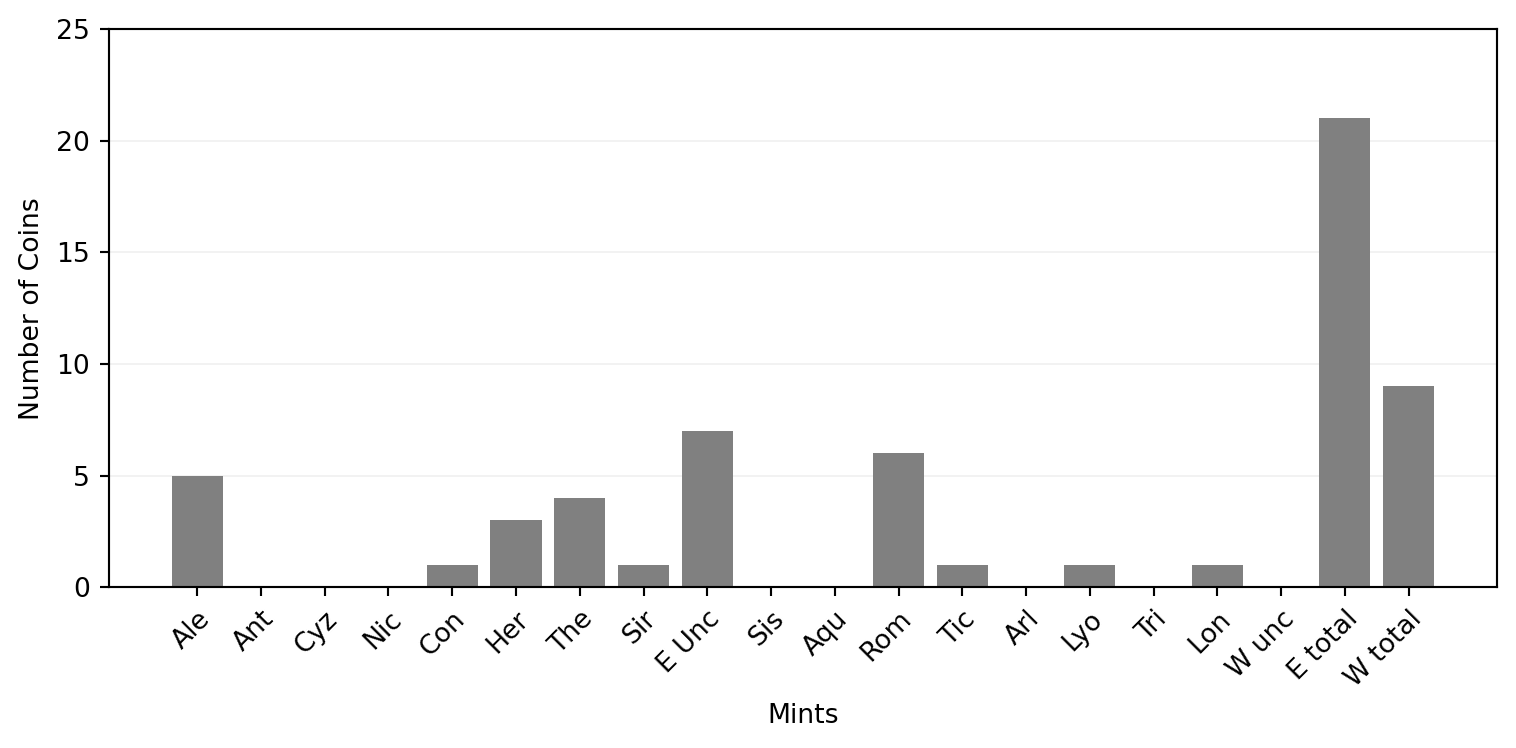
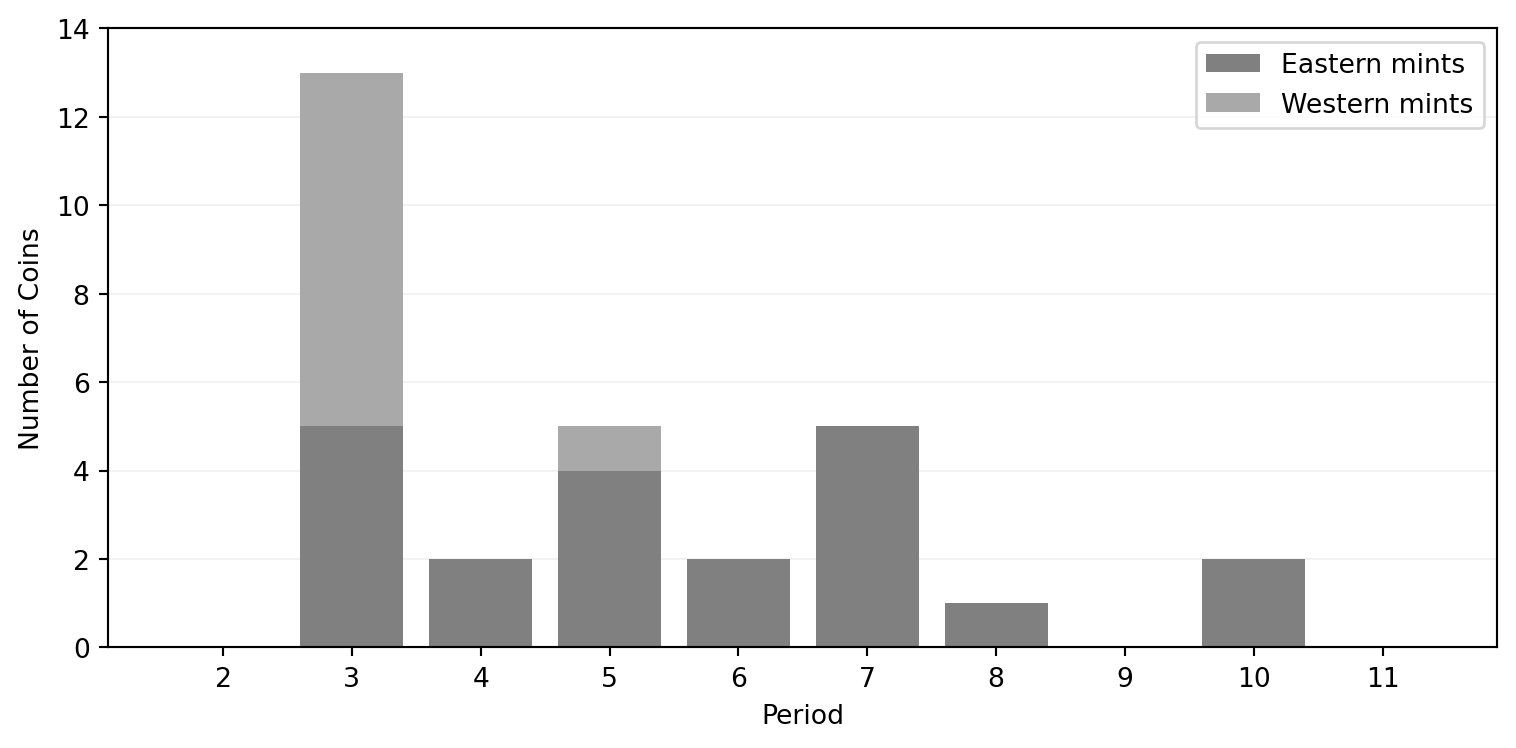
Thirty of the coins dated or attributable to the fourth century retain traces sufficient to identify the mint to some degree of precision (Figure 9.4 and Table 9.1). This represents approximately a third of the coins assigned to a period (30/88), or just about half (30/64), if one excludes possible imitations (Section 9.4 below).
Given the small sample size and the number of illegible coins, one cannot put too much weight on this distribution. Yet the picture is a familiar one from elsewhere in Dakhla and Egypt, with a preponderance of Eastern mints, especially Heraclea and Thessalonica.12 It is somewhat surprising that coins from the mint of Alexandria do not appear early on, much less predominate, as one would expect from finds elsewhere.13 It is also surprising to have no securely identified coins from Antioch, as it was an important mint that contributed substantially to the Egyptian coin pool. That said, several of the coins from the East (“E unc”) may well be from either Alexandria or Antioch. The relatively high number of coins from western mints (including one each from London [27] and Lyons [151]), and particularly Rome, in Period 3 (312–324) is similarly paralleled elsewhere in the Oases, Alexandria, and the East.14 After 330 there is only one coin securely attributed to the West, reflecting again what appears to be a larger trend in the coin pool of Egypt (Figure 9.5).
p. 454
| Period | Date | Total Coins | Ale | Ant | Cyz | Nic | Con | Her | The | Sir | E unc | Sis | Aqu | Rom | Tic | Arl | Lyo | Tri | Lon | W unc | E total | W total | Unc | TOTAL |
|---|---|---|---|---|---|---|---|---|---|---|---|---|---|---|---|---|---|---|---|---|---|---|---|---|
| 2 | 296–312 | 0 | 0 | 0 | 0 | 0 | ||||||||||||||||||
| 3 | 312–324 | 13 | 3 | 1 | 1 | 5 | 1 | 1 | 1 | 5 | 8 | 0 | 13 | |||||||||||
| 4 | 324–330 | 2 | 2 | 2 | 0 | 0 | 2 | |||||||||||||||||
| 5 | 330–341 | 8 | 2 | 1 | 1 | 1 | 4 | 1 | 2 | 7 | ||||||||||||||
| 6 | 341–348 | 3 | 2 | 2 | 0 | 1 | 3 | |||||||||||||||||
| 7 | 348–364 | 20 | 1 | 1 | 3 | 5 | 0 | 5 | 10 | |||||||||||||||
| 8 | 364–378 | 12 | 1 | 1 | 0 | 5 | 6 | |||||||||||||||||
| 9 | 378–383 | 0 | 0 | 0 | 0 | 0 | ||||||||||||||||||
| 10 | 383–403 | 3 | 1 | 1 | 2 | 0 | 1 | 3 | ||||||||||||||||
| 11 | 404–457 | 0 | 0 | 0 | 0 | 0 | ||||||||||||||||||
| 2–10 | 4 c | 14 | 0 | 0 | 12 | 12 | ||||||||||||||||||
| 6–10 | Second half of 4 c | 5 | 0 | 0 | 3 | 3 | ||||||||||||||||||
| 8–11 | Late 4–5 c | 8 | 0 | 0 | 5 | 5 | ||||||||||||||||||
| TOTAL | 88 | 5 | 0 | 0 | 0 | 1 | 3 | 4 | 1 | 7 | 0 | 0 | 6 | 1 | 0 | 1 | 0 | 1 | 0 | 21 | 9 | 34 | 64 |
p. 455
p. 456
9.4 Imitations
Despite Roman laws to the contrary, unofficial coinage (i.e., not struck at an imperial mint) circulated freely in fourth- and fifth-century Egypt.15 What precisely qualifies as an imitation or counterfeit is debated, partly because the identification of struck imitations is, at some level, subjective;16 and partly because both struck and cast imitations seem often to have been fabricated with some degree of tolerance, if not the tacit permission, of local authorities, calling into question precisely what it means to be a “forgery” or “counterfeit.”17 Generally speaking, imitations will exhibit poorly executed, erroneous, or stylistically divergent portraits, types, or legends, while cast coins will betray their production method by showing generation loss in the details, imperfections and reductions in the flan, and occasionally sprue stems from the casting process.18
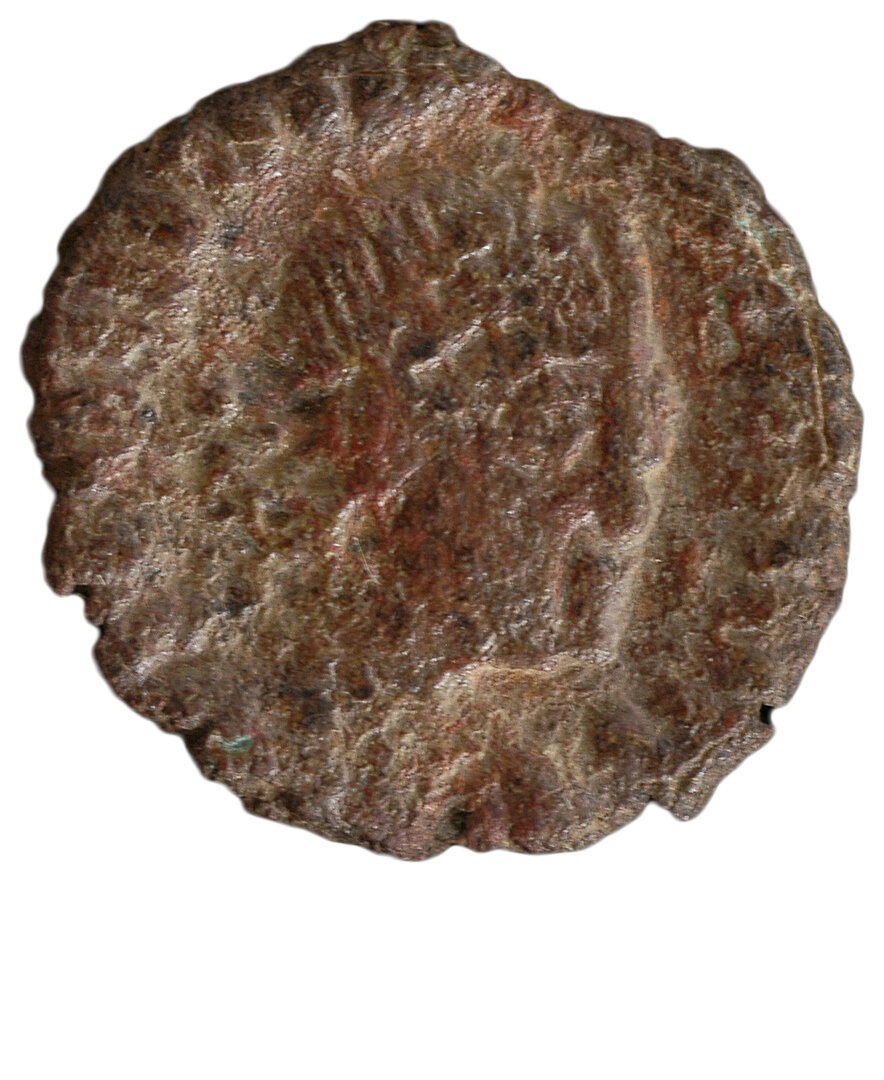
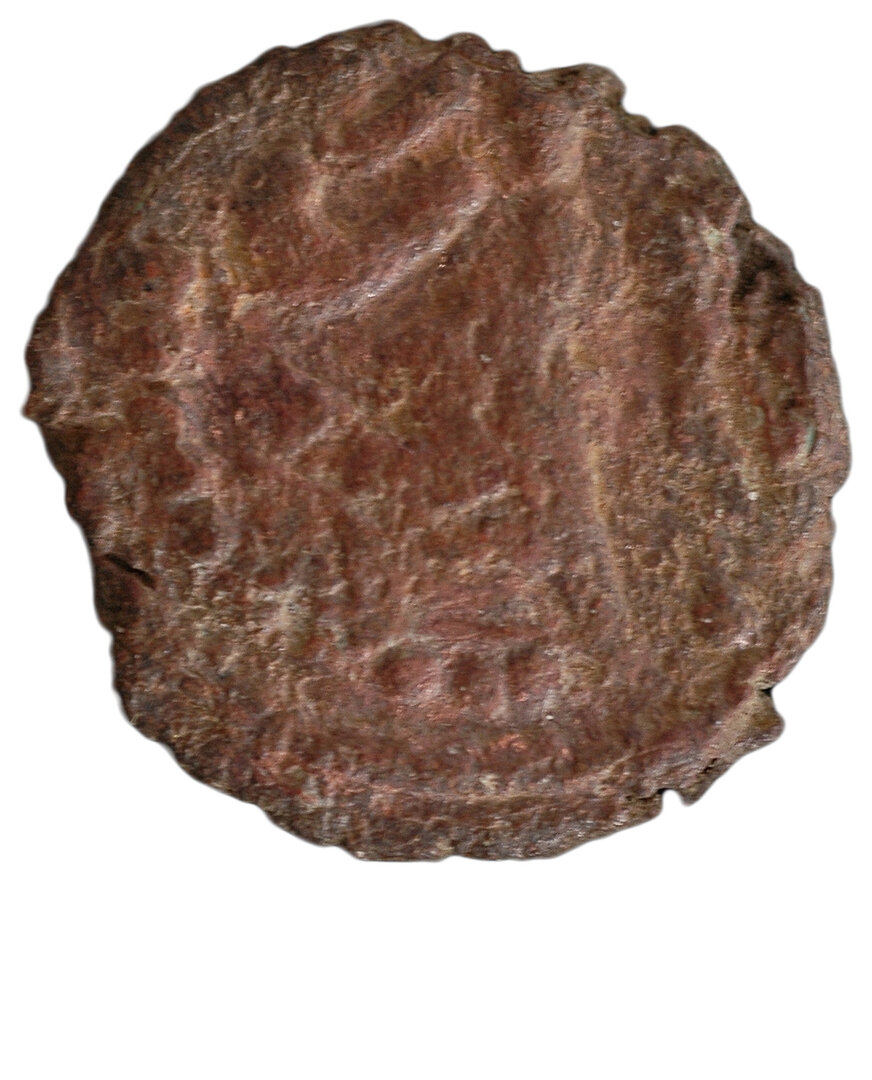
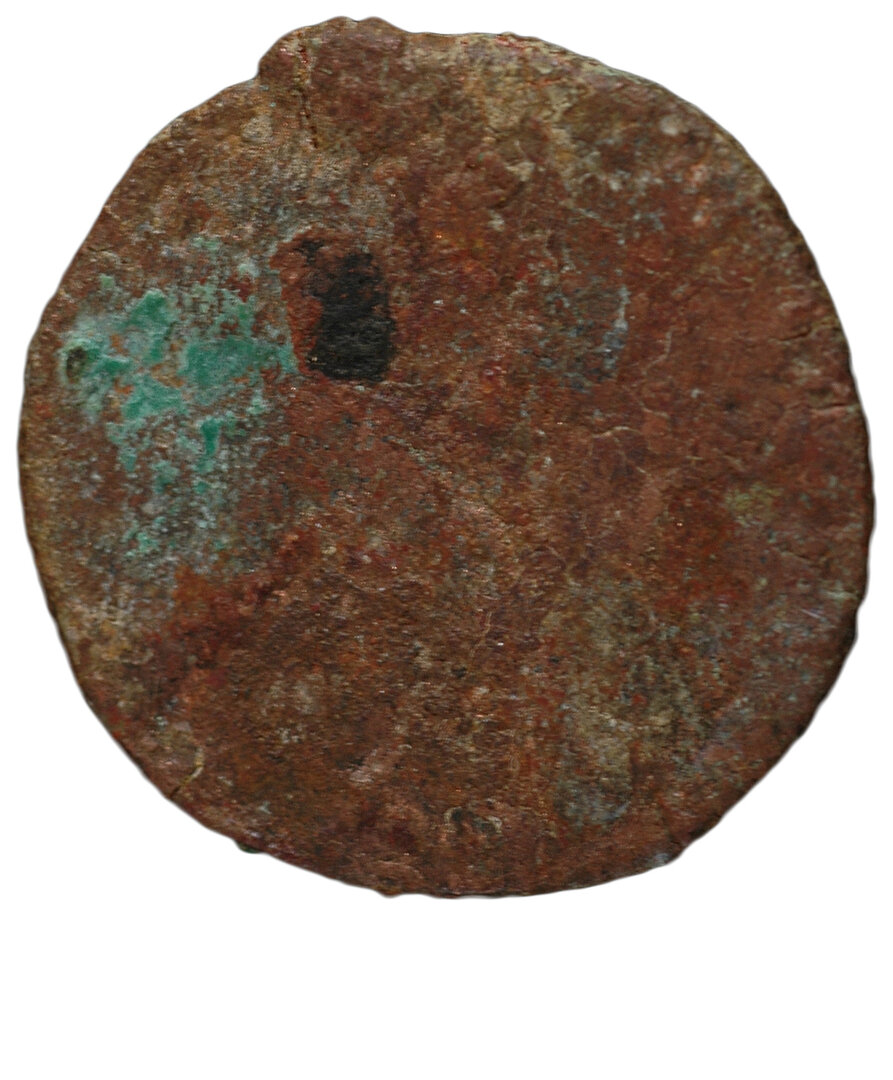
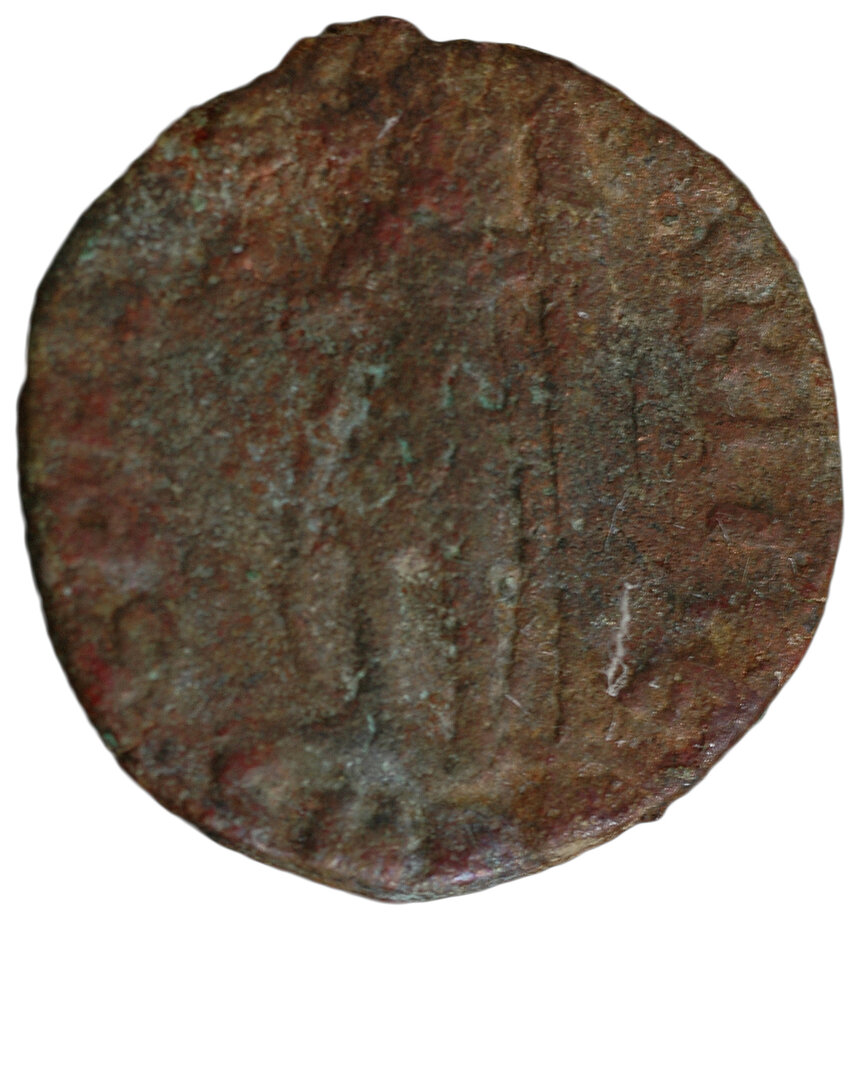
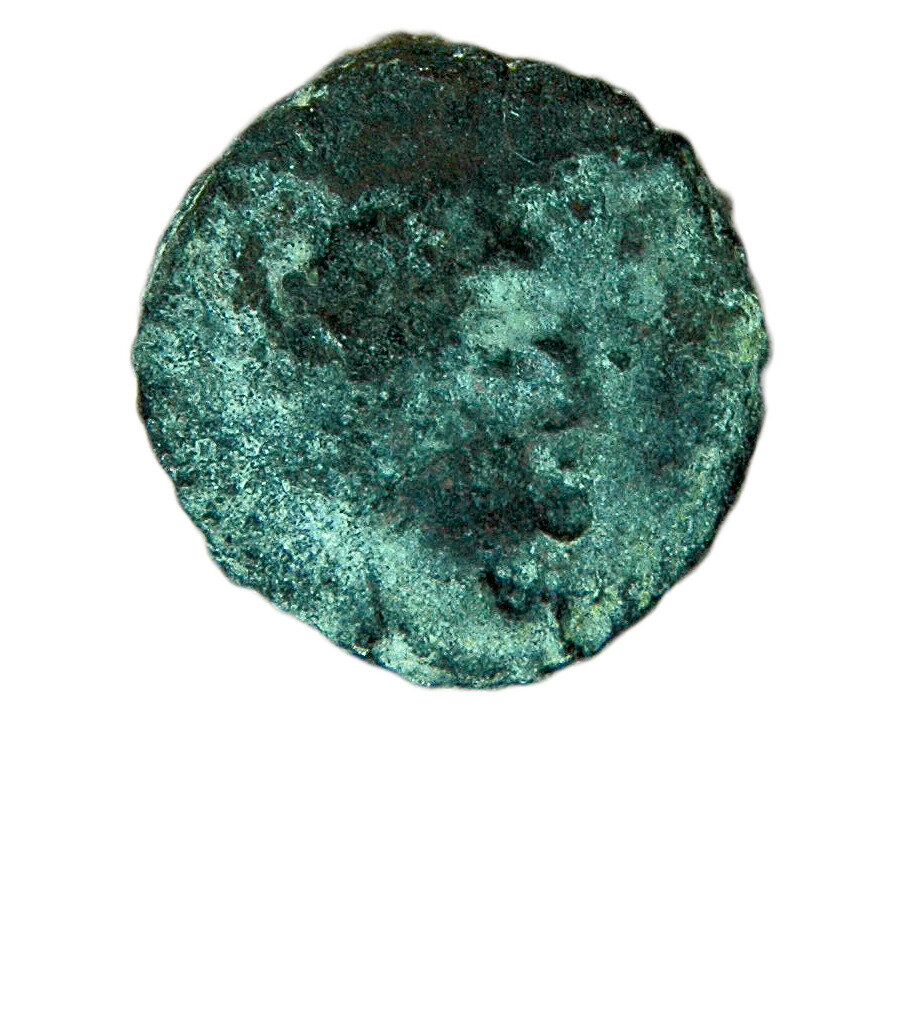
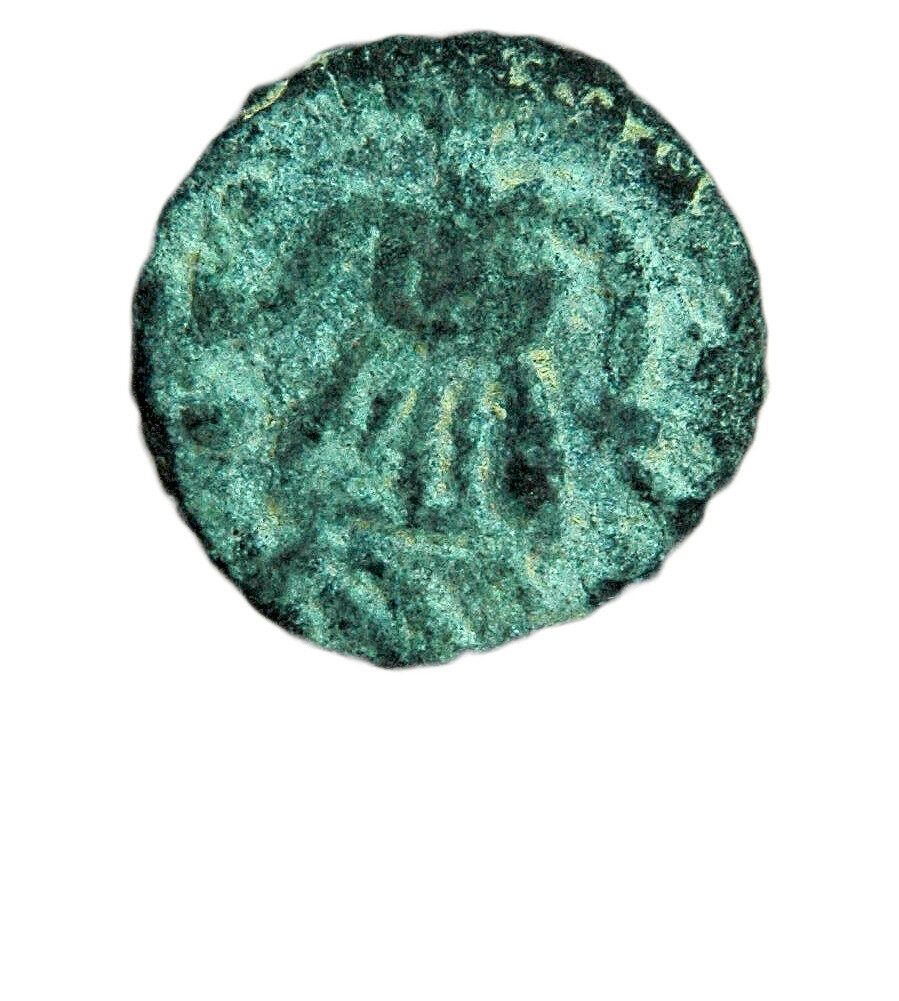
We see evidence of both kinds of imitations at ʿAin el-Gedida. 106, for example, is a coin cast from a mold modeled on an authentic Spes reipublice type and exhibiting the telltale nub of a residual sprue stem. Coins 104 and 125, on the other hand, are small (ca. 9–10 mm, ca. 0.5 g); have crudely executed victories on the reverse, after the fashion of a Securitas reipublicae or Salus reipublicae type; and show obverse portraits that do not comport with official style. The obverse portrait of 104 is particularly noteworthy in this regard, as it is rendered in nearly threequarters profile, turning toward the face of the coin, with very large eyes and an elongated head. The legend on the reverse, and perhaps what is supposed to be the mint mark in the exergue (unless it is the hem of the victory’s dress), would seem to be bars or dots rather than letters.19
In her recent analysis of 1,535 fourth- and fifth-century coins from excavations in Alexandria, Marcellesi found that cast imitations first appear in the coin pool in large numbers after 330. They then grow as a percentage of the coin pool in each successive period until in Period 8 (364–378) they represent nearly 70% of specimens.20 According to her research, nearly 90% of fifth-century coins are cast. High percentages of cast and other irregular coins have also been reported at other late antique and Byzantine sites in Egypt.21 Given that the coins of Kellis and ʿAin el-Gedida show every indication of following the general circulation patterns of Egypt, we should expect to find a substantial number of imitations at late antique sites in Dakhla.22
I identified 25 likely or possible imitations (primarily cast) in the coins from ʿAin el-Gedida (Table 9.2). This represents approximately a quarter of the legible coins, though in fact most were from the second half of the fourth century. The most frequent types imitated were, predictably, the popular Fel temp reparatio, falling horseman (351–361) and Valentinian’s Securitas reipublicae (364–378).23] The distribution and types of imitations comports well enough with the general consensus about imitations over the course of the fourth century in Egypt and with Marcellesi’s recent work at Alexandria (Table 9.3).
p. 457
| Loading ITables v2.4.0 from the internet... (need help?) |
The poor condition of the coins at ʿAin el-Gedida and the need to work from images together render the identification of imitations challenging. As a consequence, one cannot place much weight on the precise percentages in Table 9.3. Indeed, one should suspect that a healthy percentage of the illegible coins at ʿAin el-Gedida were cast. My aim here is merely to note that, in line with expectations, there are a good number of imitation or cast coins at ʿAin el-Gedida and likely elsewhere in Dakhla and Kharga.
p. 458
| Period | AG | CEAlex |
|---|---|---|
| 2 | 0% | 0% |
| 3 | 0% | 3% |
| 4 | 0% | 0% |
| 5 | 13% | 8% |
| 6 | 0% | 20% |
| 7 | 55% | 28% |
| 8 | 50% | 68% |
| 9 | 0% | 59% |
| 10 | 0% | 66% |
9.5 Archaeological Observations
The six coins from area A (1–6) have no reliable archaeological context. The 146 coins from area B, on the other hand, were recovered through systematic archaeological excavation of strata of varying reliability in eighteen of the 24 rooms investigated (Table 9.4). Eighty-seven of these coins were dated.
The coins from area B of ʿAin el-Gedida are interesting from two archaeological perspectives. First, they are objects with a date stamp, and so useful in assigning absolute date points to the relative chronology established by stratigraphic excavation and analysis. Because coins circulate, however, they persist in use well after their initial minting, as demonstrated by the evidence of hoards. The date of minting therefore provides a terminus post quem for subsequent archaeological events or features. Hoards give us a sense of when coins drop out of circulation, and therefore suggest a useful, if fuzzier, terminus ante quem for prior events or features. The facts of circulation and hoarding bring us to the second archaeological perspective, or the archaeology of coins as a distinct class of cultural object. The disposition of coinage in an archaeological site is, from this perspective, a record of coin production and use. More precisely, the coins recovered in an archaeological site are a complex artifact of the phenomenon of coin handling and loss in a specific space during specific periods.24
| Room | Total Coins | Dated Coins |
|---|---|---|
| 4 | 1 | 0 |
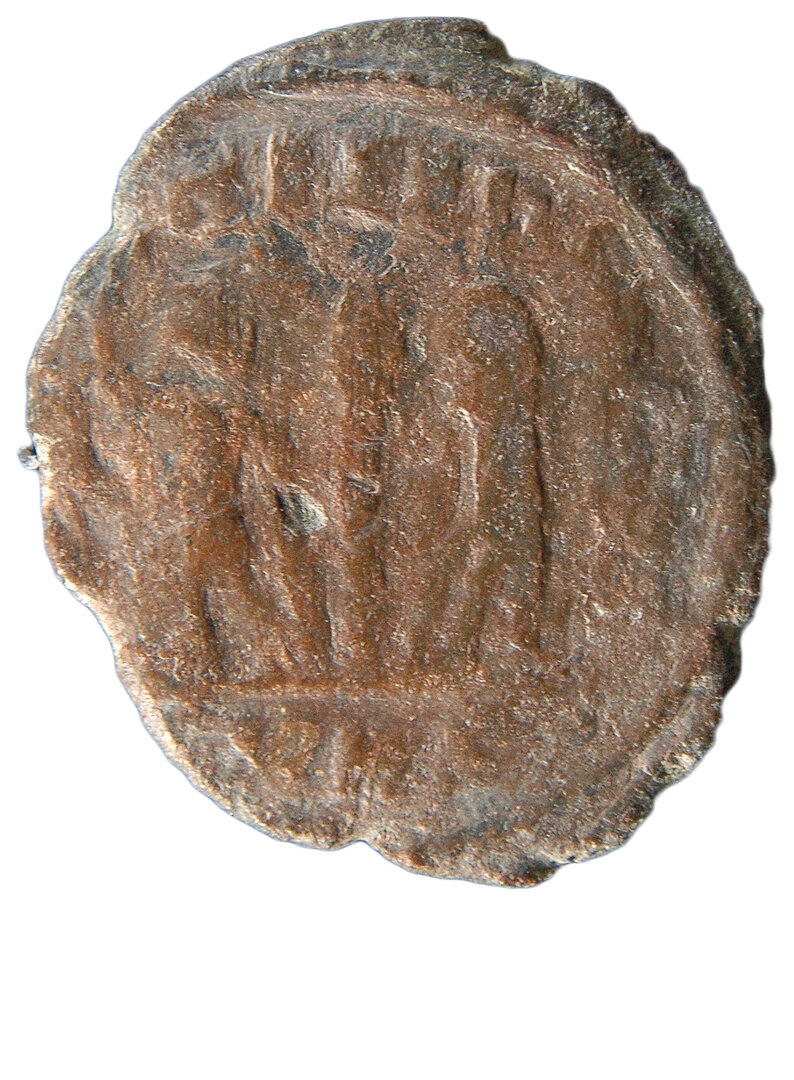
| 5 | 36 | 28 |
| 6 | 2 | 2 |
| 8 | 1 | 1 |
| 9 | 1 | 1 |
| 10 | 1 | 1 |
| 11 | 15 | 6 |
| 12 | 33 | 20 |
| 13 | 17 | 4 |
| 14 | 6 | 4 |
| 15 | 16 | 9 |
| 17 | 3 | 1 |
| 18 | 2 | 0 |
| 19 | 7 | 6 |
| 20 | 1 | 0 |
| 21 | 1 | 1 |
| 23 | 2 | 2 |
| 24 | 1 | 1 |
| Total | 146 | 87 |
Table 9.5 shows the distribution of coins in area B by room and DSU or FSU. The table displays the number of dated coins and imitations found in each context. The dated coins establish a terminus post quem for the unit and those above it. I have also calculated an approximate volume for each unit in order to arrive at a coin density, or the number of coins found per cubic meter in a given unit. Just as a frequency facilitates comparison of relative output of coinage from period to period (section 9.2 above), so a density facilitates comparison between stratigraphic units of varying sizes and depths. However, densities (frequencies, or normalized volumes) of coin (per 1000) are most useful when one has a baseline for comparison. For example, the west complex on mound I at the occupational levels has a density of approximately 0.9 coins/m3. Is this a lot or a little? Is it typical of this sort of space in late antique Dakhla? Such questions can only be answered once we have a large enough sample of densities and coin lists. All this is by way of saying that the densities here are of limited use. Indeed, one might say that their meaning is latent and will only become clear as more contexts and their coin lists are published.
p. 459
A quick glance at the two tables in this section reveals that coin loss was not evenly distributed across the areas excavated at ʿAin el-Gedida. Rooms B1–B3, which have been interpreted as a likely domestic context, did not yield a single coin in approximately 70–80 m3 of excavated material. To put this into perspective, B5, one of the main rooms of the church, contained a similar volume of material but yielded 36 coins. One coin was recovered in B4, but this was a surface find in a context that seems not to be original to the room, which was used as a midden in its final phase. The ceramic assemblage and ostraca finds in B1–B3 (Section 2.3.1) suggest that it had a fourth-century phase, and certainly late antique domestic contexts from Kellis and Amheida have yielded coins. However, the building of which B1–B3 are a part has not been fully excavated; we may therefore draw no conclusions about coin use and loss in this area until that point.
The west complex on mound I (B17–B24) has been interpreted as a temple that had been converted into a pottery workshop sometime around the fourth century (Section 6.7). The entire complex yielded 17 coins. Eleven, however, come from surface or ancient abandonment or post-abandonment layers (B17: DSU152; B19: DSU171, 173; B21: DSU138; B24: DSU174). Thus four rooms yielded five coins from units associated with the final occupation phase of the west complex (B1: DSU156; B19: BF180; B20: DSU143; and B23: DSU147). Regrettably, coins 139–140 from DSU156 were not fully cleaned. 147 is an odd specimen, curiously heavy for its module. It retains traces that clearly date it to the fourth century, but I have yet to succeed in identifying it more precisely. 148 from DSU143 is illegible. Thankfully, both of the coins in DSU147 and the occupational level just above the floor BF183 in B23, are legible Soli invicto comiti types (150–151). Hoard evidence suggests that these types were no longer circulating by sometime in the 330s, making that decade the latest likely date for the laying of floor BF183.25
p. 460
p. 461
| Loading ITables v2.4.0 from the internet... (need help?) |
p. 462
The other main excavated area at ʿAin el-Gedida includes a church complex and several surrounding spaces (B5–B15). 128 coins were recovered from this complex of rooms and passageways. Approximately forty percent (51) were discovered in surface, abandonment, or postabandonment layers (B5: surface, DSU20, 22, 23, 24, 28, 29, 33; B8: DSU44; B10, DSU76; B13: DSU94, 104, 105, 109, 110; B14: DSU84, 127; B15: DSU86, 129). Rooms B14 and B15 postdate the conversion of B5 and A46 into an apsidal church, encroaching upon and transforming the street B12 (section 5.1) in order to accommodate a bakery. The only coins discovered in the pre-abandonment layers of this part of the site are 129–**132 in DSU132 and 133–135 in DSU137. DSU132 lay below the most recent floor BF174 and while DSU137 was above floor BF175, which belongs to the period in which the ovens were active. None of the coins in DSU132 provide a secure terminus post quem for the floor above, though all are likely from the later half of the fourth century or early fifth century. At least two, and perhaps all three, of the coins in DSU137 are cast imitations of types that circulated in the last three decades of the fourth century. 133 is a Salus reipublicae type, suggesting that the layers above it were deposited after 383.
p. 463
B11–B13 were streets and passageways that predated the conversion of B5 into a church and were subsequently modified in order accommodate the transformation of the church complex (section 5.1). In B12 there were a series of floors, with earlier ones connected to the alteration of B5 and subsequent ones associated with the construction of B14–B15 to the east. Two early strata produced one coin each: BF135, an early floor; and DSU101, a preparation layer for another early floor (BF155). One of these coins was not fully cleaned (96). The other coin (83) is a votive issue of Jovian dated to 363–364. This implies that the subsequent phases of B12 should be dated to after 363. In B11 coin 63, minted in 320–321, was discovered embedded in the lowest floor (BF141). Hoard evidence suggests that this coin was no longer in circulation by 340, again suggesting a rough terminus ante quem for the floor.26 Unfortunately, the coins in the earliest levels of B13 were either not fully cleaned or are otherwise illegible.
In the church complex itself (B5–B9) three rooms produced coins: B5, B6, and B9 (the coin find in B8 is post-abandonment). B6–B9 were built simultaneously (section 5.1) and produced only four coins. The coin in B9 is illegible. B6 produced two coins: 44 in DSU59, an occupational layer above floor BF83, in which 45 was embedded. The former is a Fel temp reparatio type (351–361) and the latter a votive coin of Julian (361–363). B5 has two coins in early layers: 41 in DSU35 and 42 in DSU41, the preparation layer for the floor. 42 is illegible; 41 was minted in 317 and was unlikely to be circulating actively by 330.27 B5 also contains numerous pits (Section 3.1.1). The fill of one (DSU43) contained a single coin (43), a Gloria exercitus type dated to 335–337 and in the coin pool until sometime in the 360s. DSU32 has also been related to ancient digging activity. This small unit not only produced 10 coins (density 25.5), but also produced the only coins excavated from ʿAin el-Gedida thus far that pre-date Diocletian’s reform (29–30, 33–34, 38). These late third-century tetradrachms were discovered with coins from the fourth century, including a Fel temp reparatio type. It is hard to know what to make of such a deposit. Late third-century tetradrachms have been found in the churches at Kellis, and Bowen has argued that they suggest their continued circulation well after Diocletian’s currency reform.28
We thus have three contexts with three distinct numismatic profiles. B1–B4 yielded no coins in the historical layers. The west complex (B17–B24) produced 17 coins, but an average density of 0.9/m³ for occupation layers.29 Temple sites and churches, on the other hand, are often productive of coins, the result of a combination of intentional donation, commercial activity, and loss (see the discussion of B5 immediately below). The numismatic profile of the west complex would, therefore, seem to be that of its latest phase as a workshop. By way of comparison, the admittedly larger temple mound at Amheida has yielded not only far more coins from the fourth century, but also a substantial hoard of first- and second-century tetradrachms, whereas second-century tetradrachms and even money boxes (empty) have been discovered in the temple of Tutu at Kellis.30 While this may reflect a difference in coin use and loss in the west complex, it may also reflect the extent of erosion and deflation in this area, which affected both the strata of the earlier temple and the subsequent workshops.31
p. 464
Rooms B14–B15 produced 22 coins and had units that ranged in density from 1.6–2.5/m³. Although streets B11–B12 and courtyard/intersection B13 produced 36 coins—double the number from the west complex—the layers with the greatest number of coins, DSU90 and DSU91, in fact had relatively low densities for the site (0.6 and 0.9, respectively). Densities in the refuse and occupational layers ranged from approximately 1.0–2.5, resembling the west complex at one end of the spectrum (if we may take them as diagnostic), and certain layers in B14–B15 at the other. Finally, in the church complex itself, there were several rooms with few or no coins (B6–B9; density equal to or less than 1.0), as contrasted with B5 itself, in which we find the greatest coin densities at the site so far. We might explain the difference with how people may have used and lost or did not lose coins in passageways, access points, pantries, or kitchens, as B6–B9 have been interpreted,32 as opposed to the church itself, where one might expect donations (if not other activities) to lead to various types of loss. However, it will take more excavation and quantifying and mapping of coin loss in order to build up a meaningful typology of coin loss in different contexts in Dakhla.
9.6 Catalogue
The catalogue is organized by archaeological area, room, and stratigraphic unit or feature. Restored features are represented in square brackets ([ … ]). “NA” signals when information is not available; “ND” signifies “No Date”. All coins are scaled at 2:1.
Abbreviations
FTR, FH Fel temp reparatio, falling horseman series
D. G. Dattari (1901). Monete imperiali greche. Numi Augg. Alexandrini. Cairo.
G. A. Geissen (1974–83). Katalog Alexandrinischer Kaisermünzen der Sammlung des Instituts für Altertumskunde der Universität zu Köln (Papyrologica Coloniensia V). 5 vols. Opladen: Westdeutscher Verlag. (Vol. 4 in collaboration with W. Weiser).
L left
M. J. G. Milne (1933). Catalogue of Alexandrian Coins. Oxford: Oxford University Press. Reprinted 1971 (London: Spink).
R right
RIC H. G. Mattingly et al., eds. (1923–1944). Roman Imperial Coinage. London: Spink. P. M. Bruun, VII: Constantine and Licinius: A.D. 313–337 (1996). J. P. C. Kent, VIII: The family of Constantine I: A.D. 337–364 (1981). J. W. E. Pearce, IX: Valentinian I-Theodosius I (1951).
Sal Reip Salus reipublicae
Sec Reip Securitas reipublicae
p. 465
1
Inventory Number 1
Context Area A, room A41, surface clearance (FN1)
Material AE
Diam. 23 mm
Weight 3.0 g
Axis 6h
Module/Denom. AE3/Nummus
Obv. Imp. bust, R; laureate. Legend: IM[P] LIC LICINIUS [P F AU]G
Rev. Jupiter Conservator, standing L, with globe and victory, leaning on scepter. Eagle with wreath to L on ground. Legend: IOVI CONSE-R[VATORI] AUGG
Mint Thessalonica
Mint Mark -/-//● T S [●] A ● (Final letter may also be B)
Date 313–316
Ref. RIC VII Thessalonica 2
Image ref. to the database OBV: 0001-AG06--0014; REV: 0001-AG06--0012
2
Inventory Number 2
Context Area A, room A41, surface clearance (FN2)
Material AE
Diam. 22 mm
Weight 3.3 g
Axis 6h
Module/Denom. AE3/Nummus
Obv. Imp. bust, R; laureate, cuirassed. Legend: IMP [LICI]NIUS P F AUG
Rev. Sol, radiate, standing L, globe in L, raising R hand, chlamys across L shoulder. Legend: SOLI INV-I-CTO COMITI
Mint Rome
Mint Mark (R on X)/F//RP
Date 314–315
Ref. RIC VII Rome 30
Image ref. to the database OBV: 0002-AG06--0011; REV: 0002-AG06--0010
3
Inventory Number 501
Context Area A, room A25, surface clearance (FN1)
Material AE
Diam. 20 mm
Weight 1.8 g
Axis 12h
Module/Denom. AE3/Nummus
Obv. Imp. bust, R. Legend: CONSTA[N-TIN]US AUG
Rev. Votive wreath, inscribed VOT / X X. Legend: D N CONSTANTINI MAX AUG
Mint Heraclea
Mint Mark *//SMHB
Date 324
Ref. RIC VII Heraclea 60
Image ref. to the database OBV: 0501-AG07--0169; REV: 0501-AG07--0056
p. 466
4
Inventory Number 502
Context Area A, room A25, surface clearance (FN2)
Material AE
Diam. 19 mm
Weight 2.2 g
Axis 6h
Module/Denom. AE3/Nummus
Obv. Imp. bust, R; cuirassed, draped(?), laureate. Legend: IUL CRIS-PUS NOB C
Rev. Camp gate, no doors, two turrets, star in between. Legend: PROVIDEN-TIAE CAESS
Mint Thessalonica
Mint Mark SMTS . (officina illegible)
Date 326
Ref. RIC VII Thessalonica 155
Image ref. to the database OBV: 0502-AG10–3059; REV: 0502-AG10–3060
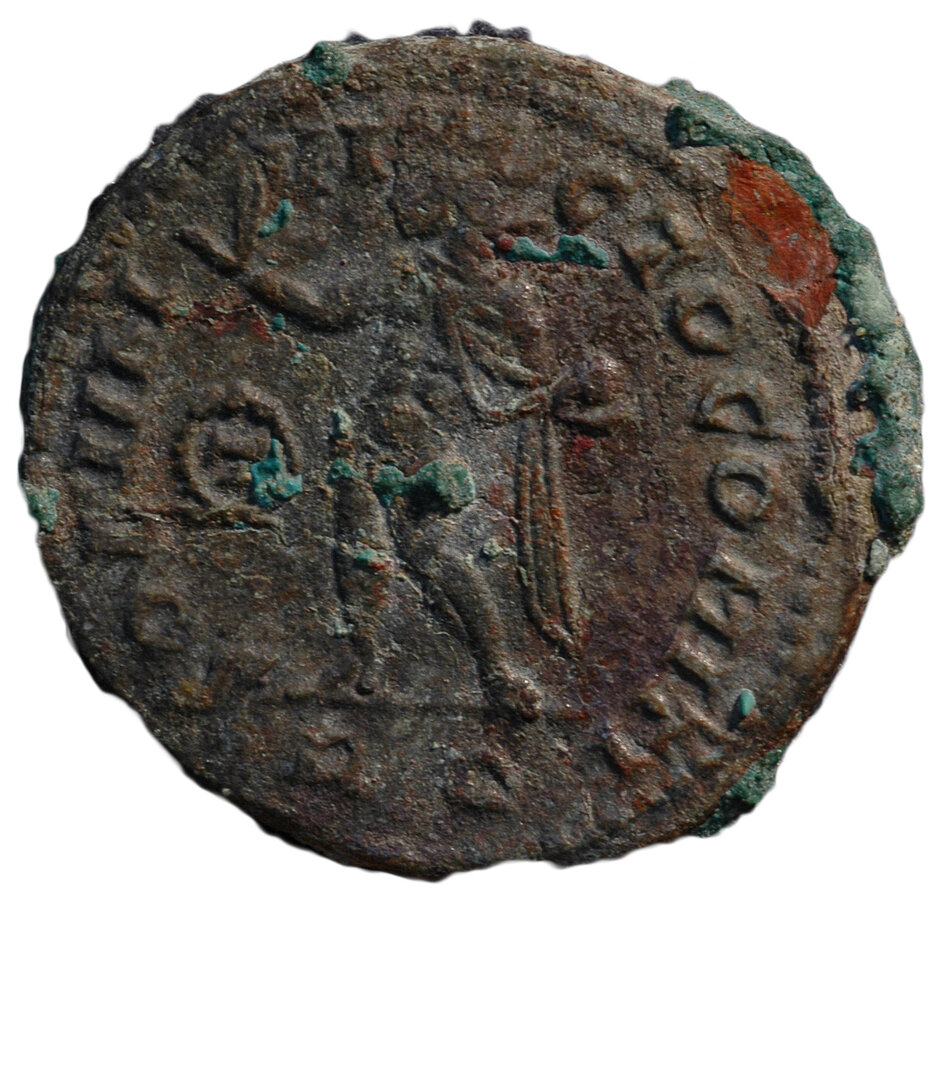
5
Inventory Number 503
Context Area A, room A25, DSU1
Material AE
Diam. 21 mm
Weight NA
Axis 12h
Module/Denom. AE3/Nummus
Obv. Imp. bust, R; head only, laureate. Legend: IMP CONSTANTINUS PF AUG
Rev. Sol, radiate, standing L, facing L, R arm raised, chlamys over L shoulder. Legend: SOL[I IN VI] CTO COM[ITI] (breaks not legible)
Mint Rome
Mint Mark R/[F]//RS
Date 313
Ref. RIC VII Rome 1
Image ref. to the database OBV: 0503-AG07--0173; REV: 0503-AG07--0174
6
Inventory Number 504
Context Area A, room A25, DSU1 (FN7)
Material AE
Diam. 22 mm
Weight NA
Axis 12h
Module/Denom. AE3/Nummus
Obv. Imp. bust, R; headdress uncertain: diadem? Legend: [I]M[P] CONSTANTINUS P FA[UG]
Rev. Sol, radiate, standing L, chlamys over L arm; other attributes obscure. Legend: SOLI IN - VI - CTO COMITI
Mint Rome
Mint Mark C or (wreath)/?//RT
Date 315–318
Ref. RIC VII Rome 39–41 or 97 var
Note Variant of RIC 7 Rome 39–41 or 97, depending on the mint mark in the field. Variants of this type with respect to the break of the reverse legend are fairly common. Recorded weight to be checked
Image ref. to the database OBV: 0504-AG07--0058; REV: 0504-AG07--0057
7
Inventory Number 548
Context Area B, room B4, surface
Material AE
Diam. 10 mm
Weight 0.5 g
Axis NA
Module/Denom. NA
Condition Illegible
Date ND
p. 467
8
Inventory Number 545
Context Area B, room B5, surface
Material AE
Diam. 14 mm
Weight 1.7 g
Axis 2h
Module/Denom. AE3/Maiorina
Obv. Imp. bust, R; diadem. No trace of legend. Portrait seems elongated
Rev. Traces of legend along L. FTR, FH type, but a very tight composition
Mint NA
Mint Mark illegible
Date 355–361
Ref. NA
Note Axis is approximately 2h. Likely an imitation
Image ref. to the database OBV: 00545-AG10--3069; REV: 00545-AG10--3070)
9
Inventory Number 546
Context Area B, room B5, surface
Material AE
Diam. 12 mm
Weight 0.7 g
Axis NA
Module/Denom. NA
Condition Illegible
Date ND
10
Inventory Number 547
Context Area B, room B5 surface
Material AE
Diam. 13 mm
Weight 0.6 g
Axis NA
Module/Denom. NA
Condition Illegible, fragmentary
Date ND
11
Inventory Number 33
Context Area B, room B5, DSU20 (FN15)
Material AE
Diam. 21 mm
Weight 1.2 g
Axis NA
Module/Denom. AE3
Obv. Traces of Imp. bust, R; diadem. Legend: D [N … ]?
Rev. Traces of legend and design
Condition Fragmentary
Mint NA
Mint Mark illegible
Date 4th c.
Ref. NA
12
Inventory Number 32
Context Area B, room B5, DSU22, FN20
Material AE
Diam. 19 mm
Weight 2.0 g
Axis NA
Module/Denom. AE3/Nummus
Obv. Imp. bust, R; laureate. Legend: CONSTAN-TINUS AUG
Rev. Votive wreath, inscribed: VOT ● XX. Legend: D N CONSTANTINI MAX AUG
Mint Heraclea
Mint Mark *//SHMA
Date 324
Ref. RIC VII Heraclea 60
Image ref. to the database OBV: 00032-AG10--3041; REV: 00032-AG10--3042
p. 468
13
Inventory Number 29
Context Area B, room B5, DSU23 (FN17)
Material AE
Diam. 17 mm
Weight 2.3 g
Axis 12h
Module/Denom. AE3/Maiorina
Obv. Imp. bust, R; cuirassed, draped, diadem. Legend: [ … ] … CAES
Rev. Traces of FTR, FH design. Legend: [FE]L TEMP R[E – PARATIO]
Mint NA
Mint Mark illegible
Date 351–361
Ref. NA
Note Portrait is either Gallus or Julian. Possibly an imitation
Image ref. to the database OBV: 0029-AG06--0031; REV: 0029-AG06--0030
14
Inventory Number 30
Context Area B, room B5, DSU24 (FN18)
Material AE
Diam. 18 mm
Weight 2.2 g
Axis NA
Module/Denom. AE3
Condition [Illegible] Date ND
15
Inventory Number 31
Context Area B, room B5, DSU24 (FN19)
Material AE
Diam. 17 mm
Weight 1.5 g
Axis 12h
Module/Denom. AE3/Centenionalis?
Obv. Traces of Imp. bust, R. Traces of legend
Rev. Votive wreath, number of vota inscribed illegible
Mint NA
Mint Mark illegible
Date 341–364
Ref. NA
Image ref. to the database OBV: 0031-AG06--0020; REV: 0031-AG06--0019
16
Inventory Number 34
Context Area B, room B5, DSU24 (FN22)
Material AE
Diam. 18 mm
Weight 3.5 g
Axis NA
Module/Denom. AE2/AE3
Condition Illegible
Date ND
p. 469
17
Inventory Number 522
Context Area B, room B5, DSU24 (FN19)
Material AE
Diam. 17 mm
Weight 1.8 g
Axis NA
Module/Denom. AE3
Obv. Traces of Imp. bust, R, cuirassed, draped, and legend
Rev. NA
Mint NA
Mint Mark illegible
Date 4th c.
Ref. NA
18
Inventory Number 520
Context Area B, room B5, DSU26 (FN17)
Material AE
Diam. 22 mm
Weight NA
Axis 6h
Module/Denom. AE2/AE3/Maiorina
Obv. Imp. bust, R. Legend: [D N CONS]T[AN] - TIUS P F AUG
Rev. FTR, FH type. Legend: [FEL TEMP REPA]RATIO
Mint NA
Mint Mark illegible
Date 351–361
Ref. NA
Note Recorded weight to be checked
19
Inventory Number 521
Context Area B, room B5, DSU26 (FN18)
Material AE
Diam. 17 mm
Weight 2.8 g
Axis 12h
Module/Denom. AE3/Maiorina
Obv. Imp. bust, R; diadem. Traces of legend L
Rev. Type uncertain. Legend: [FEL TEMP RE]PARATIO
Mint NA
Mint Mark illegible
Date 351–361
Ref. NA
Note Perhaps an imitation and/or cast
Image ref. to the database OBV: 00521-AG10--3064; REV: 00521-AG10--3063
20
Inventory Number 523
Context Area B, room B5, DSU26 (FN20)
Material AE
Diam. 17 mm
Weight 0.6 g
Axis 11h
Module/Denom. AE4/Nummus centenionalis?
Obv. Imp. bust, R; cuirassed, draped, diadem. Traces of legend
Rev. Two soldiers, with spears, single standard between them. Legend: [GL]OR – [IA EXER] C – ITUS
Mint NA
Mint Mark illegible
Date 335–341
Ref. NA
p. 470
21
Inventory Number 562
Context Area B, room B5, DSU26 (FN27)
Material AE
Diam. 14 mm
Weight 1.8 g
Axis 12h
Module/Denom. AE4/Nummus centenionalis
Obv. Imp. bust, R; head only, pearl diadem. Legend: D N CONSTAN – [TIUS P F A]UG
Rev. Votive wreath, inscribed: VOT / X X / MULT / X X X
Mint NA
Mint Mark illegible
Date 347–348
Ref. NA
Note Minted by all eastern mints, from Heraclea to Alexandria, with the possible exception of Constantinople
Image ref. to the database OBV: 00562-AG10--3021; REV: 00562-AG10--3022
22
Inventory Number 526
Context Area B, room B5, DSU28 (in sand below brick collapse)
Material AE
Diam. 16 mm
Weight 1.6 g
Axis 6h
Module/Denom. AE3/Maiorina
Obv. Imp. bust, R; diadem. Legend: [D N] CON[…]
Rev. Traces of FTR, FH type. Legend: FEL TEMP [REPARATIO]
Mint NA
Mint Mark illegible
Date 351–361
Ref. NA
Note Possibly an imitation
23
Inventory Number 527
Context Area B, room B5, DSU28 (from sand layer beneath brick collapse)
Material AE
Diam. 15 mm
Weight 0.8 g
Axis NA
Module/Denom. NA
Condition Illegible (not fully cleaned)
Date ND
24
Inventory Number 528
Context Area B, room B5, DSU28 (from sand layer beneath brick collapse)
Material AE
Diam. 13 mm
Weight 1.6 g
Axis NA
Module/Denom. AE3/Maiorina
Obv. Illegible
Rev. Traces of design and legend consistent with FTR, FH type
Mint NA
Mint Mark illegible
Date 351–361
Ref. NA
Note Not fully cleaned
p. 471
25
Inventory Number 505
Context Area B, room B5, DSU29 (FN2)
Material AE
Diam. 18 mm
Weight 3.7 g
Axis 12h
Module/Denom. AE3/Maiorina
Obv. Imp. bust, R; cuirassed, draped, no diadem. Legend: D N CONSTANTI - [US … CAES]
Rev. FTR, FH with traces of legend
Mint Antioch, Thessalonica, or Alexandria
Mint Mark L?//traces
Date 351–361
Ref. NA
Image ref. to the database OBV: 0505-AG07--0051; REV: 0505-AG07--0052
26
Inventory Number 506
Context Area B, room B5, DSU29 (FN3)
Material AE
Diam. 16 mm
Weight 0.9 g
Axis 10h?
Module/Denom. AE3/Nummus centenionalis?
Obv. Bust of Constantinople, L; helmeted, scepter over L shoulder. Legend: CONSTAN – TINOPOLIS
Rev. Victory L; R foot on prow, L hand on shield. No legend
Mint Alexandria
Mint Mark -/-//SMALA•
Date 340–347(?)
Ref. RIC VIII Alexandria 27
Note There is some uncertainty as to when this issue came to an end. Cf. Marcellesi 2012: 433; RIC VII, p. 535
Image ref. to the database OBV: 0506-AG07--0053; REV: 0506-AG07--0180
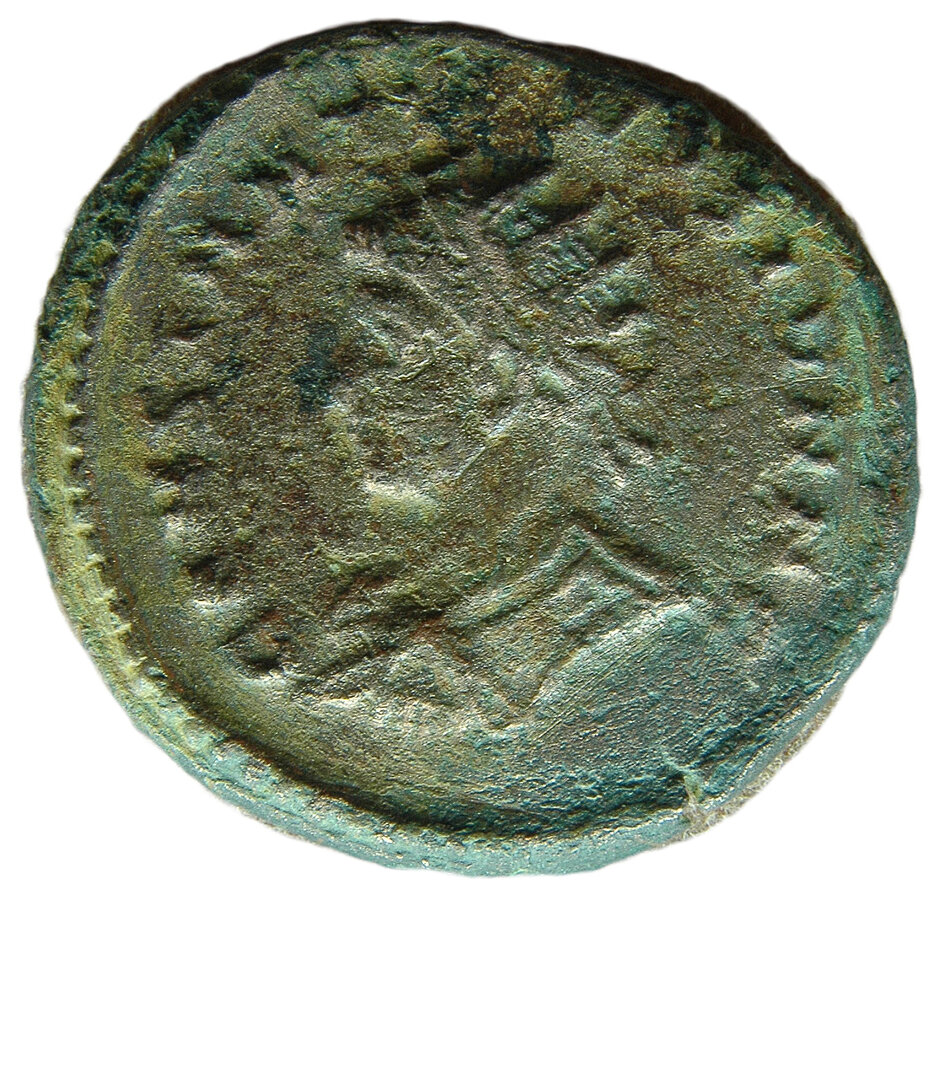
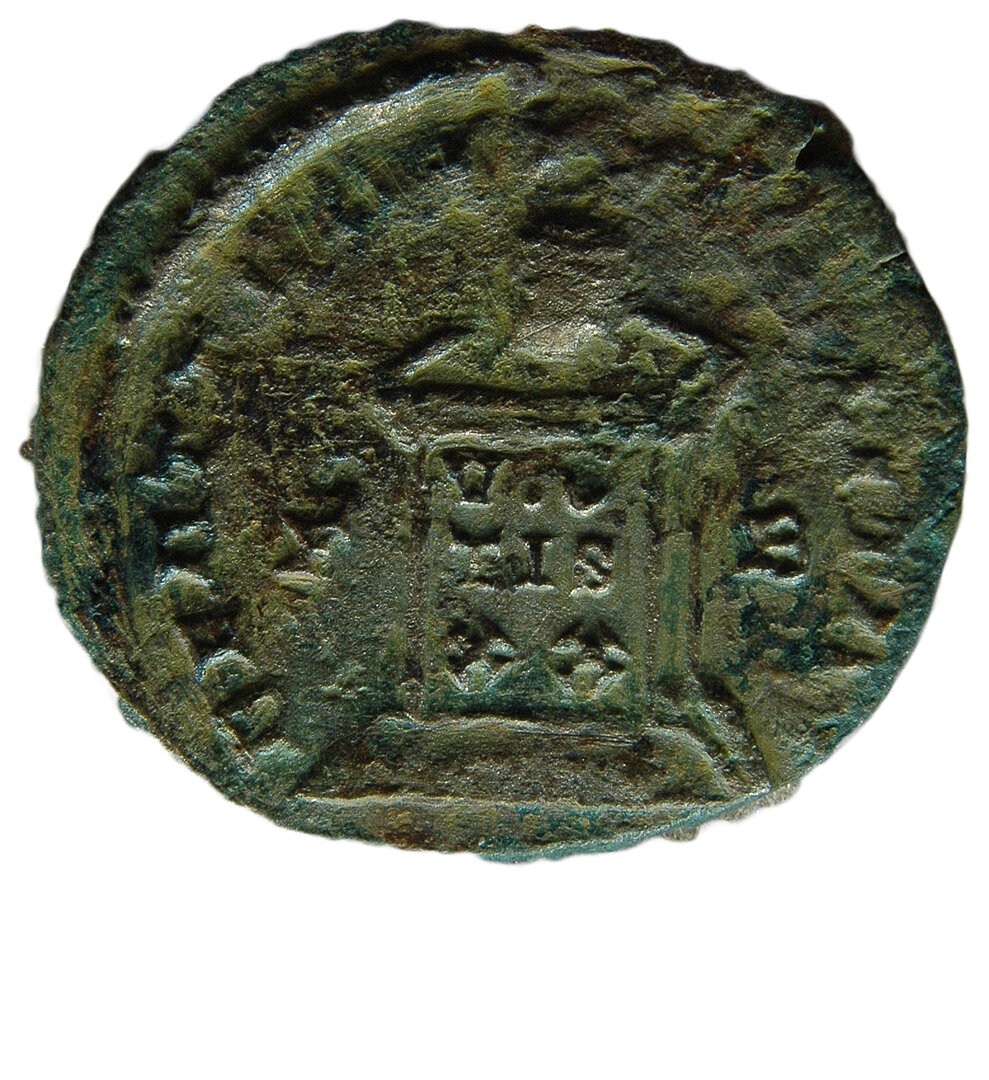
27
Inventory Number 507
Context Area B, room B5, DSU29 (FN4)
Material AE
Diam. 19 mm
Weight 2.8 g
Axis 12h?
Module/Denom. AE3/Nummus
Obv. Imp. bust, L; radiate, draped, cuirassed. Legend: CONSTANTI - NUS IUN N C
Rev. Altar with globe, inscribed VO / TIS / X X (reverse break usually VOT / IS). Three stars above. Legend: BEAT TRA – NQLITAS
Mint London
Mint Mark F/B//[PLON]
Date 322–323
Ref. RIC VII London 255 var
Image ref. to the database OBV: 00507-AG10--3045; REV: 00507-AG10--3046
p. 472
28
Inventory Number 508
Context Area B, room B5, DSU29 (FN5)
Material AE
Diam. 14 mm
Weight 1.0 g
Axis NA
Module/Denom. NA
Condition Illegible (not fully cleaned)
Date ND
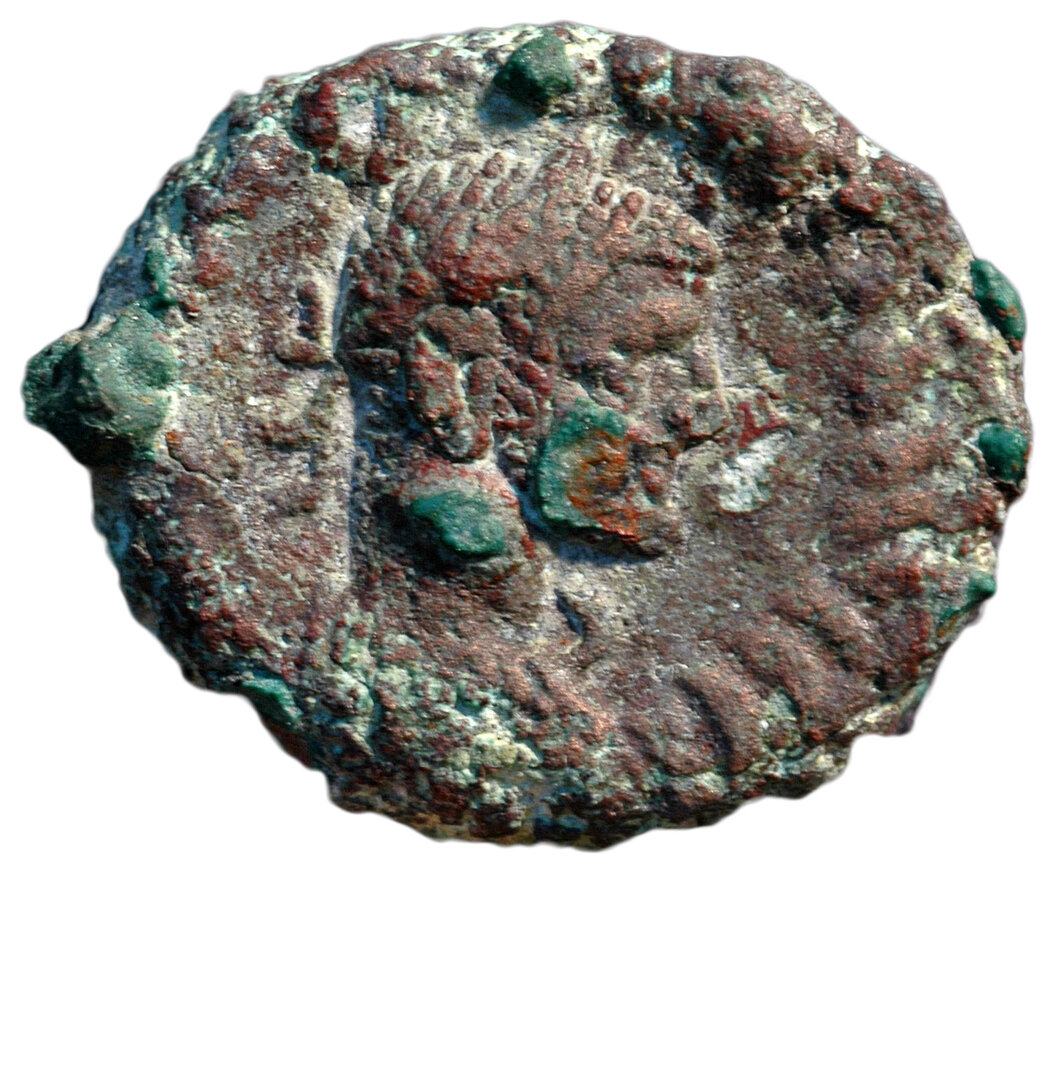
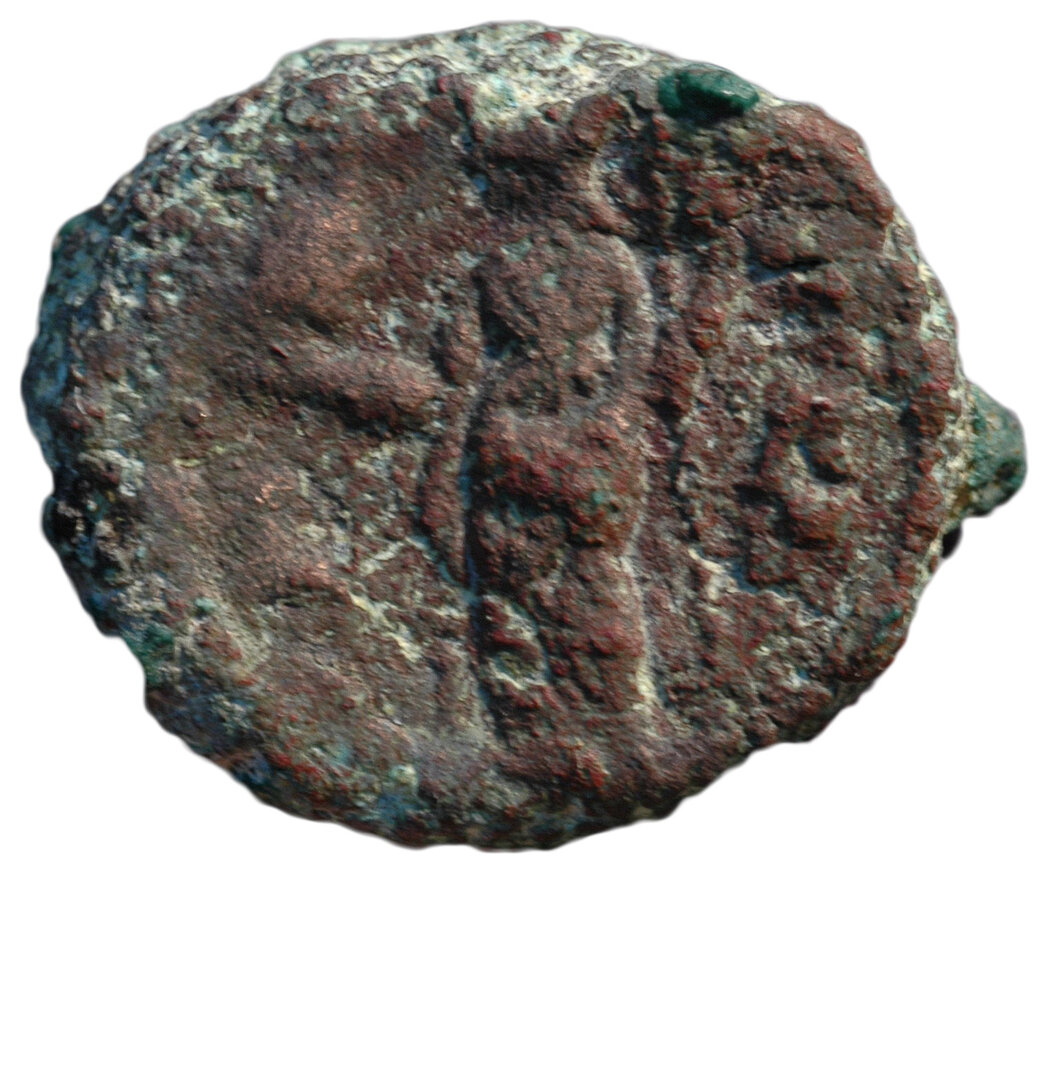
29
Inventory Number 509
Context Area B, room B5, DSU32 (FN6)
Material Bi
Diam. 19 mm
Weight 7.1 g
Axis 12h
Module/Denom. Tetradrachm
Obv. Imp. bust, R; laureate, wreath ties back. Legend: […] IANOC CEB
Rev. Alexandria in mural crown facing L, holding staff or scepter in L hand and head of Serapis in R
Mint Alexandria
Mint Mark LB (= Year 2)
Date 271/272 Aurelian, Year 2
Ref. D. 5435; M. 4355
Date 285/286 Diocletian, Year 2
Ref. D. 5622; M. 4781; G. 3210
Image Ref. to the Database OBV: 0509-AG07--0184; REV: 0509-AG07--0185
p. 473
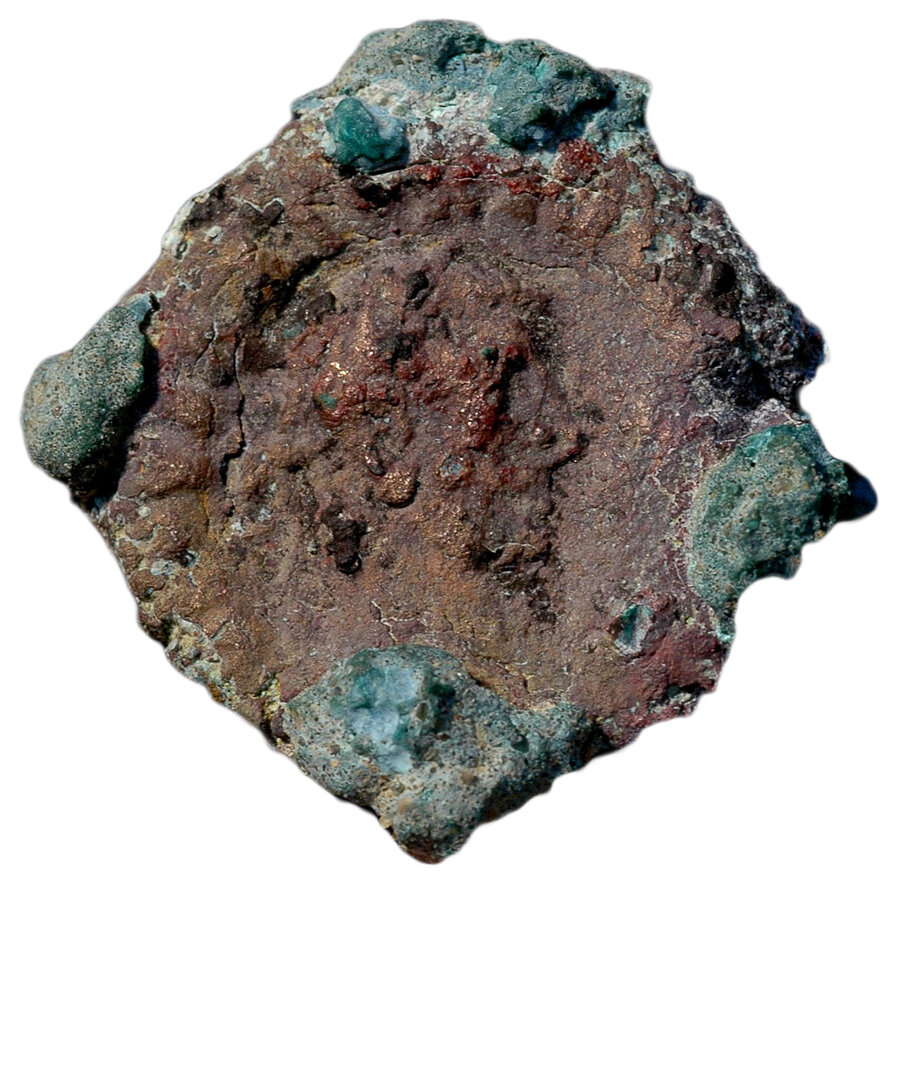
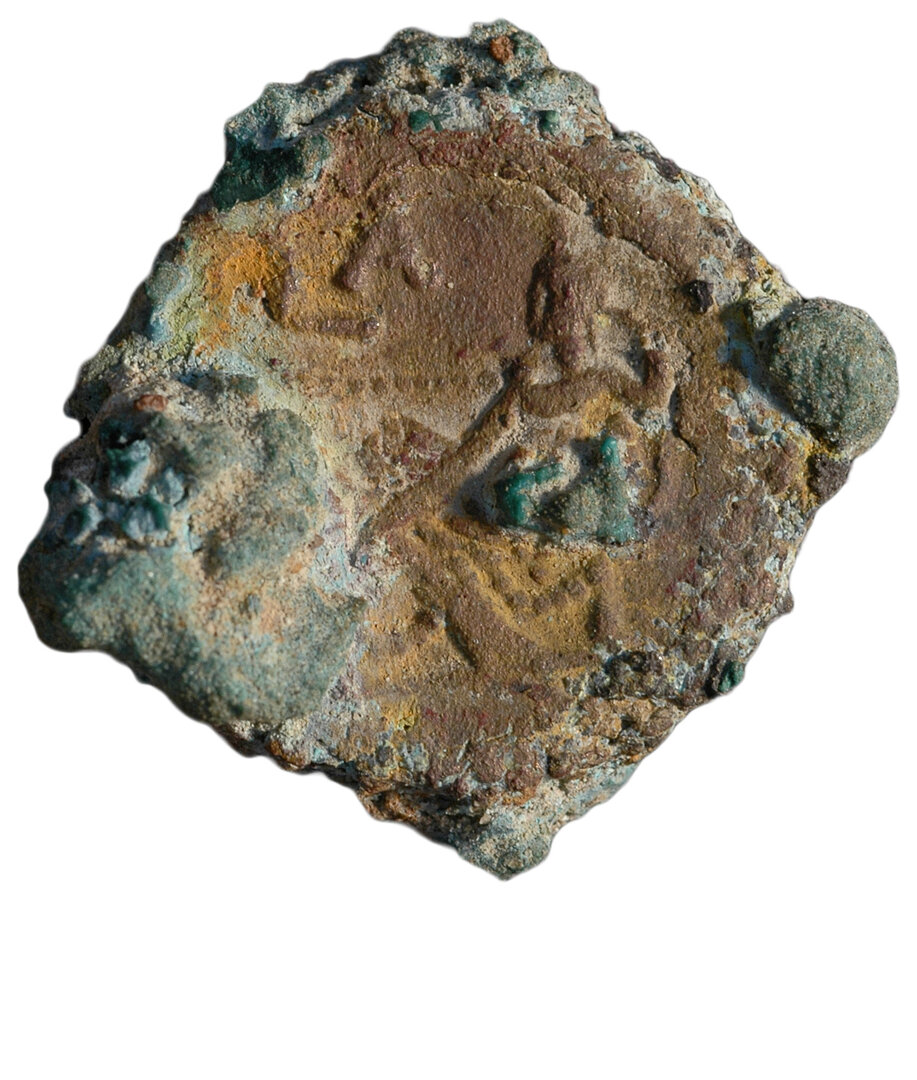
30
Inventory Number 510
Context Area B, room B5, DSU32 (FN7)
Material Bi
Diam. 20 mm
Weight 7.0 g
Axis 12h
Module/Denom. Tetradrachm
Obv. Imp. bust, R; laureate. Legend: A K Γ OΥAΛ ΔIOKΛHT[IANOC CEB]
Rev. Tyche, reclining on a couch; R hand on rudder
Mint Alexandria
Mint Mark LA (= Year 1)
Date 284–285
Ref. D.5766; M.4756; G.3208
Image ref. to the database OBV: 0510-AG07--0149; REV: 0510-AG07--0068
31
Inventory Number 511
Context Area B, room B5, DSU32 (FN8)
Material AE
Diam. 17 mm
Weight 1.8 g
Axis NA
Module/Denom. AE3/Maiorina
Obv. Illegible
Rev. Traces of FTR, FH
Mint NA
Mint Mark illegible
Date 351–361
Ref. NA
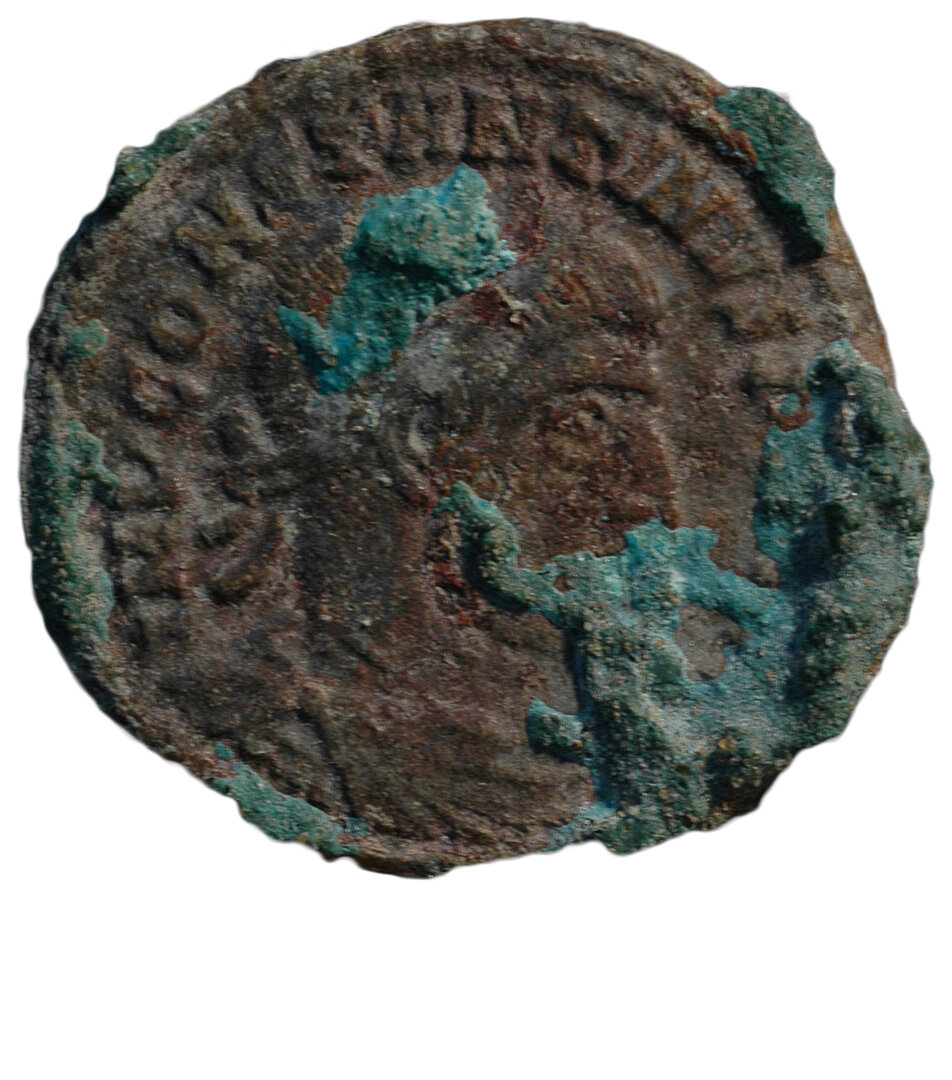
32
Inventory Number 512
Context Area B, room B5, DSU32 (FN9)
Material AE
Diam. 20 mm
Weight 2.9 g
Axis 6h
Module/Denom. AE3/Nummus
Obv. Imp. bust, R; diadem, draped, cuirassed. Legend: IMP CONSTANTINUS P [F AUG]
Rev. Sol, radiate, standing L; chlamys over L arm, R arm upraised with victory, L arm with globe. Legend: SOLI IN - VI - CTO COMITI
Mint Rome
Mint Mark (T in wreath)/-//RQ
Date 318
Ref. RIC VII Rome 136
Image ref. to the database OBV: 0512-AG07--0188; REV: 0512-AG07--0189
p. 474
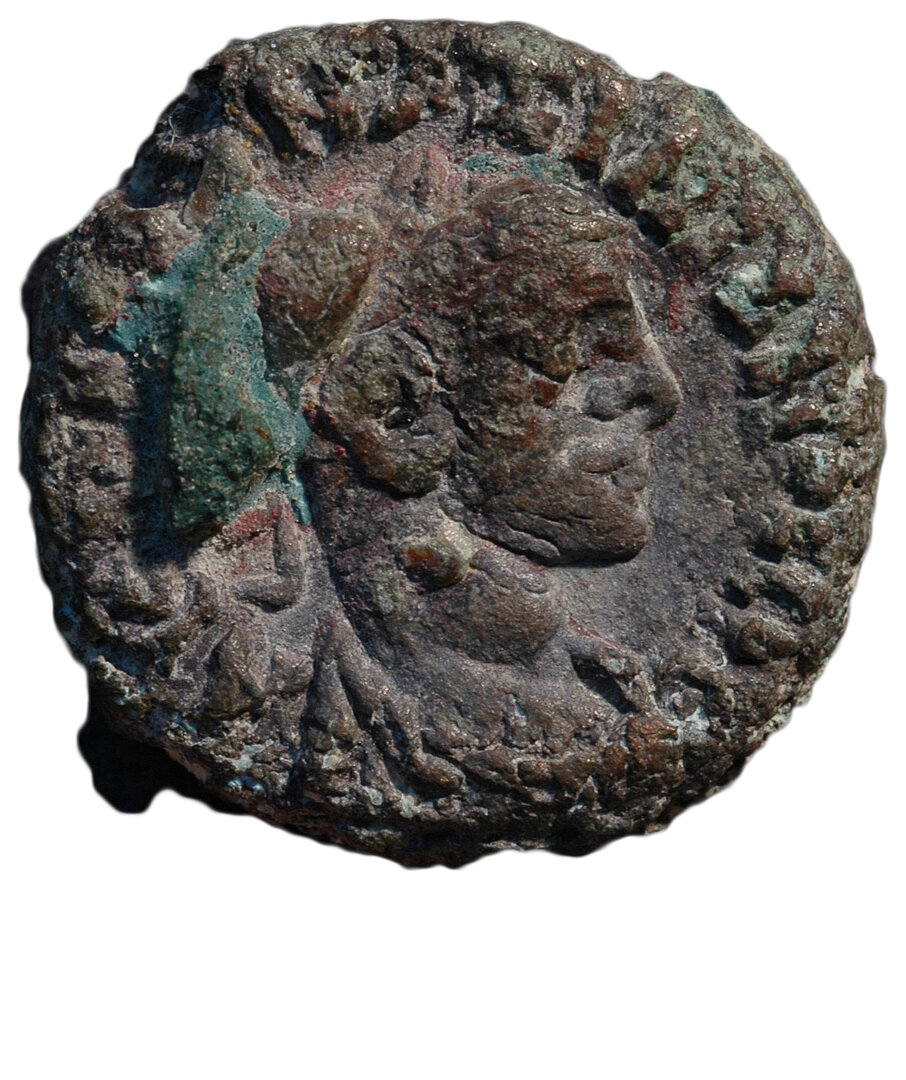
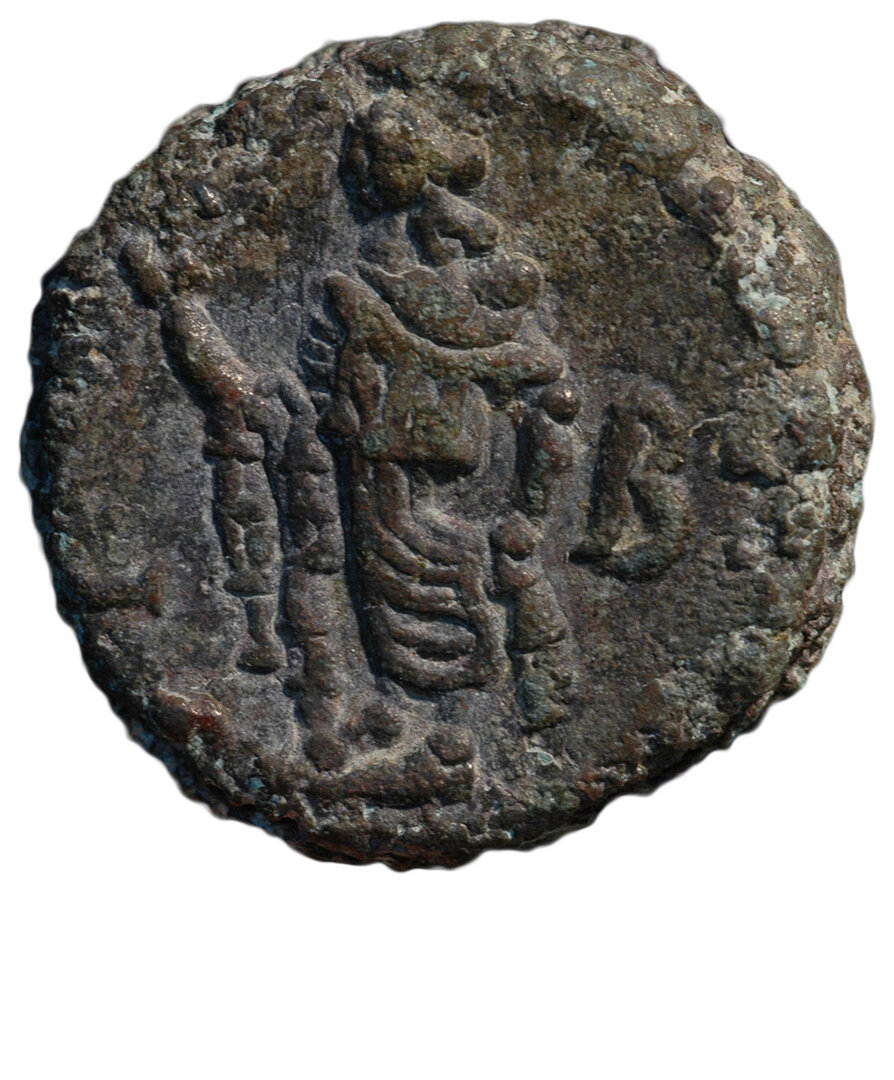
33
Inventory Number 513
Context Area B, room B5, DSU32 (FN10)
Material Bi
Diam. 19 mm
Weight 8.0 g
Axis 12h
Module/Denom. Tetradrachm
Obv. Imp. bust, R; laureate, draped. Legend: A K M A OYA MAΞIMIANOC CEB
Rev. Elpis, standing L; flowers in R hand, L gathering chiton
Mint Alexandria
Mint Mark LB (= Year 2)
Date 286–287 Maximian, Year 2
Ref. M.4814; G.3285
Image Ref. to the Database OBV: 0513-AG07--0190; REV: 0513-AG07--0191
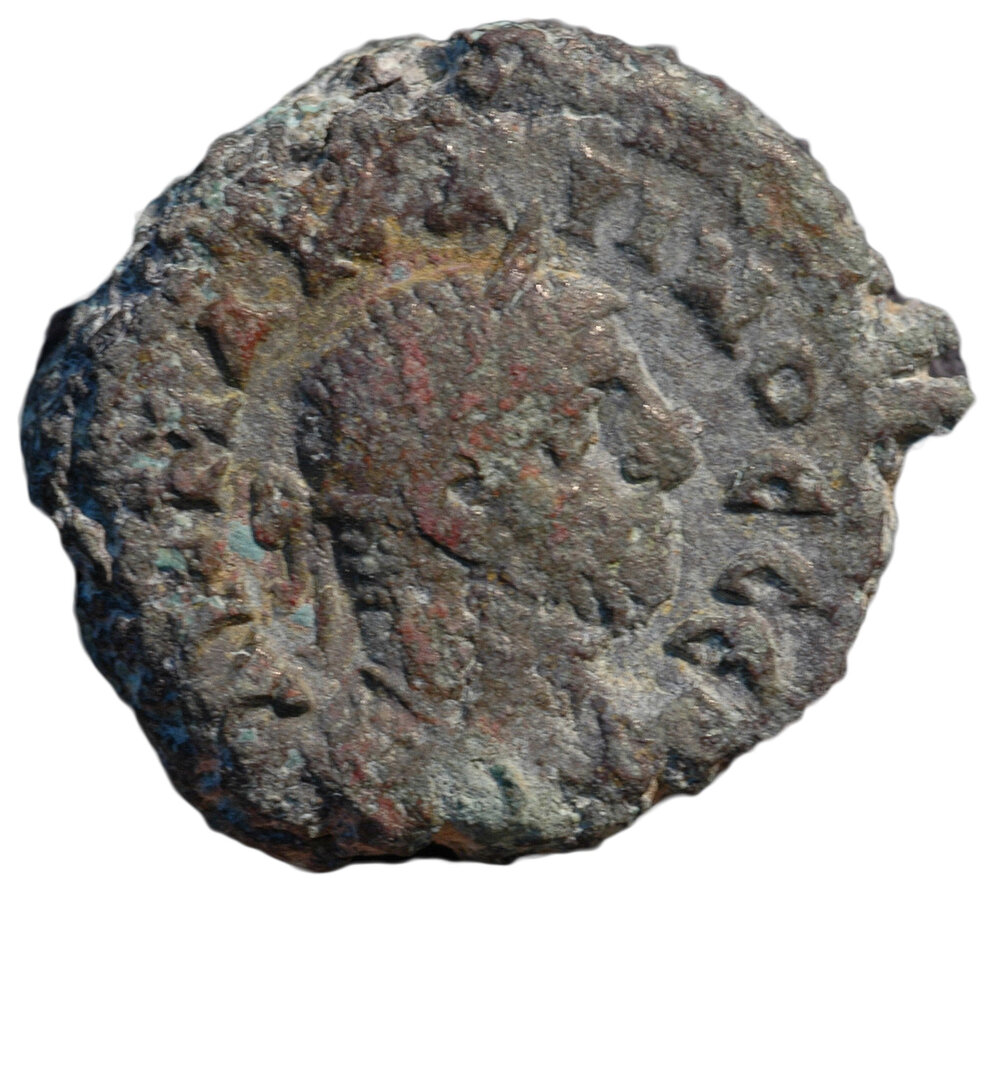
34
Inventory Number 514
Context Area B, room B5, DSU32 (FN11)
Material Bi
Diam. 20 mm
Weight 7.6 g
Axis 12h
Module/Denom. Tetradrachm
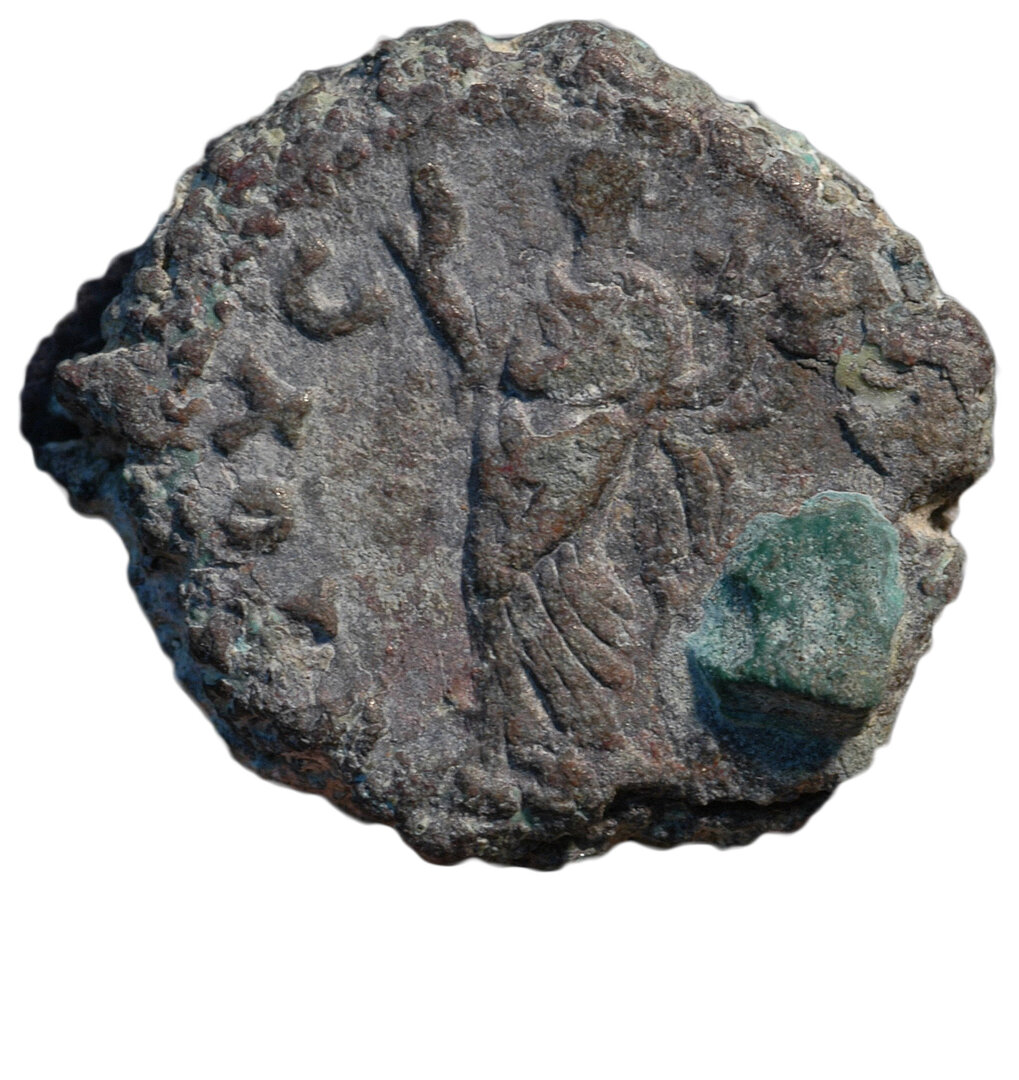
Obv. Imp. bust, R; laureate, draped. Legend: A K M A KA - PINOC CEB
Rev. Homonoia, double cornucopia in L; raising R hand
Mint Alexandria
Mint Mark ETOUC [N]
Date 284–285 Carinus, Year 3
Ref. D.5586; M.4737; G.3185
Image Ref. to the Database OBV: 0514-AG07--0192; REV: 0514-AG07--0193
p. 475
35
Inventory Number 515
Context Area B, room B5, DSU32 (FN12)
Material AE
Diam. 16 mm
Weight 1.0 g
Axis NA
Module/Denom. AE3/AE4
Obv. Imp. bust, R; laureate or diadem; traces of legend
Rev. Perhaps traces of victory adv. L with wreath
Mint NA
Mint Mark illegible
Date Late 4th–5th c.
Ref. NA
36
Inventory Number 516
Context Area B, room B5, DSU32 (FN13)
Material AE
Diam. 20 mm
Weight 1.9 g
Axis 12h
Module/Denom. AE3/Nummus centenionalis?
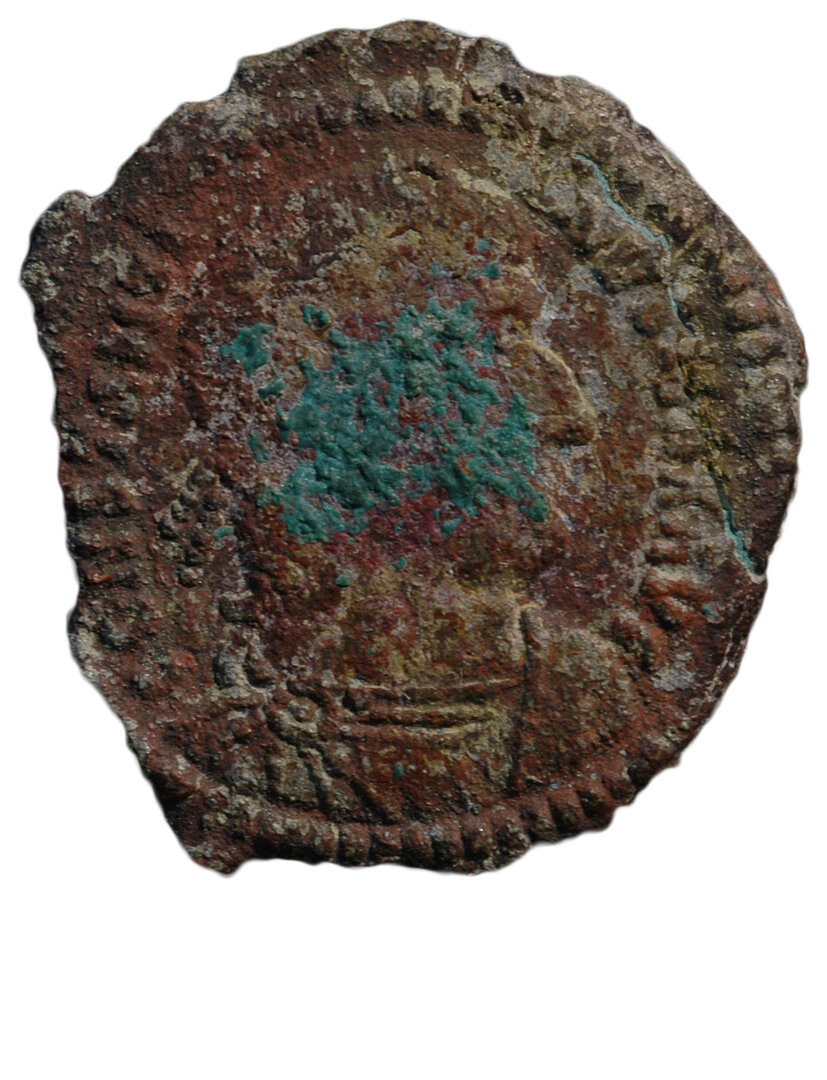
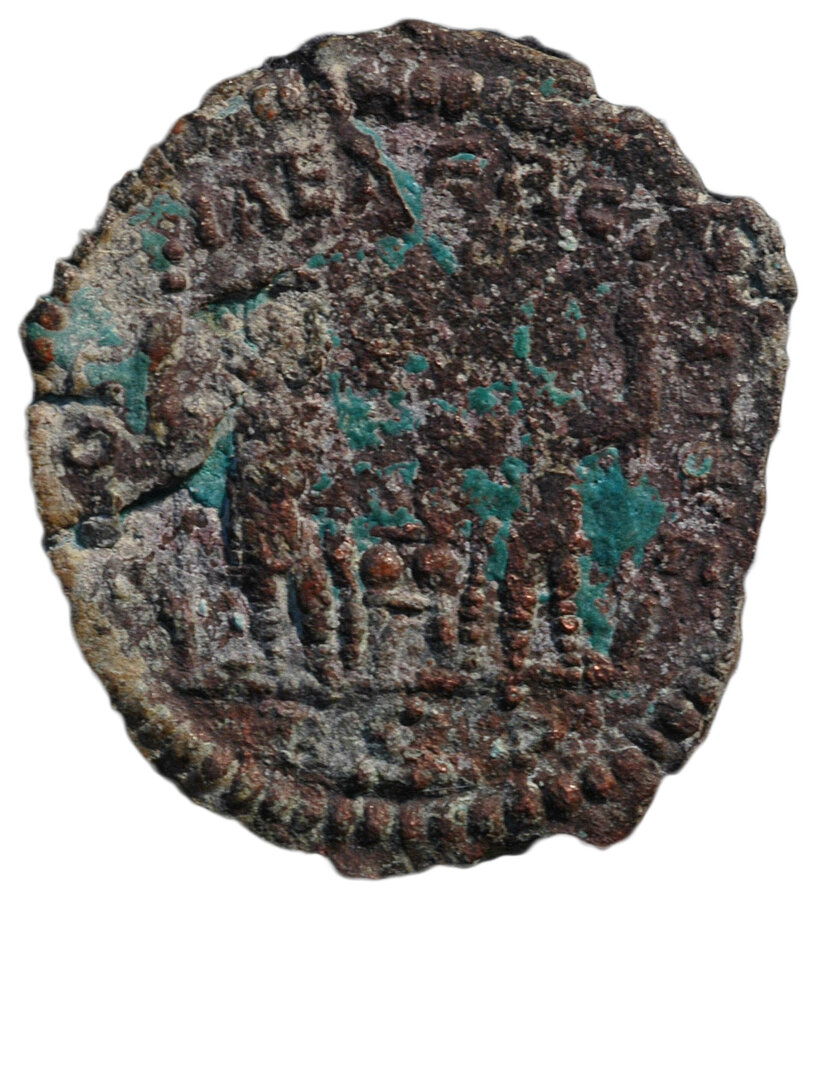
Obv. Imp. bust, R; rosette diadem, draped, cuirassed. Legend: CONSTANTI - NUS MAX AUG
Rev. Two soldiers with shields to ground, two standards between them. Legend: GLOR - IA EXERC -ITUS
Mint Rome
Mint Mark -/-//R(wreath)P
Date 333–335
Ref. RIC VII Rome 350
Image Ref. to the Database OBV: 0516-AG07--0194; REV: 0516-AG07--0196
p. 476
37
Inventory Number 517
Context Area B, room B5, DSU32 (FN14)
Material AE
Diam. 16 mm
Weight 2.1 g
Axis NA
Module/Denom. NA
Condition Illegible (not fully cleaned)
Date ND
38
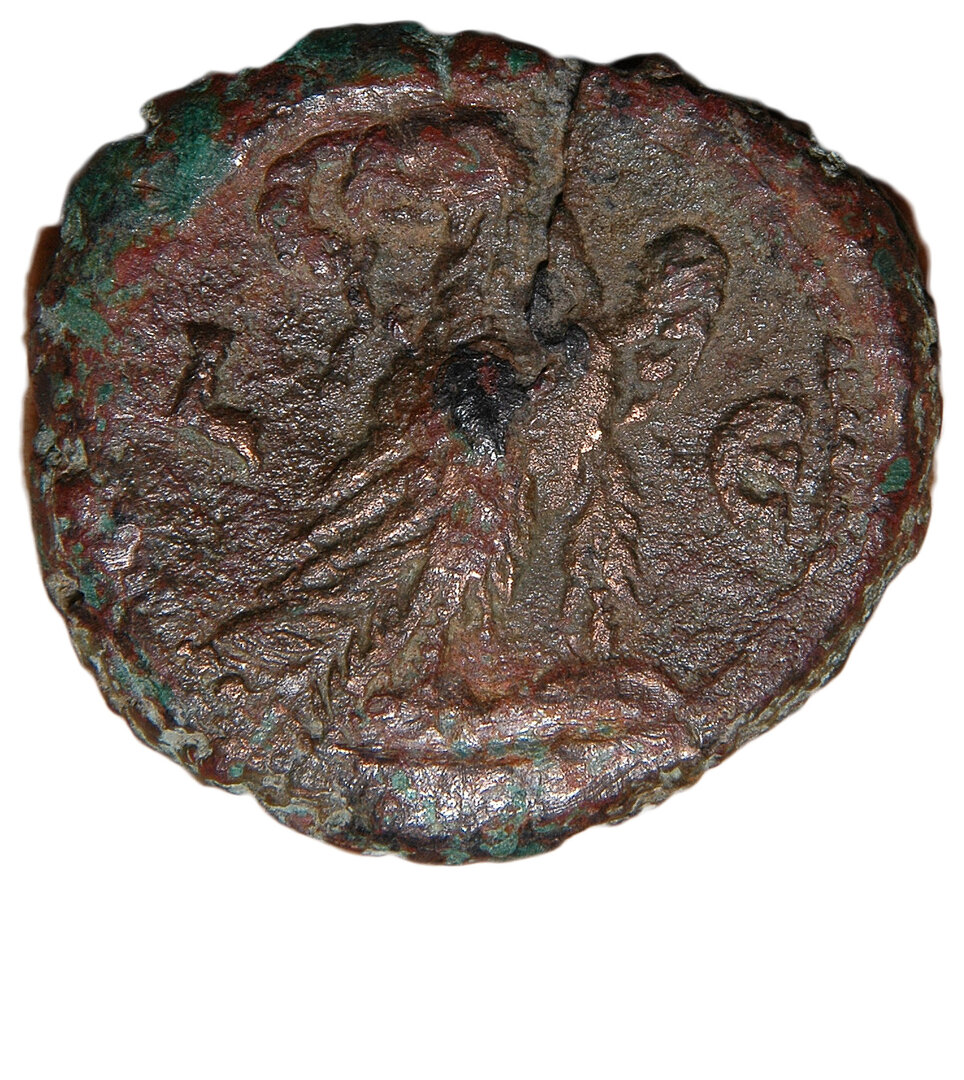
Inventory Number 518
Context Area B, room B5, DSU32 (FN15)
Material Bi
Diam. 21 mm
Weight 7.4 g
Axis 12h
Module/Denom. tetradrachm
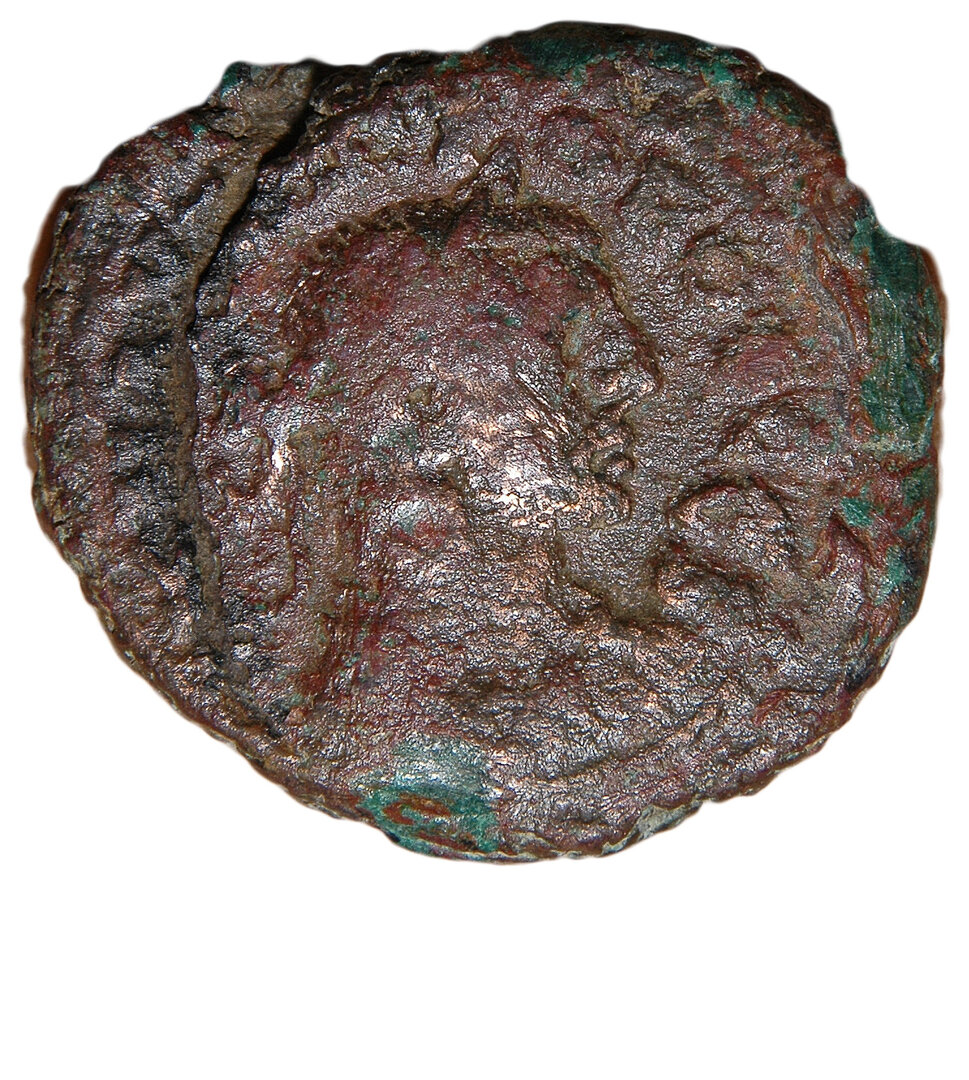
Obv. Imp. bust, R; laureate, cloaked, cuirassed. Legend: AY K M AYP ΠP-OBOC CEB
Rev. Eagle, standing L, head R, with wreath in beak
Mint Alexandria
Mint Mark LE (= Year 5)
Date 279–280 Probus, Year 5
Ref. D.5550; M.4606; G.3144
Image Ref. to the Database OBV: 00518-AG10--3053; REV: 00518-AG10--3054
39
Inventory Number 524
Context Area B, room B5, DSU33
Material AE
Diam. 13 mm
Weight 0.7 g
Axis NA
Module/Denom. AE4
Obv. Trace of imp. bust, R; diadem, perhaps legend on L
Rev. Illegible
Mint NA
Mint Mark illegible
Date Late 4th–5th c.
Ref. NA
40
Inventory Number 525
Context area B, room B5, DSU33
Material AE
Diam. 13 mm
Weight 0.9 g
Axis NA
Module/Denom. AE4
Condition Illegible
Date ND
p. 477
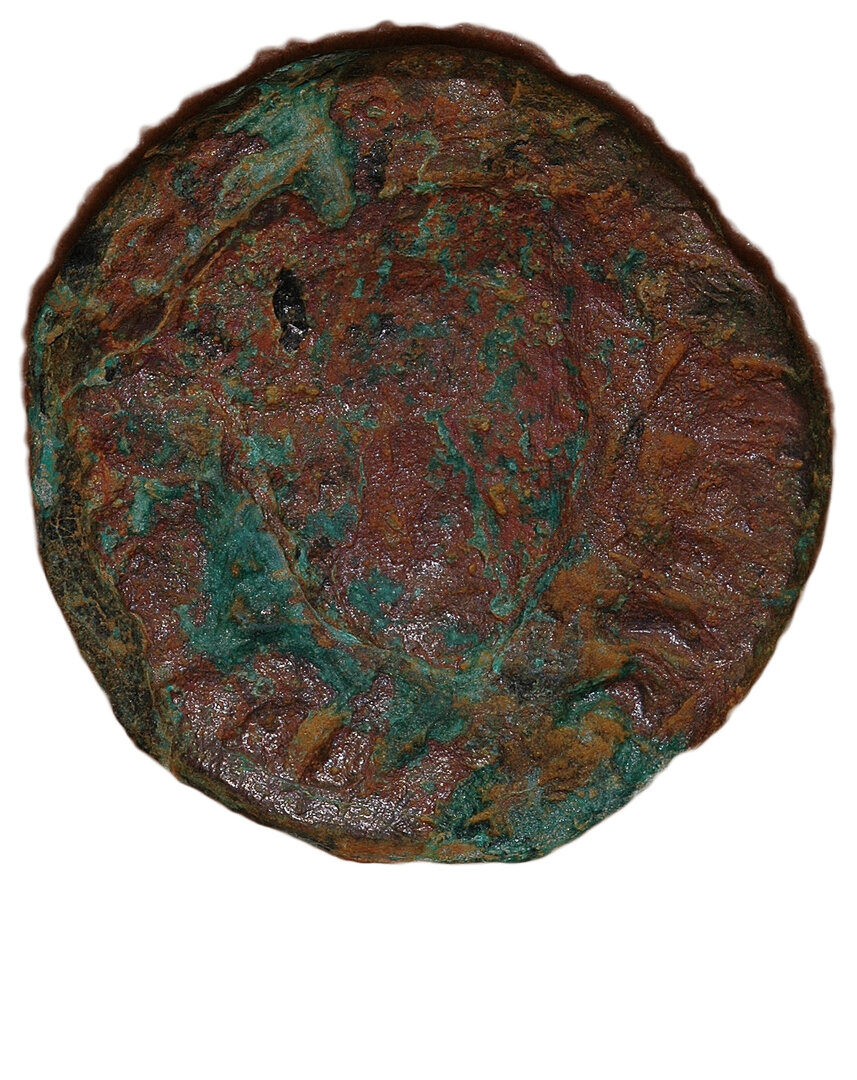
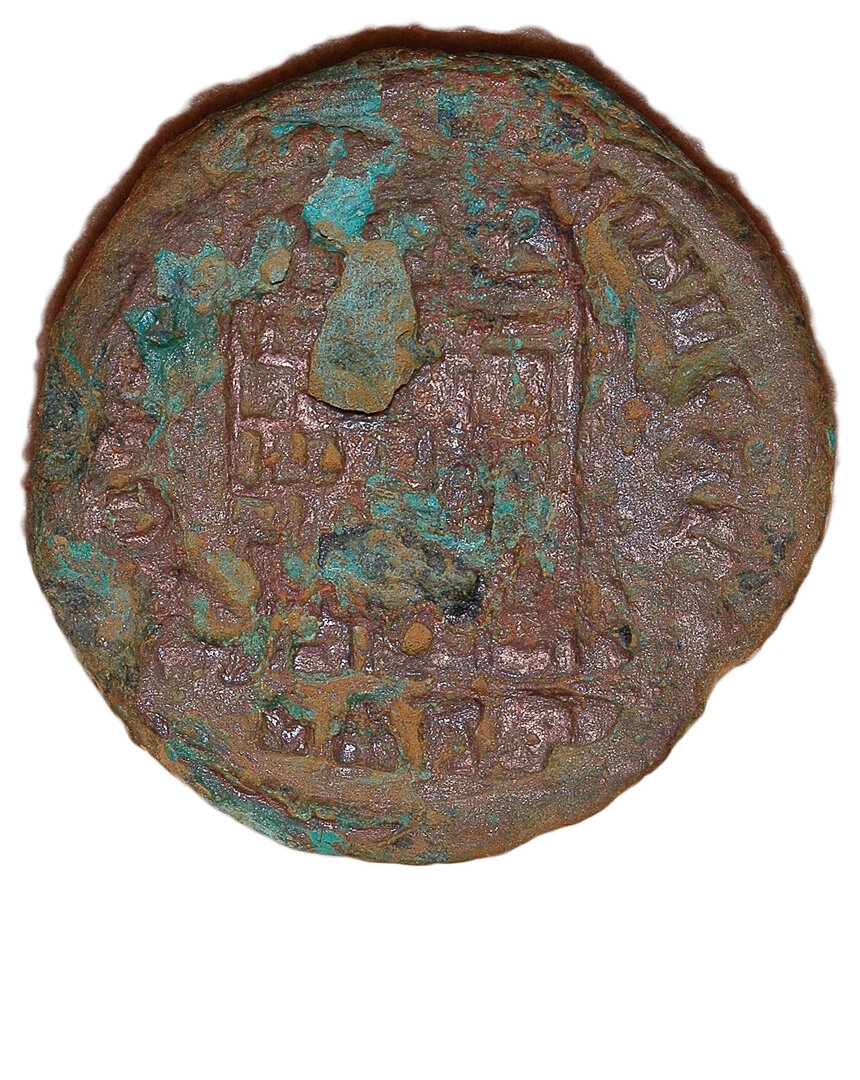
41
Inventory Number 550
Context Area B, room B5, DSU35 (FN21)
Material AE
Diam. 20 mm
Weight 2.2 g
Axis 6h
Module/Denom. AE3/Nummus
Obv. Traces of imp. bust. Legend: D N [ … ] NOB C or perhaps CAES
Rev. Camp gate, three turrets. Legend: PRO[VIDEN]-TIAE CAES[S]
Mint Heraclea
Mint Mark -/-//MHT . ?
Date 317
Ref. RIC VII Heraclea 18–27
42
Inventory Number 519
Context Area B, room B5, DSU41 (FN16)
Material AE
Diam. 13 mm
Weight 1.5 g
Axis NA
Module/Denom. AE4
Condition Illegible
Date ND
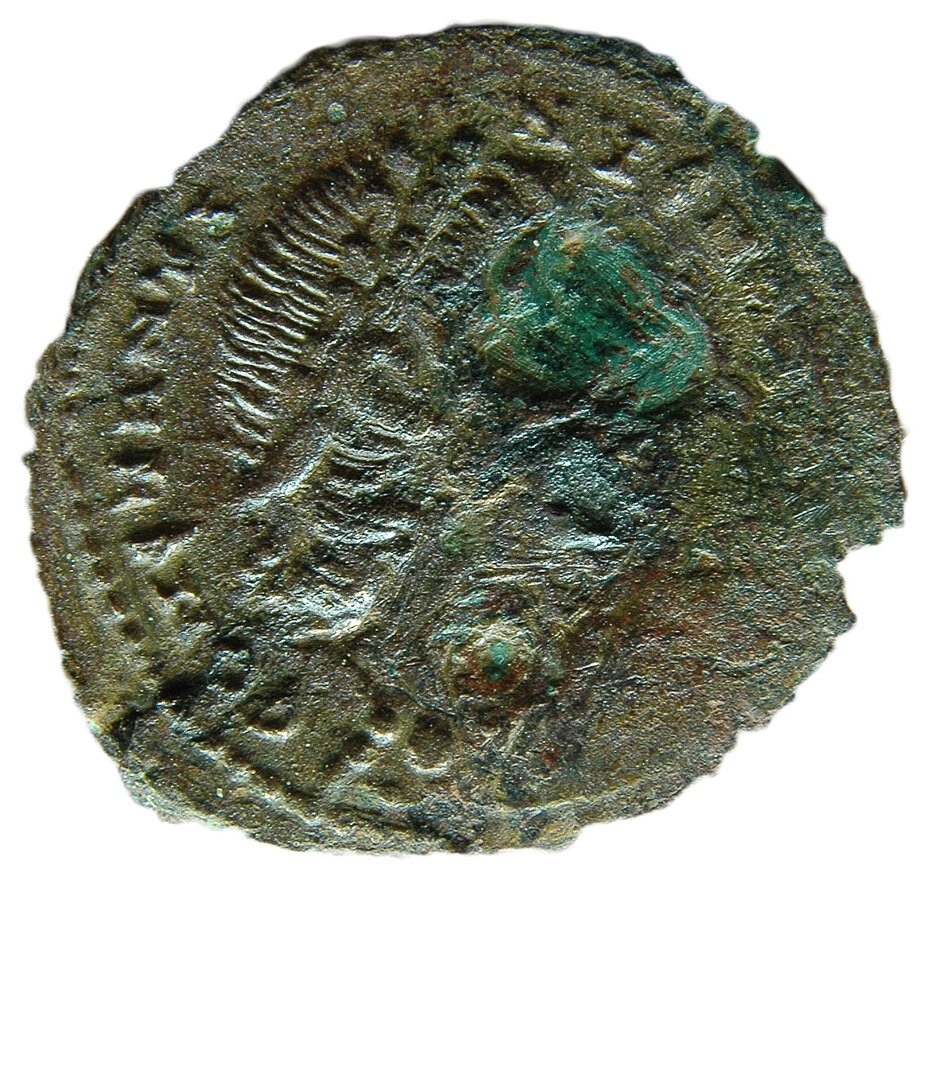
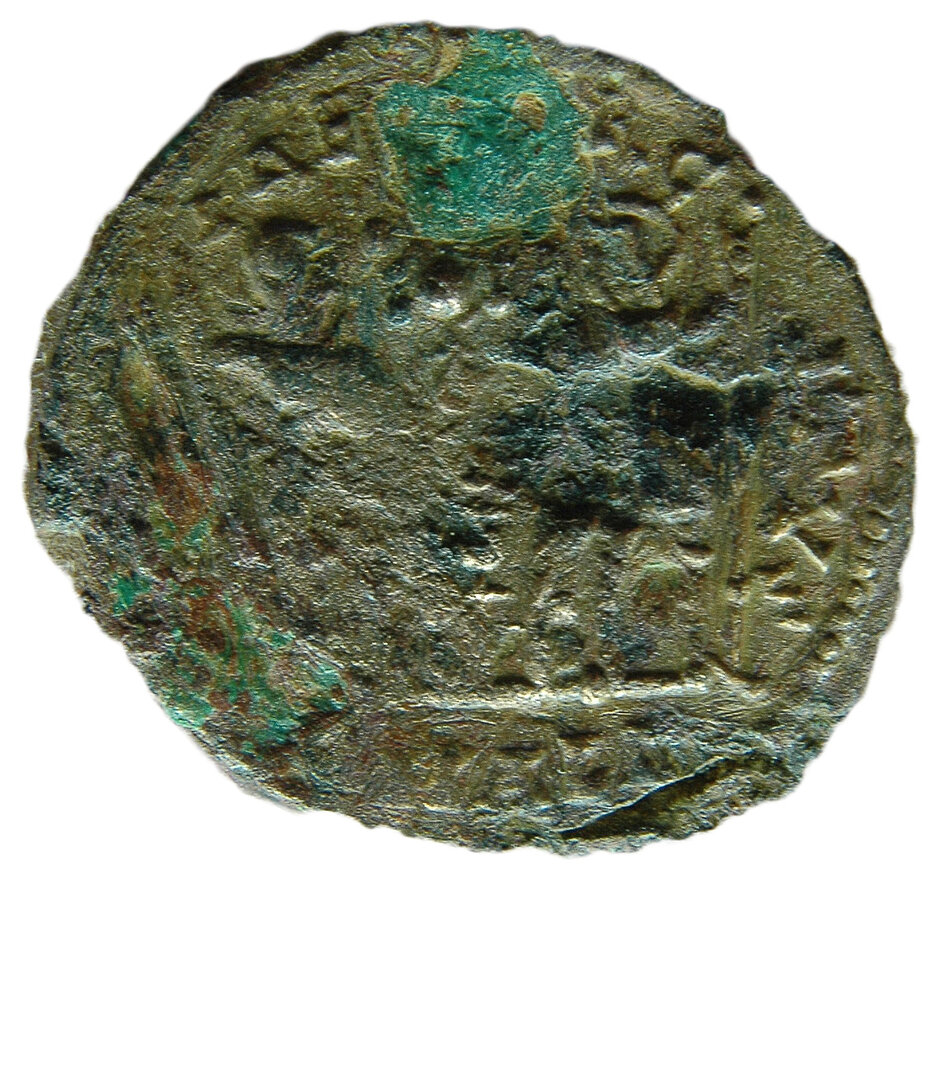
43
Inventory Number 566
Context Area B, Room B5, DSU43 (FN28)
Material AE
Diam. 16 mm
Weight 1.1 g
Axis 12h
Module/Denom. AE3/Nummus centenionalis?
Obv. Imp. bust, R; roseate diadem, draped, cuirassed. Legend: CONSTANTI - NUS MAX [AUG]
Rev. GE type with two soldiers with one standard. Legend: [GLOR]-IA E[XE]RC – ITUS
Mint Alexandria
Mint Mark -/-//SMALA or -/-//SMALΔ
Date 335–337
Ref. RIC VII Alexandria 65
Image Ref. to the Database OBV: 00566-AG10--3031; REV: 00566-AG10--3032
p. 478
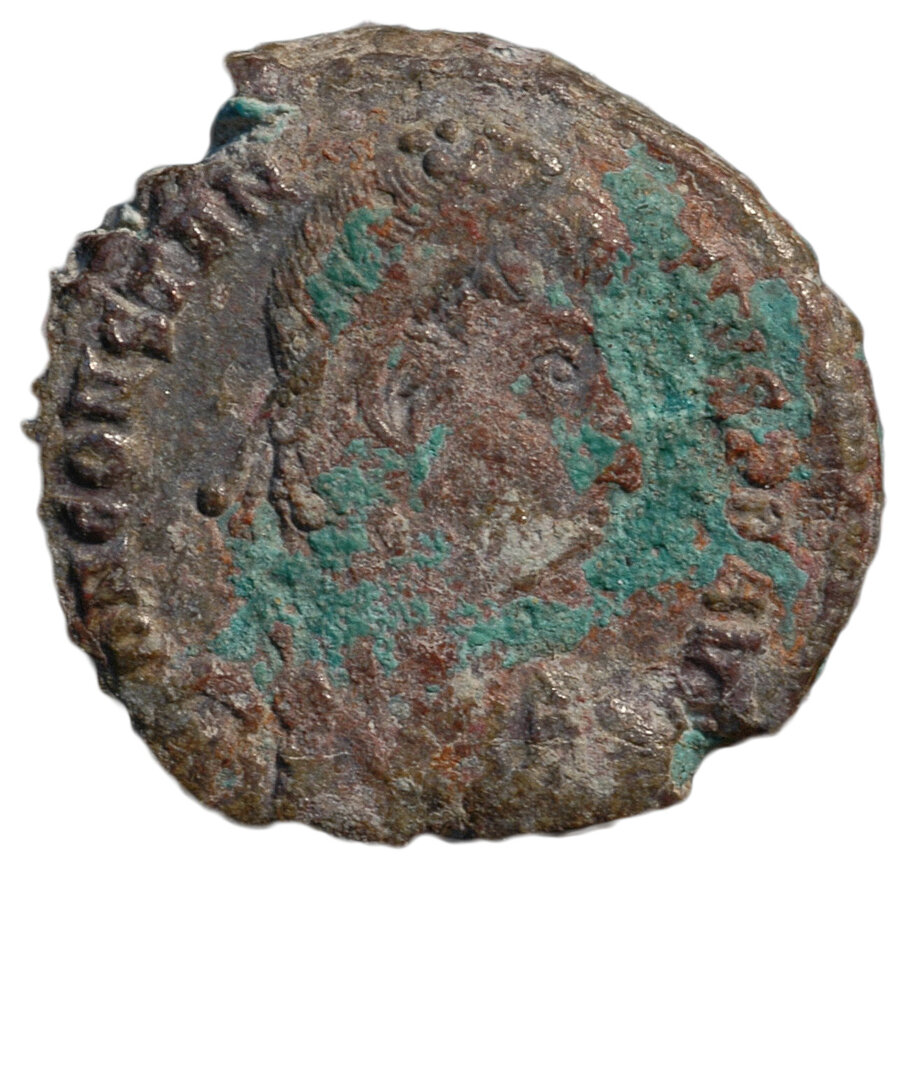
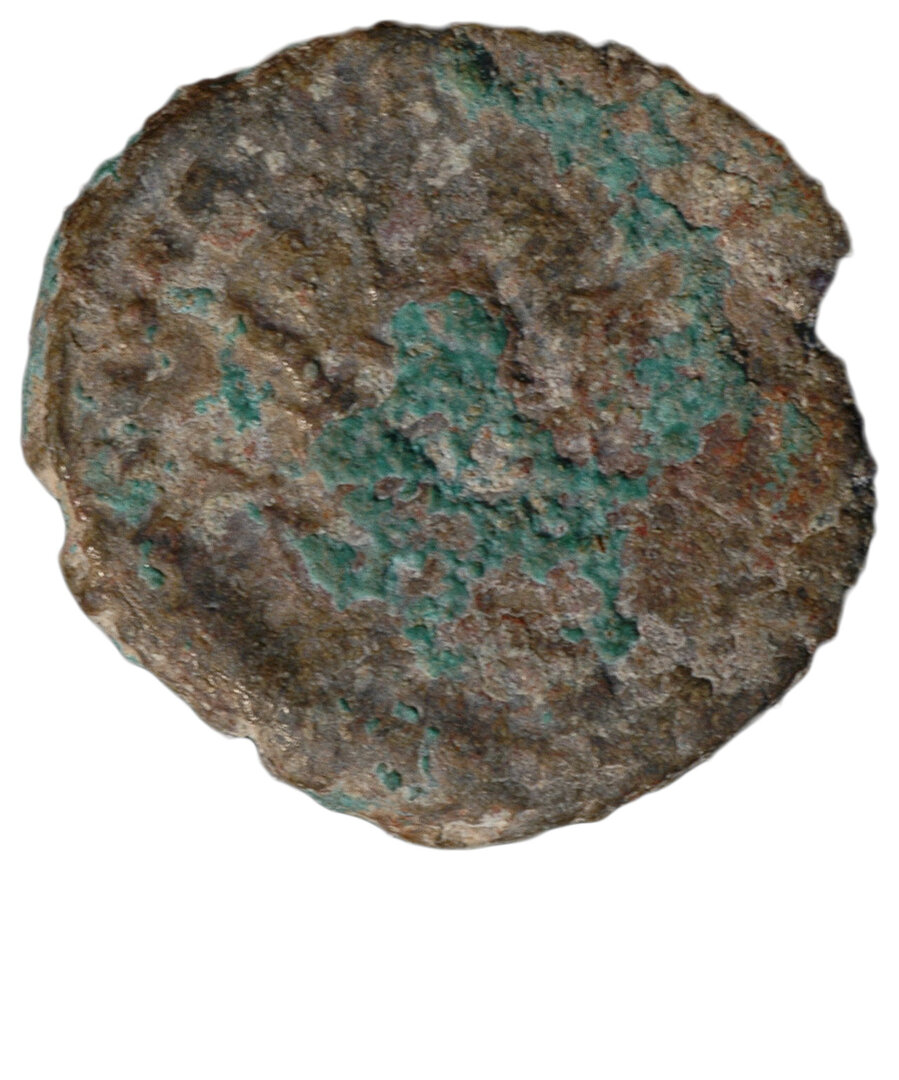
44
Inventory Number 561
Context Area B, room B6, DSU59 (FN24)
Material AE
Diam. 17 mm
Weight 2.5 g
Axis 6h
Module/Denom. AE3/Maiorina
Obv. Imp. bust, R; pearl diadem, draped, cuirassed. Legend: D N CONSTAN - TIUS P F AU[G]
Rev. Traces of FTR, FH. Legend: [FEL TEMP RE-PAR]ATIO
Mint NA
Mint Mark illegible
Date 351–361
Ref. NA
Image Ref. to the Database OBV: 0561-AG07--0215; REV: 0561-AG07--0216
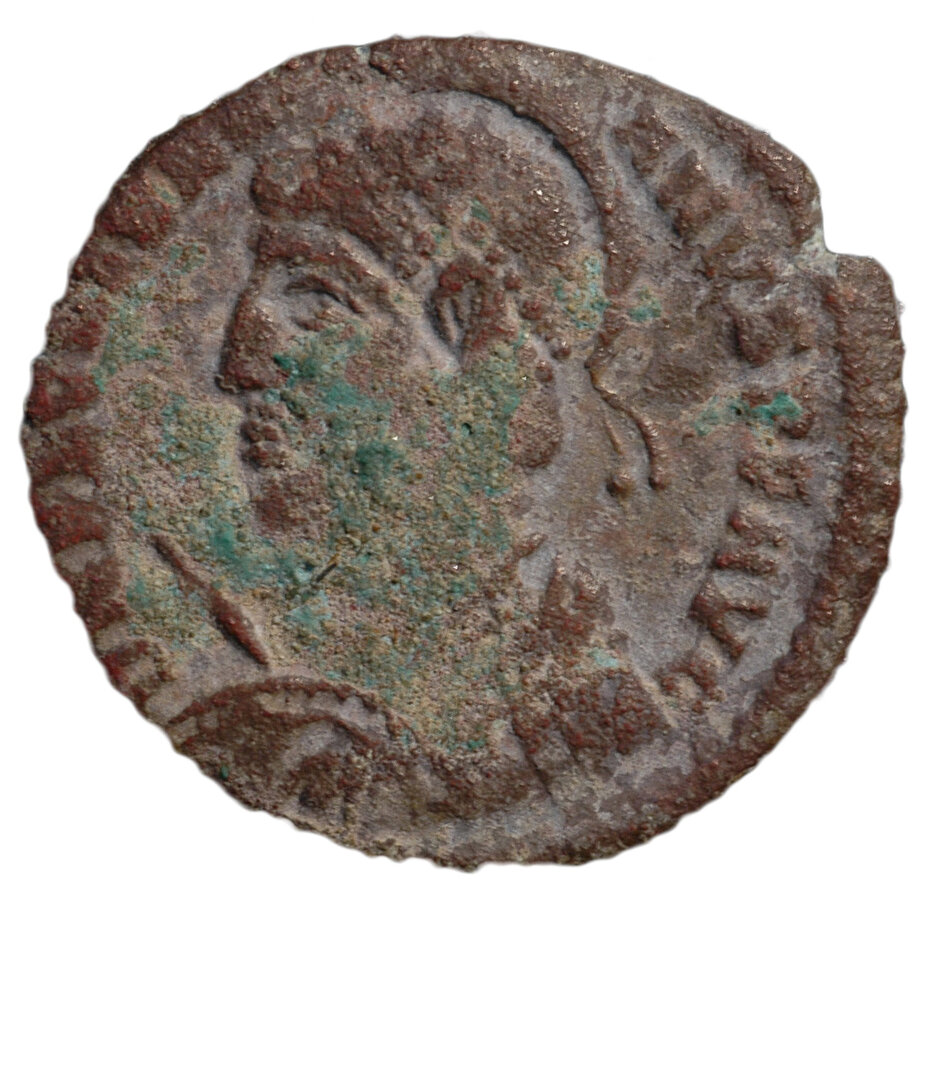
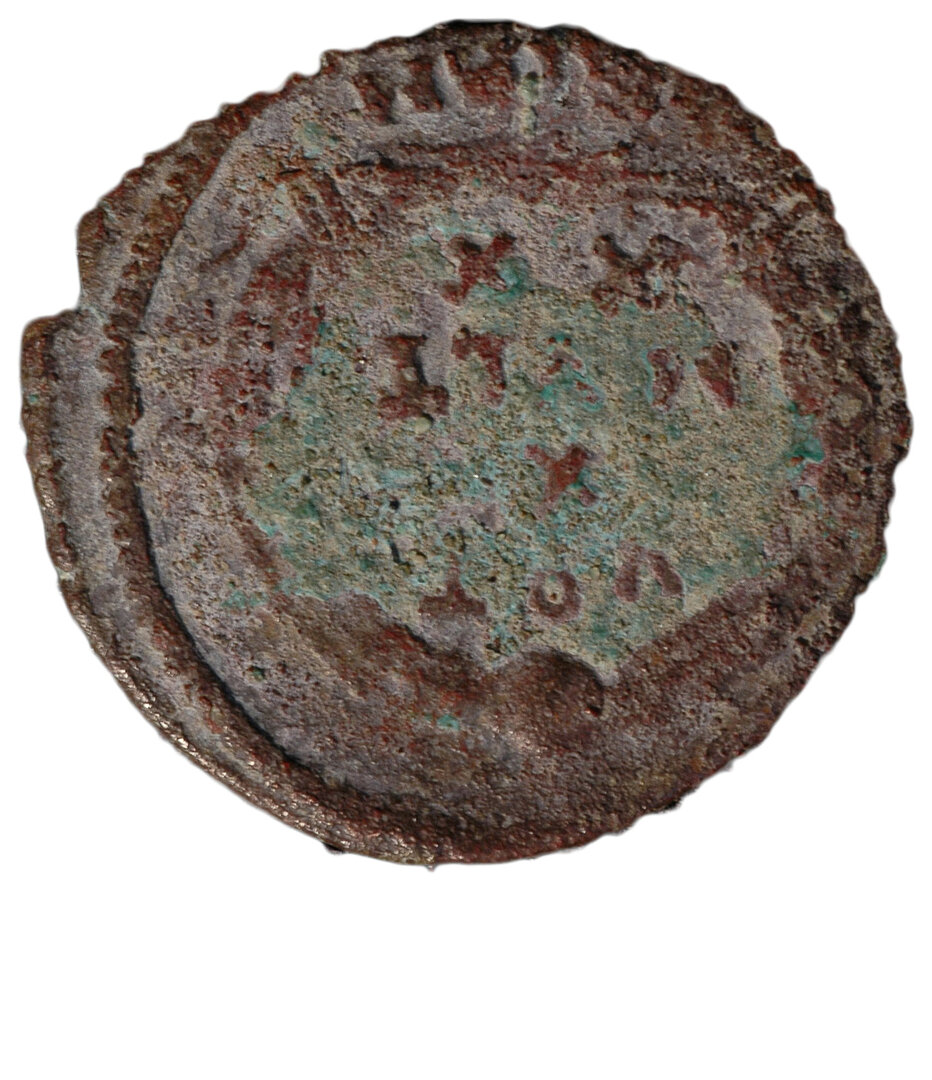
45
Inventory Number 563
Context Area B, room B6, FSU83 (FN26)
Material AE
Diam. 19 mm
Weight 2.0 g
Axis 6h
Module/Denom. AE3/Centenionalis?
Obv. Imp. bust, L; pearl diadem; helmeted, cuirassed, spear in R hand, shield in L hand. Legend: D N FL CL IULI - ANUS P F AUG
Rev. Votive wreath inscribed: VOT / X / MULT / X X
Mint Sirmium
Mint Mark -/-//ẠSIRM
Date 361–363
Ref. RIC VIII Sirmium 108
Image Ref. to the Database OBV: 0563-AG07--0219; REV: 0563-AG07--0221
p. 479
46
Inventory Number 549
Context Area B, room B8, DSU44
Material AE
Diam. 15 mm
Weight 1.7 g
Axis 12h?
Module/Denom. AE3/Centenionalis?
Obv. Imp. bust, R; diadem. Legend: … P F AUG
Rev. Victory with wreath, adv. L. Traces of legend, compatible with SecReip
Mint NA
Mint Mark illegible
Date 364–378
Ref. NA
Image Ref. to the Database OBV: 0549-AG07--0213; REV: 0549-AG07--0214
47
Inventory Number 580
Context Area B, room B9, DSU79 (FN40)
Material AE
Diam. 16 mm
Weight 2.1 g
Axis NA
Module/Denom. AE3/Maiorina?
Obv. Illegible
Rev. Traces suggestive of FTR, FH
Mint NA
Mint Mark illegible
Date 4th c.
Ref. NA
48
Inventory Number 589
Context Area B, room B10, DSU76 (FN31)
Material AE
Diam. 17 mm
Weight 2.2 g
Axis 3h?
Module/Denom. AE3/Maiorina
Obv. Imp. bust, R; cuirassed, draped, diadem. Legend: D N CONSTAN – [TIUS P F AUG]
Rev. FTR, FH. Legend: FEL TEMP [REPARATIO]
Mint NA
Mint Mark illegible
Date 351–361
Ref. NA
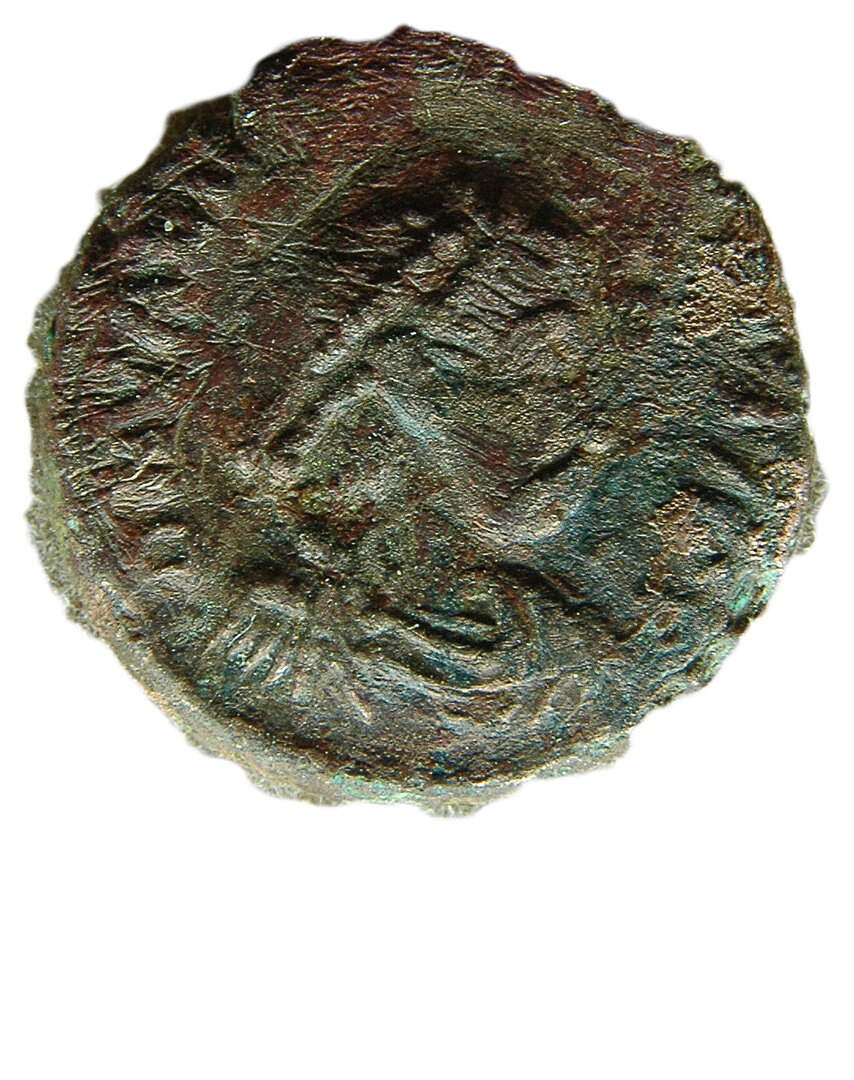
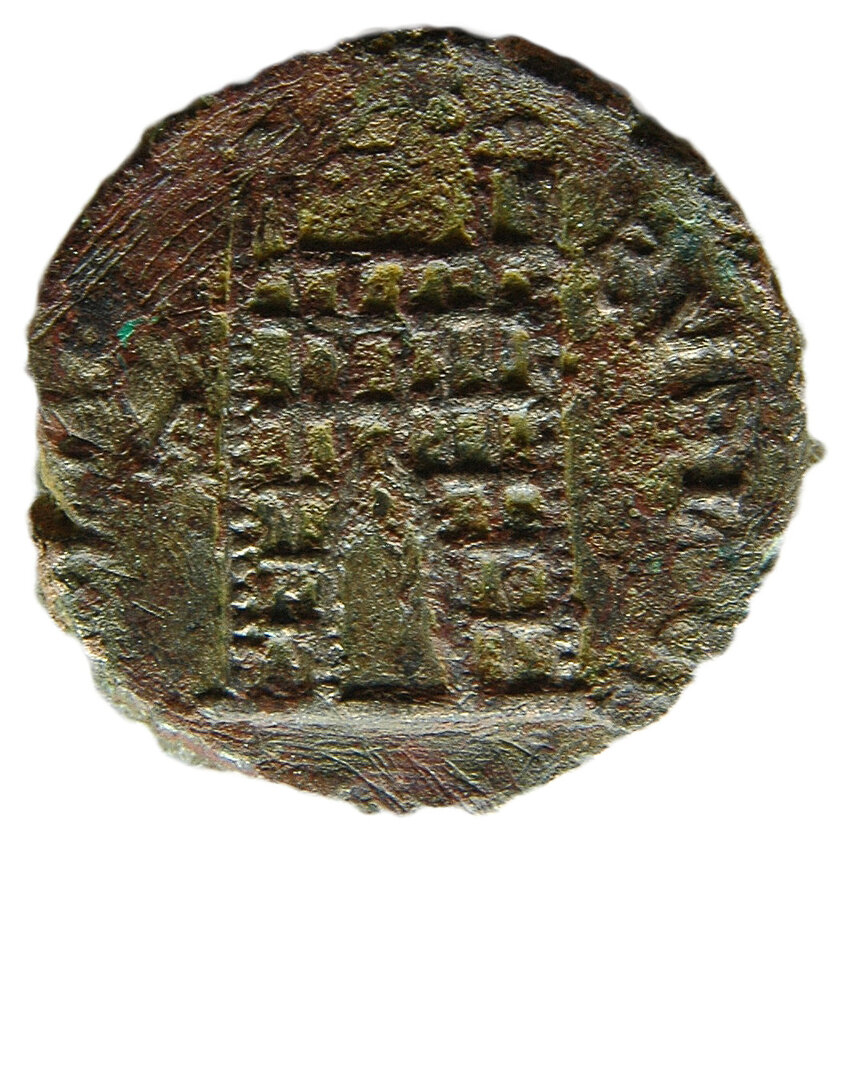
49
Inventory Number 667
Context Area B, room B11, DSU90 (FN14)
Material AE
Diam. 12 mm
Weight 1.0 g
Axis NA
Module/Denom. AE4/Fraction of a centenionalis?
Obv. Imp. bust, R; cuirassed, draped, pearl diadem. Legend: D N VALE[NTINIANUS P F] AUG
Rev. Camp gate, two turrets. Legend: GLORIA [REI] - PVBLICE
Mint Thessalonica
Mint Mark A/-//[TES]
Date 383–392
Ref. RIC IX Thessalonica 62(a).2
Image Ref. to the Database OBV: 00667-AG10--3019; REV: 00667-AG10--3020
p. 480
50
Inventory Number 674
Context Area B, room B11, DSU90 (FN22)
Material AE
Diam. 12 mm
Weight 0.6 g
Axis NA
Module/Denom. NA
Condition Interesting but illegible traces
Date ND
Image Ref. to the Database OBV: 00674-AG10--3012; REV: 00674-AG10--3011
51
Inventory Number 675
Context Area B, room B11, DSU90 (FN23)
Material AE
Diam. 13 mm
Weight 0.7 g
Axis NA
Module/Denom. AE4
Condition Illegible; fragmentary
Date ND
52
Inventory Number 676
Context Area B, room B11, DSU90 (FN24)
Material AE
Diam. 19 mm
Weight 0.9 g
Axis 12h
Module/Denom. AE3/Centenionalis?
Obv. Imp. bust, R; diadem. Legend: D N VALEN – [S P F AUG]
Rev. Victory adv. L, holding wreath and palm. Legend: [SECURITAS] REIPUBLICAE
Condition fragmentary
Mint NA
Mint Mark illegible
Date 364–378
Ref. NA
Image Ref. to the Database OBV: 0676-AG08--3664; REV: 0676-AG08--3661
p. 481
53
Inventory Number 677
Context Area B, room B11, DSU90 (FN25)
Material AE
Diam. 10 mm
Weight 0.5 g
Axis NA
Module/Denom. AE4
Condition Illegible
Date ND
54
Inventory Number 679
Context Area B, room B11, DSU90 (FN27)
Material AE
Diam. 12 mm
Weight 1.8 g
Axis NA
Module/Denom. AE4
Condition Illegible (not fully cleaned)
Date ND
55
Inventory Number 682
Context Area B, room B11, DSU90 (FN30)
Material AE
Diam. 14 mm
Weight 1.8 g
Axis NA
Module/Denom. NA
Condition Illegible; fragmentary (not fully cleaned)
Date ND
56
Inventory Number 692
Context Area B, room B11, DSU90 (coin from sieving)
Material AE
Diam. 17 mm
Weight 1.4 g
Axis 6h
Module/Denom. AE3/Nummus centenionalis?
Obv. Imp. bust, R; cuirassed, draped, diadem or laureate. Traces of legend
Rev. Two soldiers stg. with spears and shields, two standards between them. Traces of Gloria Exercitus legend
Mint NA
Mint Mark illegible
Date 330–335
Ref. NA
Image Ref. to the Database OBV: 0692-AG08--3336; REV: 0692-AG08--3339
57
Inventory Number 694
Context Area B, room B11, DSU90 (coin from sieving)
Material AE
Diam. 13 mm
Weight 2.9 g
Axis NA
Module/Denom. AE3
Obv. Imp. bust, R.; cuirassed, draped, diadem. Legend: [ --- ] P F AUG
Rev. Illegible
Mint NA
Mint Mark illegible
Date 4th c.
Ref. NA
p. 482
58
Inventory Number 695
Context Area B, room B11, DSU90 (coin from sieving)
Material AE
Diam. 14 mm
Weight 1.3 g
Axis NA
Module/Denom. NA
Condition Illegible; fragmentary (not fully cleaned)
Date ND
59
Inventory Number 671
Context Area B, room B11, DSU97 (FN19)
Material AE
Diam. 17 mm
Weight 1.6 g
Axis NA
Module/Denom. NA
Condition Illegible (not fully cleaned)
Date ND
60
Inventory Number 673
Context Area B, room B11, DSU97 (FN21)
Material AE
Diam. NA
Weight 1.2 g
Axis NA
Module/Denom. NA
Obv. Traces of imp. bust with diadem
Rev. Illegible traces
Note Not fully cleaned; two fragments; no reliable diameter
Mint NA
Mint Mark illegible
Date 4th c.
Ref. NA
61
Inventory Number 680
Context Area B, room B11, DSU108 (FN28)
Material AE
Diam. 13 mm
Weight 0.7 g
Axis NA
Module/Denom. AE4
Condition Illegible
Date ND
62
Inventory Number 803
Context Area B, room B11, DSU108 (coin from sieving)
Material AE
Diam. 15 mm
Weight 1.8 g
Axis NA
Module/Denom. NA
Condition Illegible (not fully cleaned)
Date ND
p. 483
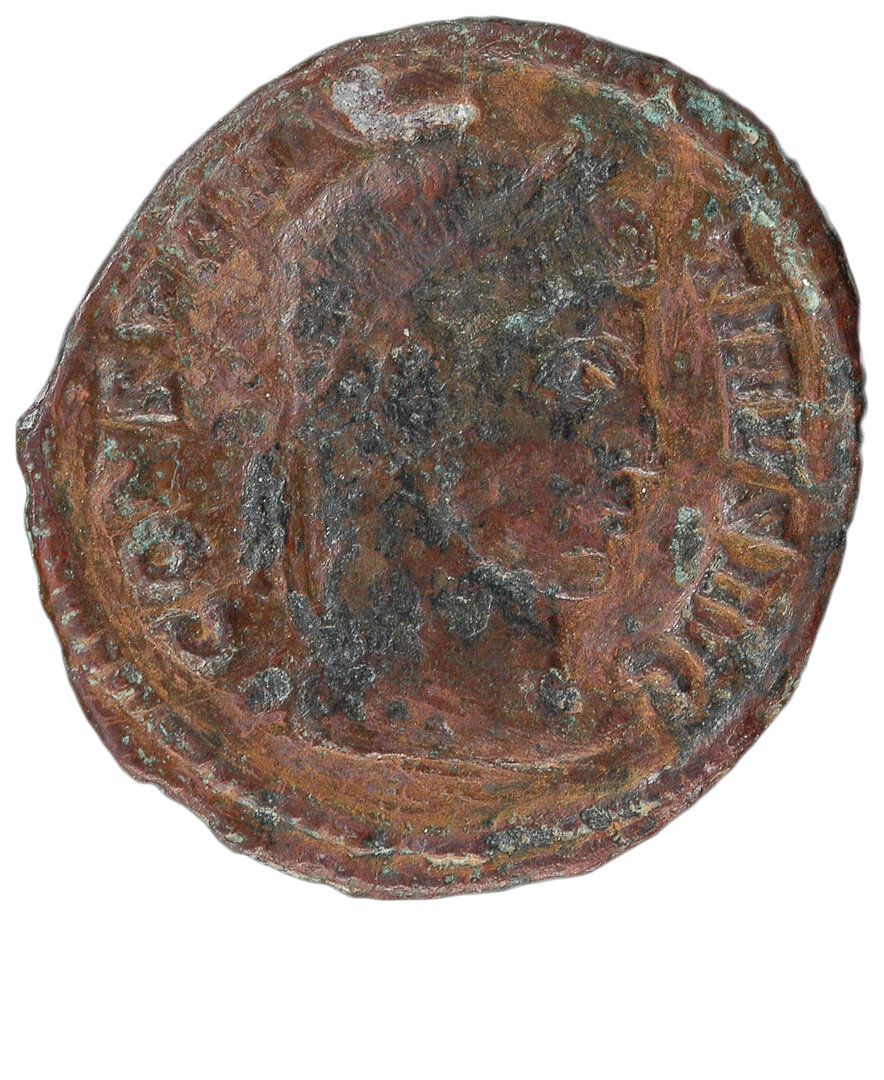
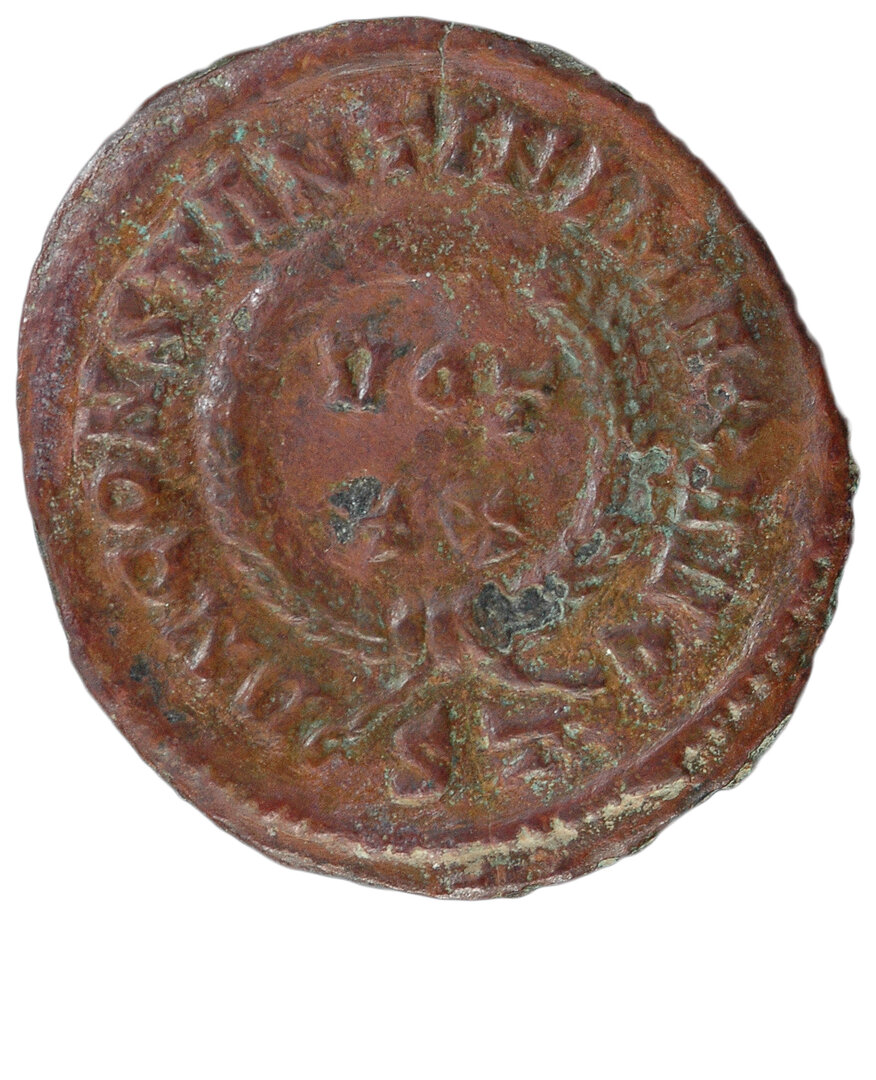
63
Inventory Number 684
Context Area B, roomB11, F141 (FN32)
Material AE
Diam. 20 mm
Weight 1.8 g
Axis 12h
Module/Denom. AE3/Nummus
Obv. Imp. bust, R; laureate. Legend: CONSTAN – TINUS AUG
Rev. Votive wreath inscribed VOT / X X. Legend: D N CONSTANTINI MAX AUG
Mint Ticinum
Mint Mark -/-//ST
Date 320–321
Ref. RIC VII Ticinum 140
Image Ref. to the Database OBV: 0684-AG08--3203; REV: 0684-AG08--3206
64
Inventory Number 652
Context Area B, room B12, DSU91 (FN5)
Material AE
Diam. 15 mm
Weight 1.9 g
Axis NA
Module/Denom. AE3
Condition Illegible
Date ND
65
Inventory Number 653
Context Area B, room B12, DSU91 (FN1)
Material AE
Diam. 17 mm
Weight 2.3 g
Axis 11h?
Module/Denom. AE3
Obv. Imp. bust, R; laureate? Legend: D N CONSTAN – TIUS P F AUG
Rev. Traces of design, compatible with FTR, FH. Legend: FEL TEMP – [REPARATIO]
Mint NA
Mint Mark illegible
Date 351–361
Ref. NA
Note likely cast
Image Ref. to the Database OBV: 0653-AG08--3324; REV: 0653-AG08--3327
p. 484
66
Inventory Number 654
Context Area B, room B12, DSU91 (FN4)
Material AE
Diam. 10 mm
Weight 0.2 g
Axis NA
Module/Denom. NA
Condition Illegible; fragmentary
Date ND
67
Inventory Number 655
Context Area B, room B12, DSU91 (FN2)
Material AE
Diam. 13 mm
Weight 0.8 g
Axis 6h
Module/Denom. AE4/Centenionalis or fraction?
Obv. Imp. bust, R; diadem or laureate. Traces of legend
Rev. Illegible with traces of legend […REI]PUBLICE
Mint NA
Mint Mark illegible
Date 355–403
Ref. NA
Image Ref. to the Database OBV: 00655-AG10--3074; REV: 00655-AG10--3073
68
Inventory Number 656
Context Area B, room B12, DSU91 (FN7)
Material AE
Diam. 13 mm
Weight 2.1 g
Axis NA
Module/Denom. AE3/Centenionalis?
Obv. Imp. bust, R; laureate or diadem. Traces of legend at R
Rev. Victory adv. L. with wreath, Sec Reip type
Mint NA
Mint Mark illegible
Date 364–378
Ref. NA
Note Likely cast and/or an imitation
Image Ref. to the Database OBV: 0656-AG08--0855; REV: 0656-AG08--0858
69
Inventory Number 657
Context Area B, room B12, DSU91 (FN6)
Material AE
Diam. 13 mm
Weight 2.6 g
Axis NA
Module/Denom. AE3
Obv. Imp. bust, R; cuirassed, diadem
Rev. Illegible
Mint NA
Mint Mark illegible
Date 4th c.
Ref. NA
Note Possibly cast
p. 485
70
Inventory Number 658
Context Area B, room B12, DSU91
Material AE
Diam. 12 mm
Weight 1.1 g
Axis NA
Module/Denom. AE4
Condition Illegible
Date ND
71
Inventory Number 659
Context Area B, room B12, DSU91
Material AE
Diam. 17 mm
Weight 1.8 g
Axis 6h
Module/Denom. AE3/Centenionalis?
Obv. Imp. bust, R; cuirassed, pearl diadem. Traces of legend R
Rev. Victory adv. L with wreath and palm. Traces of legend: […] REI P[UBL]ICAE. Sec Reip type
Condition Fragmentary
Mint NA
Mint Mark traces
Date 364–378
Ref. NA
Image Ref. to the Database OBV: 0659-AG08--0843; REV: 0659-AG08--0846
72
Inventory Number 666
Context Area B, room B12, DSU93 (FN13)
Material AE
Diam. 13 mm
Weight 1.8 g
Axis NA
Module/Denom. NA
Condition Illegible (not fully cleaned)
Date ND
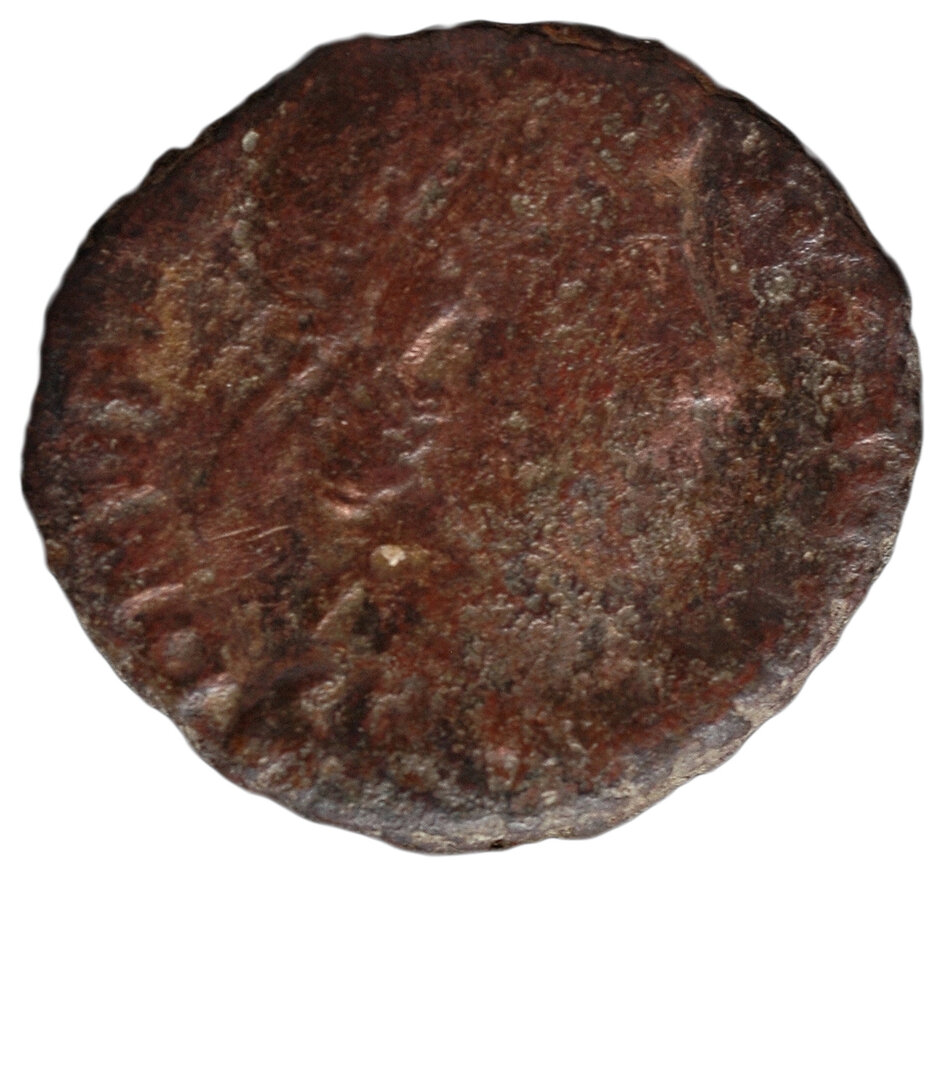
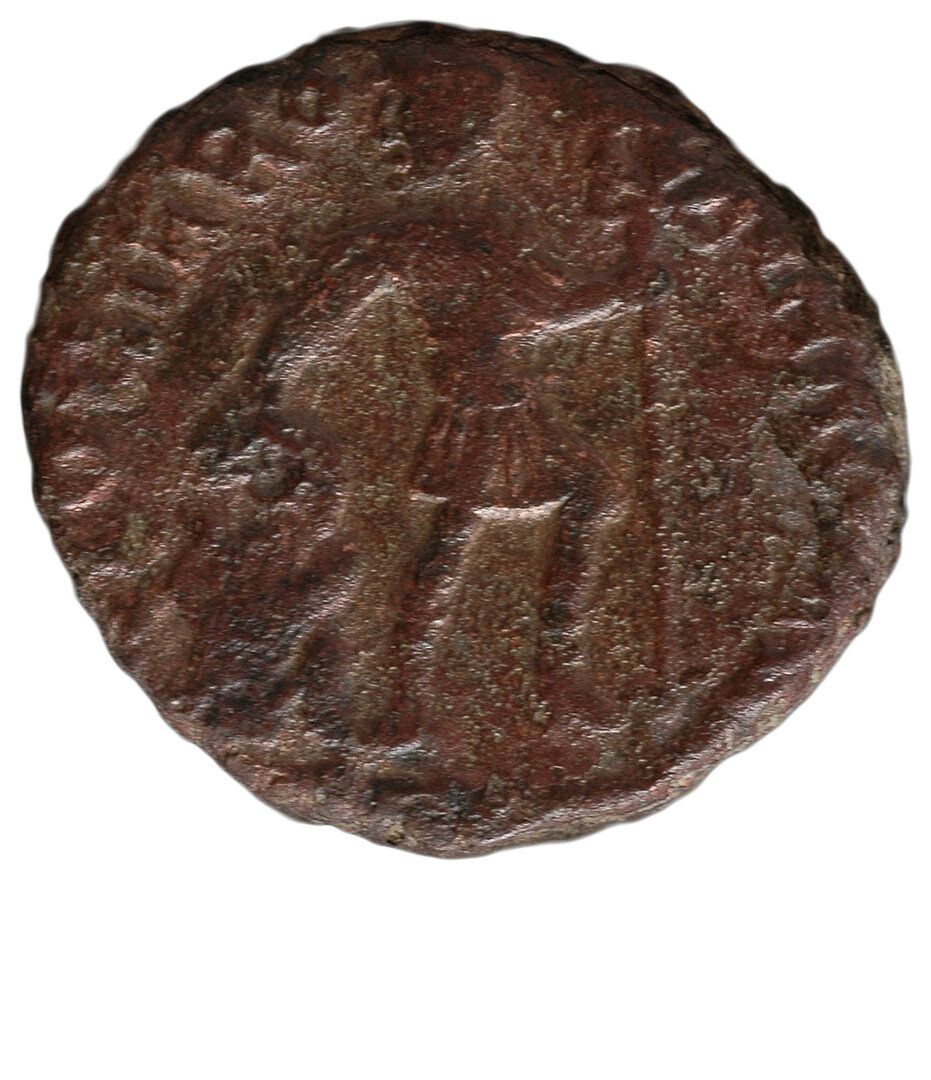
73
Inventory Number 670
Context Area B, room B12, DSU93 (FN18)
Material AE
Diam. 16 mm
Weight 4.5 g (see note)
Axis 12h
Module/Denom. AE3/Centenionalis?
Obv. Imp. bust, R; diadem. Legend: D N VALE[N… P F AUG]
Rev. Emperor standing R, looking L with labarum and captive. Legend: GLORIA RO – MANORUM
Mint NA
Mint Mark illegible
Date 364–378
Ref. NA
Note Valens or Valentinian I. Weight far too heavy. Possibly cast
Image Ref. to the Database OBV: 0670-AG08--0849; REV: 0670-AG08--0852
p. 486
74
Inventory Number 672
Context Area B, room B12, DSU93 (FN20)
Material AE
Diam. 15 mm
Weight 1.7 g
Axis NA
Module/Denom. AE3/AE4
Condition Illegible
Date ND
75
Inventory Number 696
Context Area B, room B12, DSU93 (coin from sieving)
Material AE
Diam. 13 mm
Weight 1.6 g
Axis NA
Module/Denom. AE4
Condition Illegible
Date ND
76
Inventory Number 699
Context Area B, room B12, DSU93 (coin from sieving)
Material AE
Diam. 14 mm
Weight 2.4 g
Axis 12h?
Module/Denom. AE3/Centenionalis?
Obv. Imp. bust, R; cuirassed, draped, diadem
Rev. Victory adv. L, with wreath and palm. Legend: [SECURITAS] REIPUBLICAE
Mint NA
Mint Mark Illegible
Date 364–378
Note Possibly cast
Image Ref. to the Database OBV: 00699-AG10--3009; REV: 00699-AG10--3010
77
Inventory Number 668
Context Area B, room B12, DSU95 (FN15)
Material AE
Diam. 14 mm
Weight 2.3 g
Axis 6h?
Module/Denom. AE3/Centenionalis?
Obv. Traces of imp. bust, R. and perhaps legend
Rev. Victory adv. L, with wreath and palm. Legend: […] RE[IPUBLIC .]
Mint NA
Mint Mark illegible
Date 364–378
Note Possibly cast
p. 487
78
Inventory Number 669
Context Area B, room B12, DSU95 (FN16)
Material AE
Diam. 17 mm
Weight 3.6 g
Axis NA
Module/Denom. AE3
Condition Illegible; fragmentary; not fully cleaned
Date 4th c.
79
Inventory Number 801
Context Area B, room BR12, DSU95 (coin from sieving)
Material AE
Diam. 13 mm
Weight 0.8 g
Axis NA
Module/Denom. AE4
Condition Illegible (not fully cleaned)
Date ND
80
Inventory Number 665
Context Area B, room B12, DSU96 (FN10)
Material AE
Diam. 18 mm
Weight 2.3 g
Axis 2h?
Module/Denom. AE3/Maiorina
Obv. Imp. bust, R; cuirassed, draped, pearl diadem. Legend: D N CONSTAN – TIUS P F AUG
Rev. Traces of FTR, FH legend and type
Mint NA
Mint Mark illegible
Date 351–361
Ref. NA
Note Possibly cast
Image Ref. to the Database OBV: 0665-AG08--0837; REV: 0665-AG08--0840
81
Inventory Number 697
Context Area B, room B12, DSU96 (coin from sieving)
Material AE
Diam. 16 mm
Weight 2.7g
Axis 6h
Module/Denom. AE3
Obv. Imp. bust, L; helmeted. Legend and other attributes effaced, but reverse type guarantees that the bust is of Julian
Rev. Votive wreath inscribed: VOT X / MVLT XX
Mint Unknown, but an Eastern mint, most likely Antioch or Alexandria
Mint Mark Only officina legible: A
Date 362–363
Ref. NA
Image Ref. to the Database OBV: 0697-AG08--3354; REV: 0697-AG08--3357
p. 488
82
Inventory Number 698
Context Area B, room B12, DSU96 (coin from sieving)
Material AE
Diam. 14 mm
Weight 1.5 g
Axis NA
Module/Denom. AE4
Condition Illegible (not fully cleaned)
Date ND
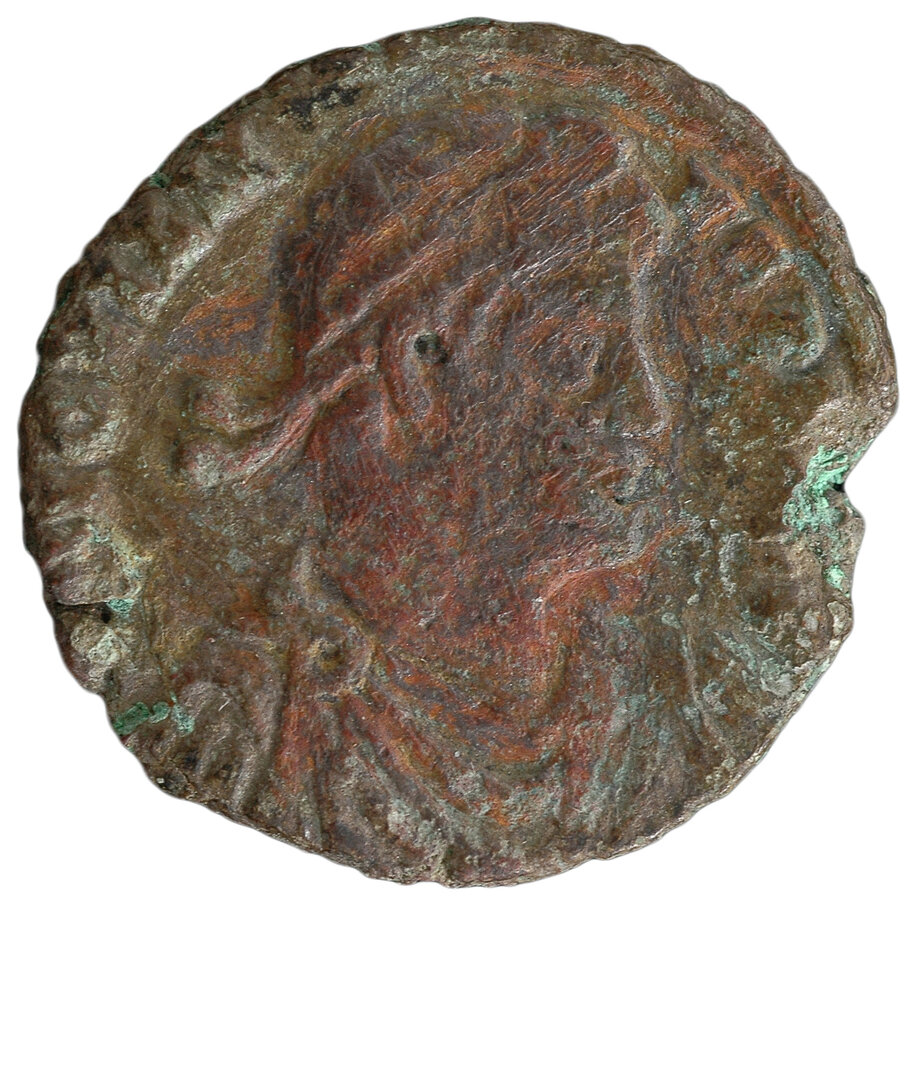
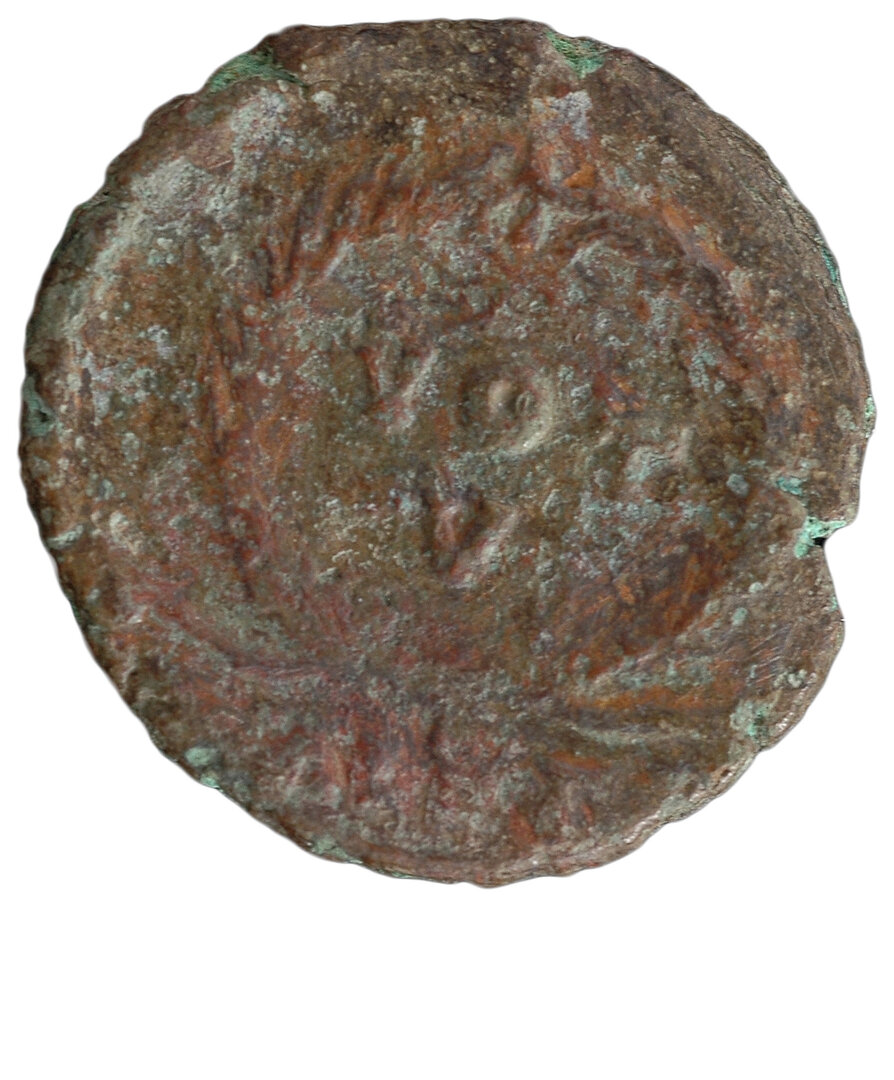
83
Inventory Number 840
Context Area B, room B12, DSU101 (FN45)
Material AE
Diam. 19 mm
Weight 2.6 g
Axis 6h
Module/Denom. AE3/Centenionalis?
Obv. Imp. bust, R; cuirassed, draped, diadem. Legend: DN IOVIAN – US P F AUG
Rev. Votive wreath inscribed: VOT / V
Mint Alexandria
Mint Mark -/-//ALEA
Date 363–364
Ref. RIC VIII Alexandria 92
Image Ref. to the Database OBV: 0840-AG08--0861; REV: 0840-AG08--0864
84
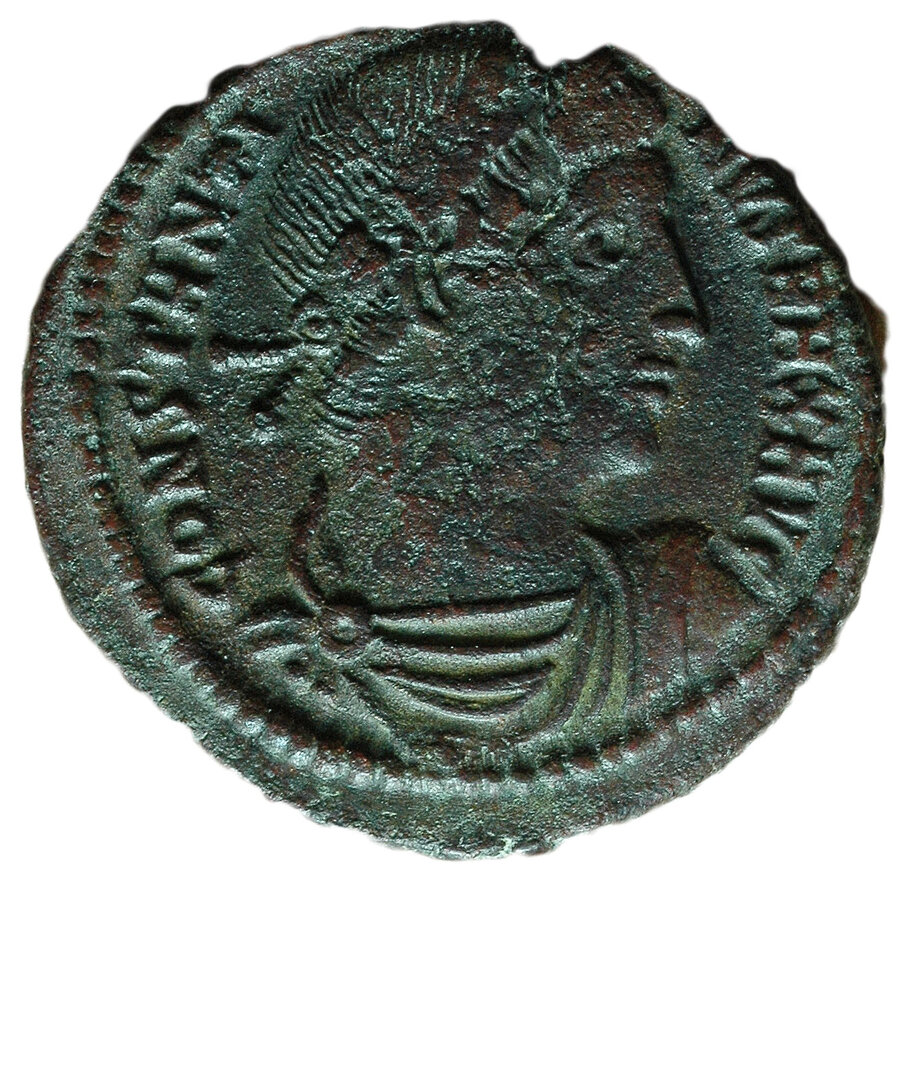
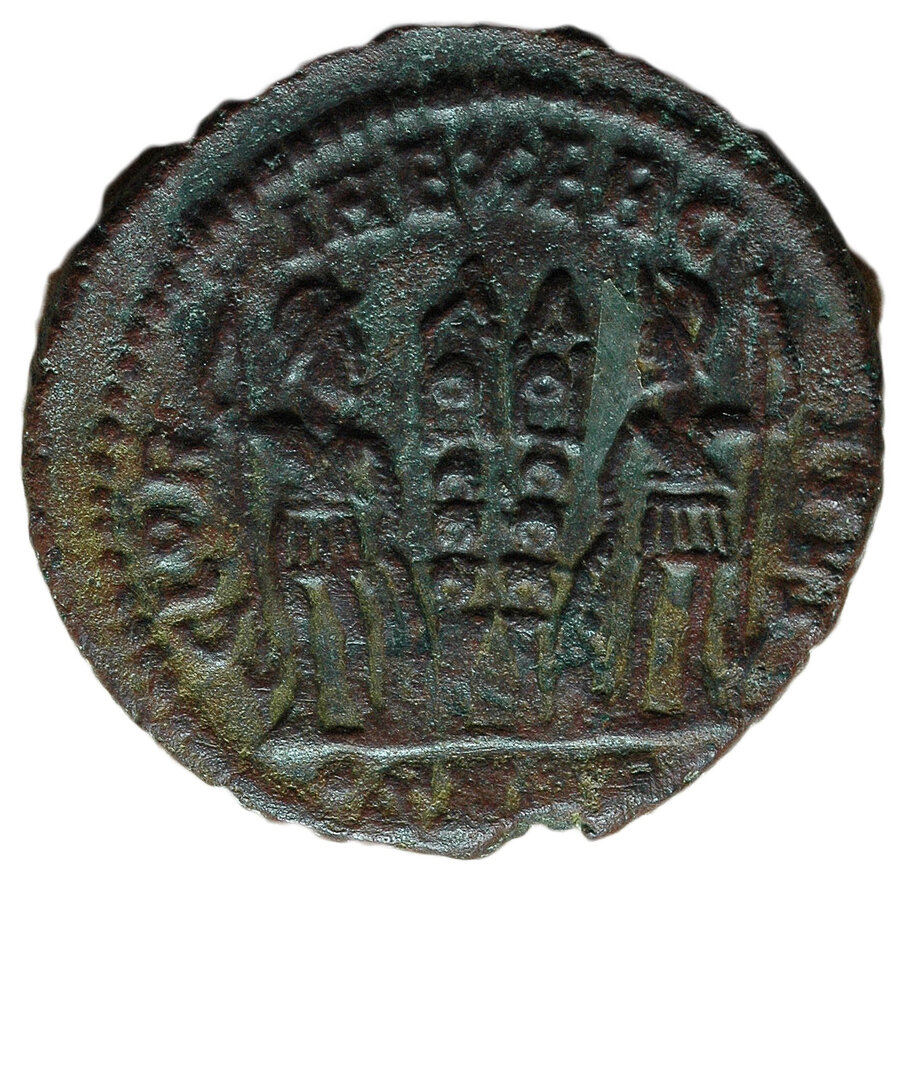
Inventory Number 688
Context Area B, room B12, DSU107 (FN38)
Material AE
Diam. 18 mm
Weight 2.6 g
Axis 6h
Module/Denom. AE3/Nummus centenionalis?
Obv. Imp. bust, R; cuirassed, draped, rosette diadem. Legend: CONSTANTI – NVS MAX AVG
Rev. Two soldiers standing with spears and shields, two standards between them. Legend: GLOR- IA EXER – CITUS
Mint Heraclea or Cyzicus
Mint Mark -/-//•SMHA or -/-//•SMKA
Date 330–335
Ref. RIC VII Heraclea 116 or Cyzicus 94
Image Ref. to the Database OBV: 00688-AG10--0028; REV: 00688-AG10--0029
p. 489
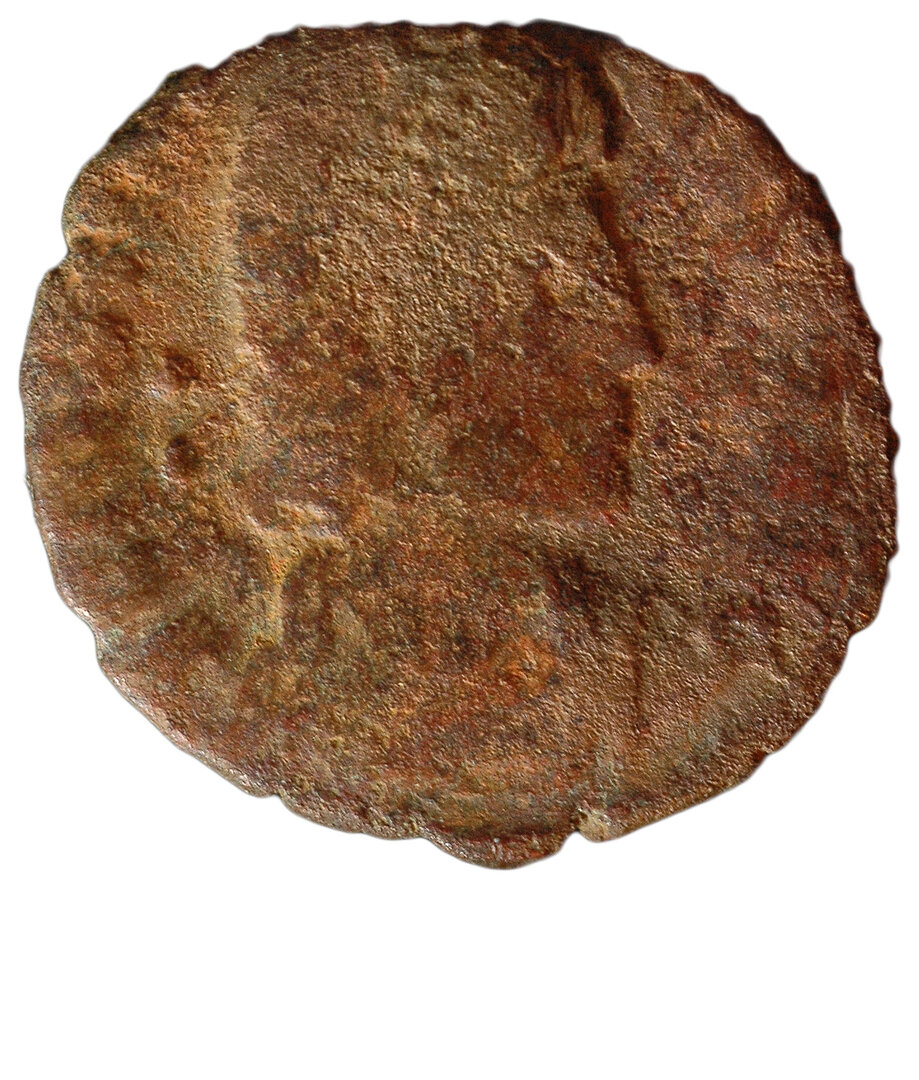
85
Inventory Number 690
Context Area B, room B12, DSU107 (FN42)
Material AE
Diam. 16 mm
Weight 1.6 g
Axis 6h
Module/Denom. AE3/Maiorina
Obv. Imp. bust, R; cuirassed, draped, diadem. Legend: D N CONSTAN[ – TIU]S P F AUG
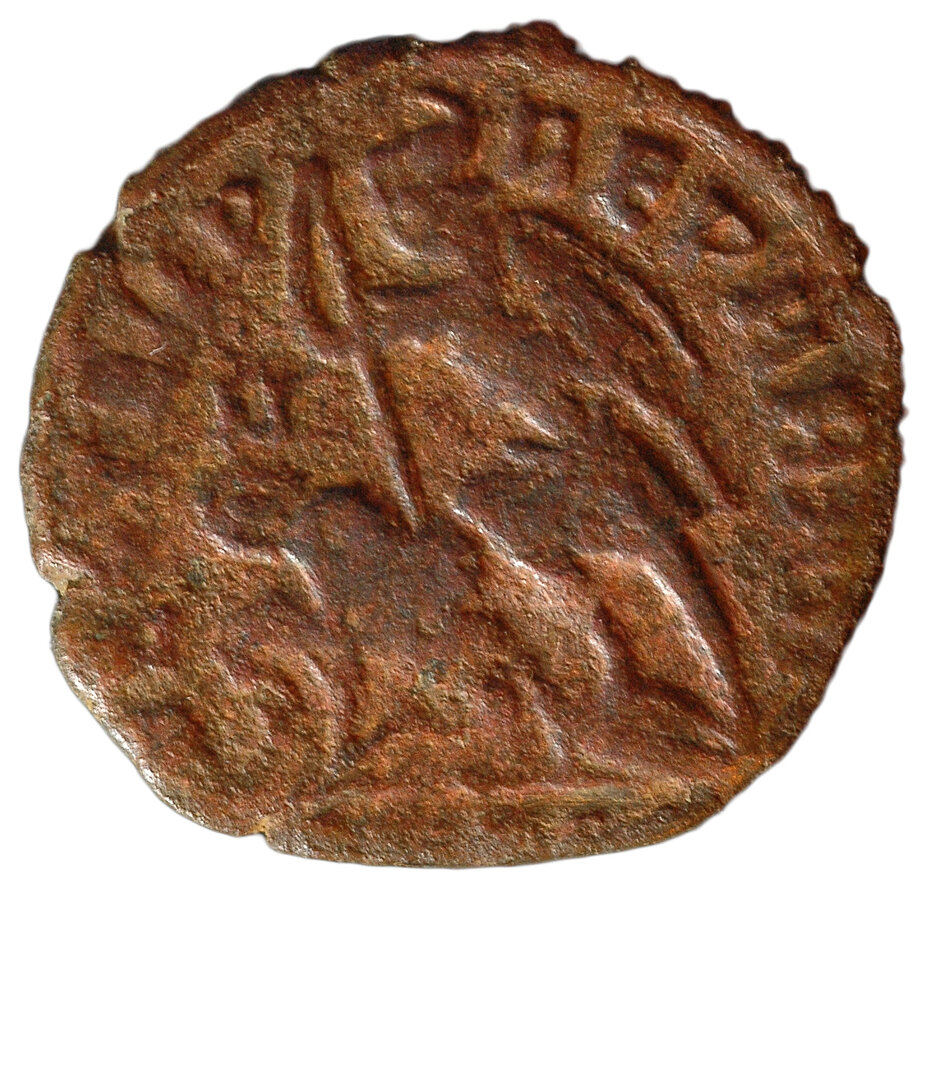
Rev. FTR, FH with legend. Horseman leans forward and clasps horse’s neck
Mint Thessalonica, Heraclea, or Antioch
Mint Mark M/-//traces
Date 355–361
Ref. RIC VIII Thessalonica 208; Heraclea 96; Antioch 191
Image Ref. to the Database OBV: 0690-AG08--3372; REV: 0690-AG08--3375
86
Inventory Number 821
Context Area B, room B12, DSU107 (FN53)
Material AE
Diam. 12 mm
Weight 1.2 g
Axis NA
Module/Denom. AE4
Condition Illegible
Date ND
p. 490
87
Inventory Number 822
Context Area B, room B12, DSU124
Material AE
Diam. 16 mm
Weight 2.1 g
Axis NA
Module/Denom. AE3/Centenionalis?
Obv. Imp. bust, R
Rev. Gloria Romanorum type. Traces of emperor standing or adv. R, looking L with labarum, likely leading a captive
Mint NA
Mint Mark illegible
Date 364–378
Ref. NA
Image Ref. to the Database OBV: 00822-AG10--3029; REV: 00822-AG10--3030
88
Inventory Number 824
Context Area B, room B12, DSU124 (FN55)
Material AE
Diam. 13 mm
Weight 0.9 g
Axis NA
Module/Denom. AE4
Obv. Traces, illegible
Rev. Victory with wreath and palm adv. L. Traces of legend R. Likely Sec Reip type
Condition not fully cleaned; oddly shaped flan, perhaps fragmentary or an imitation
Mint NA
Mint Mark illegible
Date 364–395
Ref. NA
89
Inventory Number 827
Context Area B, room B12, DSU124 (coin from sieving)
Material AE
Diam. > 16 mm
Weight 0.7 g
Axis 12h
Module/Denom. AE3/Maiorina
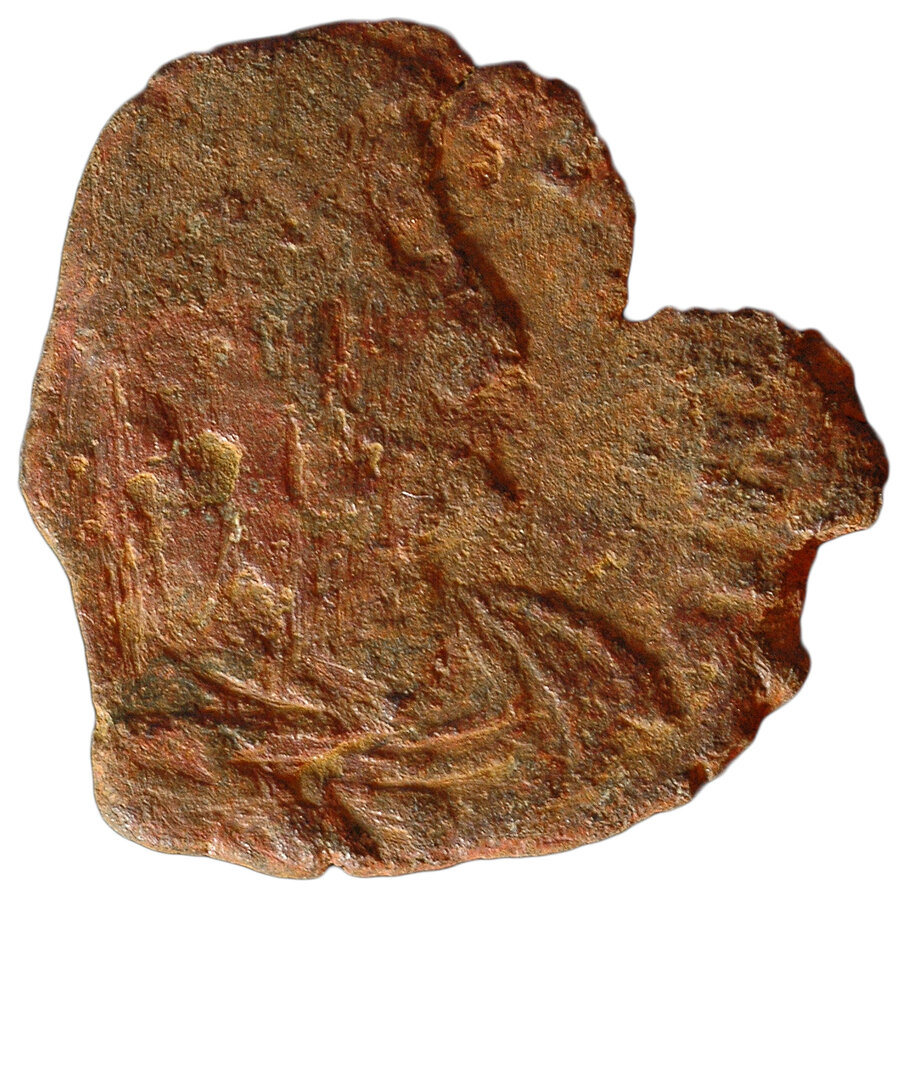
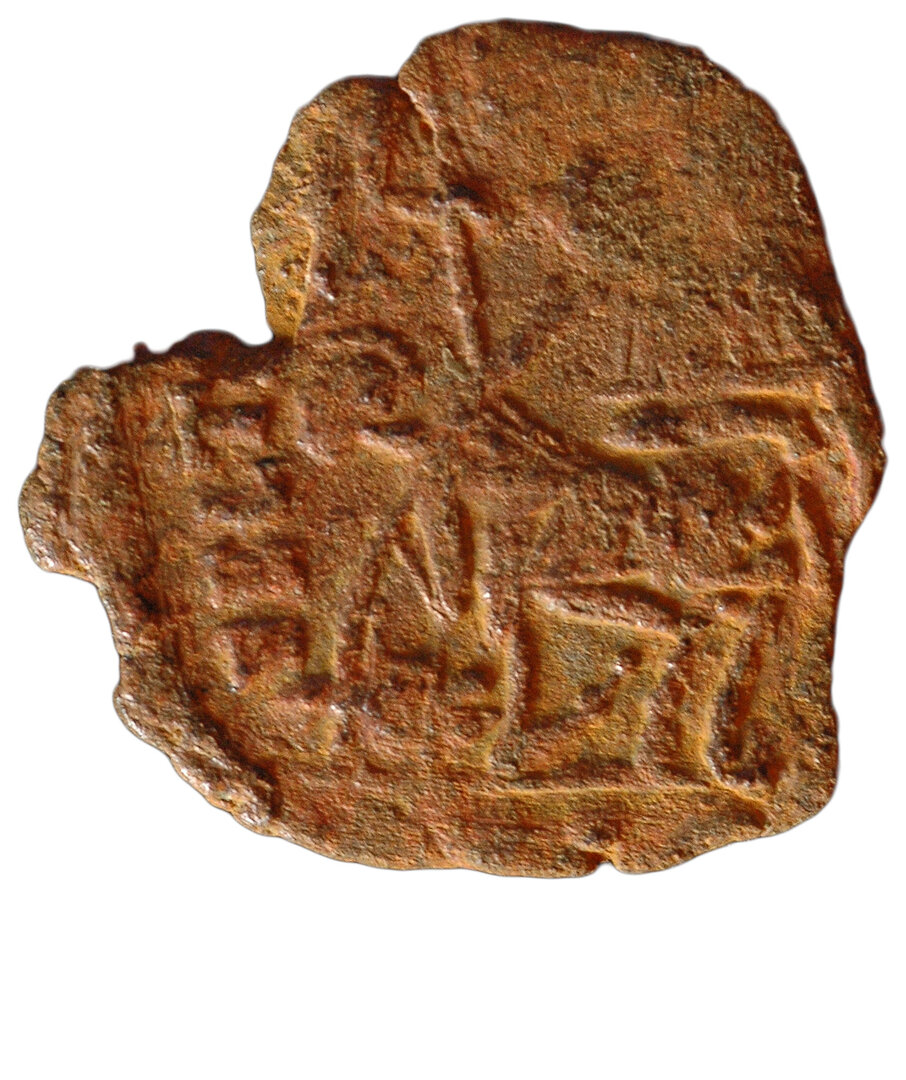
Obv. Imp. bust, R.; cuirassed, draped, rosette-diadem. Legend: [ … ] P F AUG
Rev. FTR, FH (horseman clasping neck of horse) with legend FEL T[…] at L
Mint NA
Mint Mark illegible traces in exergue. Possible trace of mm in L field
Date 351–361
Ref. NA
Note Likely an imitation
Image Ref. to the Database OBV: 0827-AG08--3360; REV: 0827-AG08—3360
p. 491
90
Inventory Number 828
Context Area B, room B12, DSU124 (FN56)
Material AE
Diam. 15 mm
Weight 0.8 g
Axis 6h
Module/Denom. AE3/AE4
Obv. Imp. bust, R; diadem
Rev. Victory adv. L with wreath and palm. Most likely Sec Reip type
Mint NA
Mint Mark illegible
Date 364–395
Ref. NA
91
Inventory Number 1042
Context Area B, room B12, DSU124
Material AE
Diam. 11 mm
Weight 0.5 g
Axis NA
Module/Denom. AE4
Condition Illegible (not fully cleaned)
Date ND
92
Inventory Number 1046
Context Area B, room B12, DSU124
Material AE
Diam. 12 mm
Weight 0.8 g
Axis NA
Module/Denom. AE4
Condition Illegible possibly fragmentary (not fully cleaned)
Date ND
93
Inventory Number 1049
Context Area B, room B12, DSU124 (FN57)
Material AE
Diam. 18 mm
Weight 2.5 g
Axis 12h
Module/Denom. AE3/Maiorina
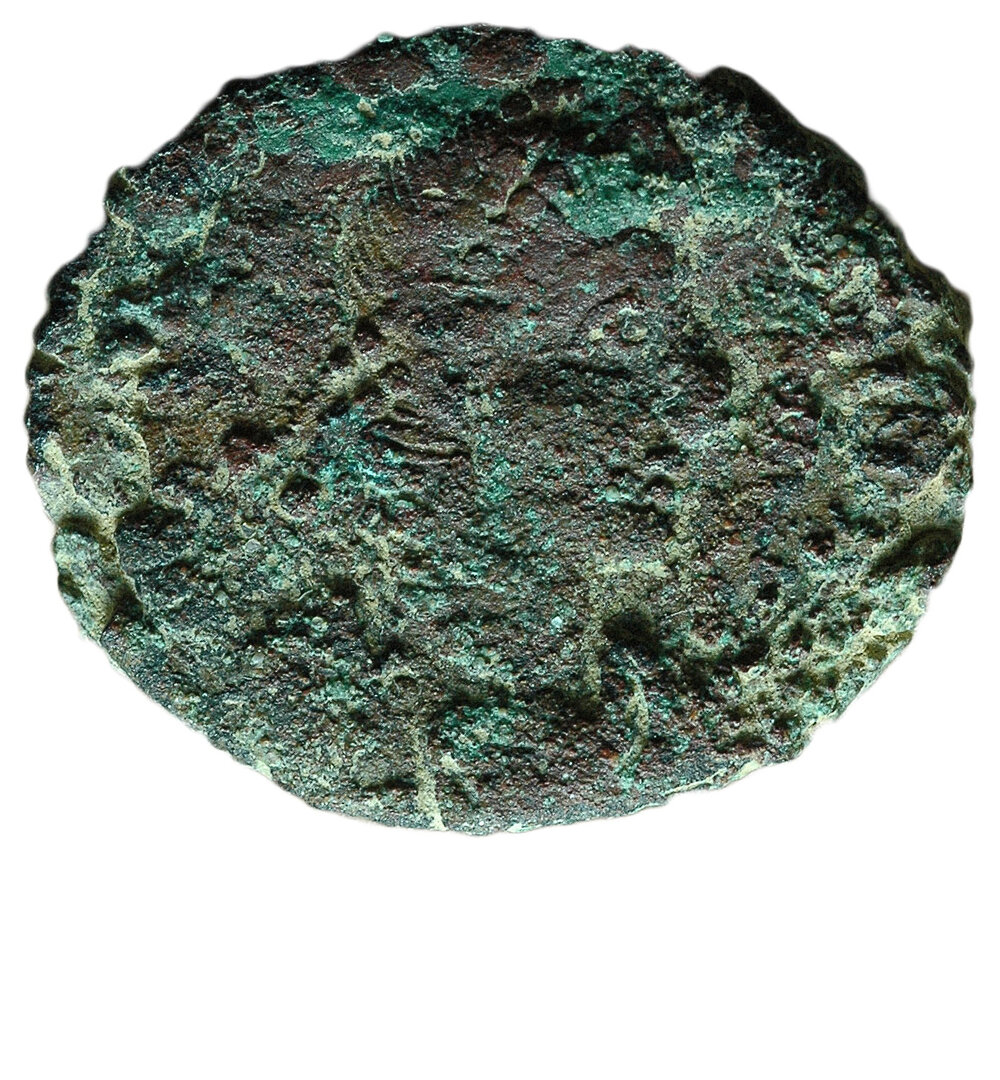
Obv. Imp. bust, R; cuirassed, diadem, pearl diadem. Legend: D N CON[…] P F AUG
Rev. FTR, FH type. Legend: [FEL TEMP RE]PARATIO
Mint NA
Mint Mark illegible
Date 351–361
Ref. NA
Image Ref. to the Database OBV: 01049-AG10--0032; REV: 01049-AG10--0033
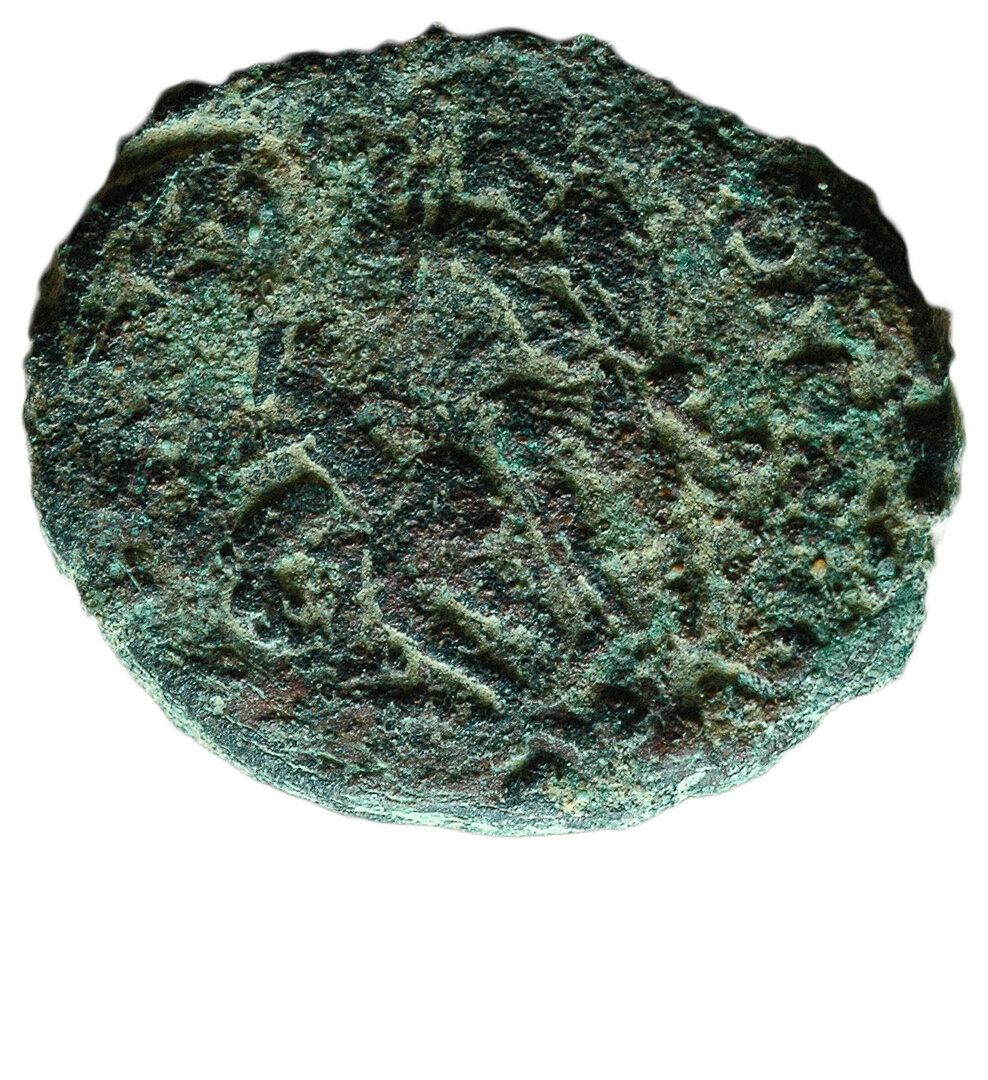
94
Inventory Number 1076
Context B R12 DSU124 (coin from sieving)
Material AE
Diam. 11 mm
Weight 0.5 g
Axis NA
Module/Denom. AE4
Condition Illegible (not fully cleaned)
Date ND
95
Inventory Number 1099
Context Area B, room B12, DSU124 (FN58)
Material AE
Diam. 15 mm
Weight 1.1 g
Axis NA
Module/Denom. AE4
Obv. Imp. bust, R; diadem. Illegible traces of legend
Rev. Illegible
Condition Not fully cleaned
Mint NA
Mint Mark illegible
Date 4th c.
Ref. NA
96
Inventory Number 678
Context Area B, room B12, F135 (FN26)
Material AE
Diam. 12 mm
Weight 1.8 g
Axis NA
Module/Denom. AE4
Condition Illegible; broken (not fully cleaned)
Date ND
p. 492
97
Inventory Number 685
Context Area B, room B13, DSU94 (FN33)
Material AE
Diam. 15 mm
Weight 1.2 g
Axis 6h
Module/Denom. AE3/Nummus centenionalis
Obv. Imp. bust, R; cuirassed, draped, laurel and rosette diadem. Traces of legend
Rev. Two victories, facing each other, each with wreath and palm. Legend: [VICTORI]AE D D [AUG]GQ N N
Mint NA
Mint Mark illegible
Date 341–348
Ref. NA
p. 493
98
Inventory Number 700
Context Area B, room B13, DSU94 (coin from sieving)
Material AE
Diam. NA
Weight 0.1 g
Axis NA
Module/Denom. NA
Condition Illegible; fragmentary
Note Originally recorded as having a diam. of 13 mm, weight of 0.5 g; possibly not a coin
99
Inventory Number 681
Context Area B, room B13, DSU104 (FN29)
Material AE
Diam. 9 mm
Weight 0.3 g
Axis NA
Module/Denom. NA
Condition Illegible; possibly fragmentary (not fully cleaned)
Date ND
100
Inventory Number 691
Context Area B, room B13, DSU105 (FN43)
Material AE
Diam. 13 mm
Weight 0.9 g
Axis NA
Module/Denom. NA
Condition Illegible; fragmentary (not fully cleaned)
Date ND
101
Inventory Number 802
Context Area B, room B13, DSU105
Material AE
Diam. 10 mm
Weight 0.4 g
Axis NA
Module/Denom. NA
Condition Illegible; fragmentary (not fully cleaned)
Date ND
102
Inventory Number 683
Context Area B, room B13, DSU109 (FN31)
Material AE
Diam. 14 mm
Weight 1.3 g
Axis NA
Module/Denom. AE4
Condition Illegible (not fully cleaned)
Date ND
p. 494
103
Inventory Number 804
Context Area B, room B13, DSU109 (coin from sieving)
Material AE
Diam. 13 mm
Weight 2.5 g
Axis NA
Module/Denom. NA
Condition Illegible; fragmentary (not fully cleaned); perhaps two coins
Date ND
104
Inventory Number 805
Context Area B, room B13, DSU109 (coin from sieving)
Material AE
Diam. 10 mm
Weight 0.6 g
Axis 3h
Module/Denom. AE4
Obv. Imp. bust, R; cuirassed, draped, pearl diadem. Bust appears to be nearly three-quarters. Traces of legend, although possible that the legend is symbolic (i.e., not actual legend)
Rev. Victory adv. L with palm or trophy and captive? Figure crudely executed. Legend and mint mark appear to be symbolic
Mint NA
Mint Mark illegible
Date Late 4th–5th c.
Ref. NA
Note “Barbarous” imitation. Cf. 125.
Image Ref. to the Database OBV: 0805-AG08--0873; REV: 0805-AG08--0876
105
Inventory Number 686
Context Area B, room B13, DSU110 (FN34)
Material AE
Diam. 15 mm
Weight 2.5 g
Axis NA
Module/Denom. AE3/AE4
Condition Illegible (not fully cleaned)
Date ND
106
Inventory Number 687
Context Area B, room B13, DSU110 (FN37)
Material AE
Diam. 14 mm
Weight 1.3 g
Axis NA
Module/Denom. AE3/Centenionalis
Obv. Illegible
Rev. Emperor helmeted and in military dress stg. L, holding globe and spear. Legend: SPES [REI – P]UBLICE
Mint Heraclea, Nicomedia, or Cyzicus
Mint Mark -/-//SM . .
Date 355–363
Ref. RIC VIII Heraclea 98–100; Nicomedia 112–114, 116–117; Cyzicus 117–124
Note Cast (note the sprue stem channel)
Image Ref. to the Database OBV: 0687-AG08--0825; REV: 0687-AG08--0828
p. 495
107
Inventory Number 689
Context Area B, room B13, DSU110 (FN41)
Material AE
Diam. 9 mm
Weight 0.3 g
Axis NA
Module/Denom. AE4
Condition Illegible
Date ND
108
Inventory Number 826
Context Area B, room B13, DSU110 (FN49)
Material AE
Diam. NA
Weight 0.1 g
Axis NA
Module/Denom. NA
Condition Illegible; fragmentary (not fully cleaned)
Date ND
109
Inventory Number 823
Context Area B, room B13, DSU115 (coin from sieving; test trench between rooms B12 and B13)
Material AE
Diam. 11 mm
Weight 0.6 g
Axis NA
Module/Denom. AE4
Condition Illegible
Date ND
p. 496
110
Inventory Number 825
Context Area B, room B13, DSU115 (FN44) (test trench between rooms B12 and B13)
Material AE
Diam. 11 mm
Weight 1.0 g
Axis NA
Module/Denom. AE4
Condition Illegible (not fully cleaned)
Date ND
111
Inventory Number 839
Context Area B, room B13, DSU115 (coin from sieving; test trench between rooms B12 and B13)
Material AE
Diam. 15 mm
Weight 1.6 g
Axis NA
Module/Denom. AE3/AE4
Obv. Imp. bust, R; diadem
Rev. Illegible
Mint NA
Mint Mark illegible
Date 4th c.
Ref. NA
112
Inventory Number 841
Context Area B, room B13, F152 (FN50)
Material AE
Diam. NA
Weight 0.7 g
Axis NA
Module/Denom. NA
Condition Illegible; fragmentary (not fully cleaned)
Date ND
113
Inventory Number 829
Context Area B, room B13, F153 (FN52)
Material AE
Diam. 10 mm
Weight 0.4 g
Axis NA
Module/Denom. NA
Condition Illegible; fragmentary (not fully cleaned)
Date ND
114
Inventory Number 1009
Context Area B, room B14, DSU84 (FN54)
Material AE
Diam. 18 mm
Weight 2.9 g
Axis NA
Module/Denom. AE3/Nummus
Obv. Imp. bust, L; draped, laureate, globe and scepter in L hand, mappa in R. Legend: [D N FL CL] CONSTANTINUS NOB C
Rev. Camp gate with three turrets or two turrets and a star. Traces of legend PROVIDEN – TIAE CAESS
Mint Heraclea?
Mint Mark -/-//MTH . ?
Date 317–320
Ref. RIC VII Heraclea 16–49?
Image Ref. to the Database OBV: 01009-AG10--0034; REV: 01009-AG10--0035
p. 497
115
Inventory Number 1035
Context Area B, room B14, DSU127 (FN64)
Material AE
Diam. NA
Weight 1.4 g
Axis NA
Module/Denom. NA
Condition Illegible; fragmentary (not fully cleaned)
Date ND
116
Inventory Number 1071
Context Area B, room B14, DSU127 (FN62)
Material AE
Diam. 10 mm
Weight 0.4 g
Axis NA
Module/Denom. AE4
Condition Illegible (not fully cleaned)
Date ND
117
Inventory Number 1072
Context Area B, room B14, DSU127 (FN71)
Material AE
Diam. 13 mm
Weight 1.0 g
Axis NA
Module/Denom. AE4
Obv. Illegible
Rev. Possibly victory adv. L
Mint NA
Mint Mark illegible
Date Late 4th–5th c.
Ref. NA
p. 498
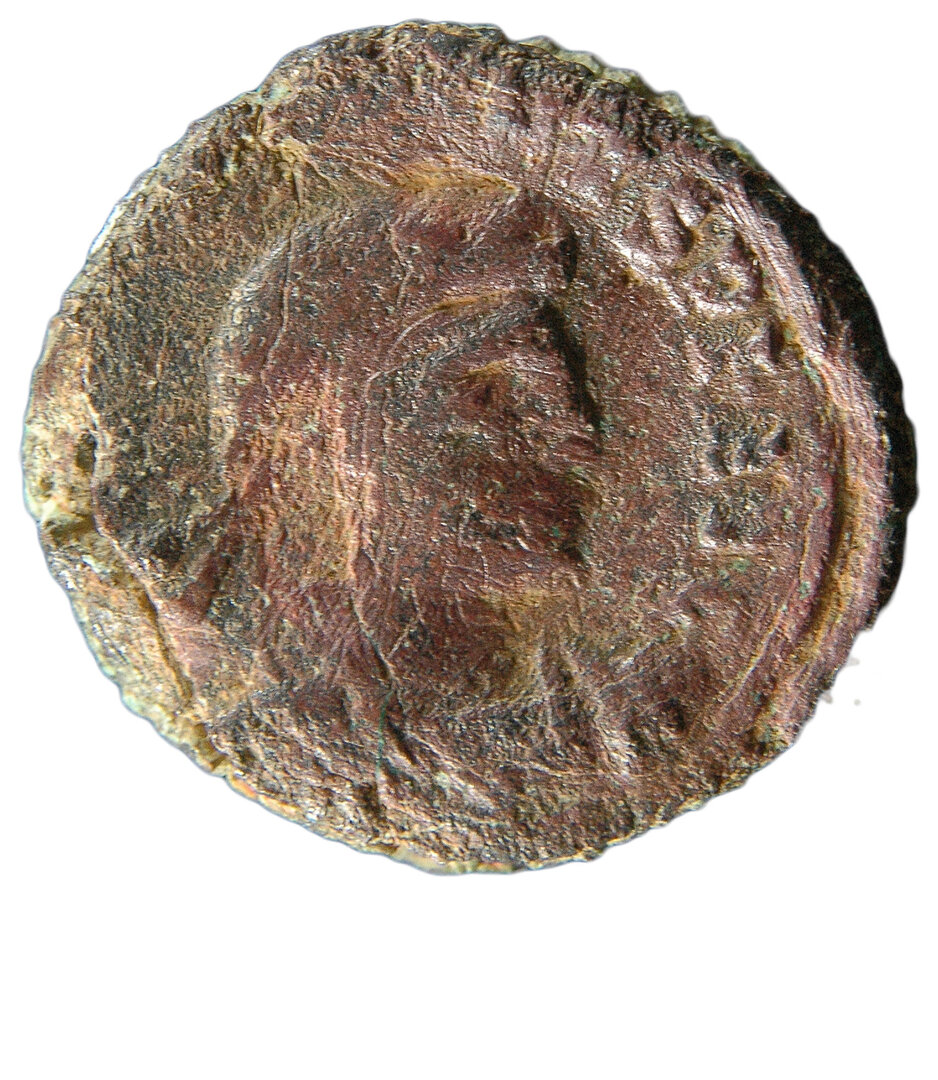
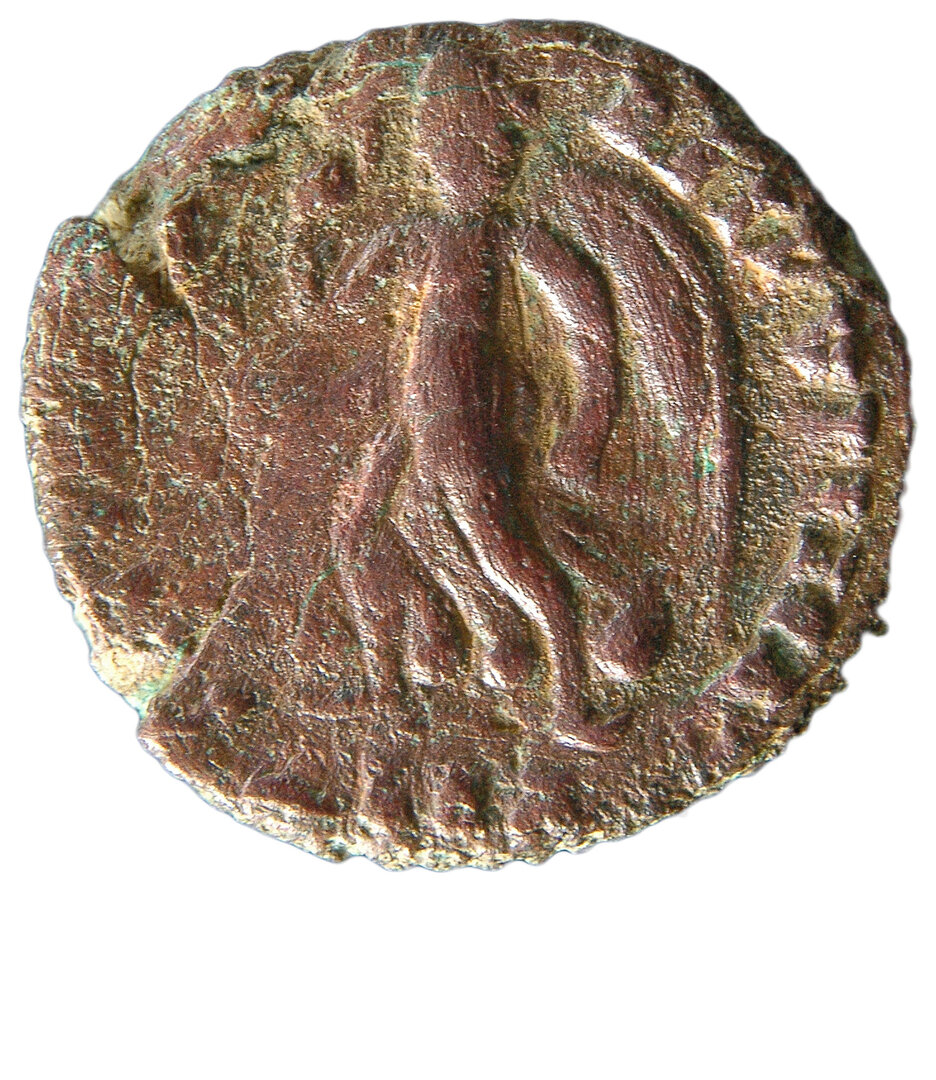
118
Inventory Number 1091
Context Area B, room B14, DSU127 (FN65)
Material AE
Diam. 17 mm
Weight 2.8 g
Axis NA
Module/Denom. AE3/Centenionalis?
Obv. Imp. bust, R; cuirassed, draped, diadem. Legend: [D N GRATIA] – NUS P F AUG
Rev. Victory adv. L with palm and wreath. Legend: SECU[RITAS] REIPUBLICAE
Mint Alexandria
Mint Mark -/-//ALEA
Date 367–375
Ref. RIC IX Alexandria 5c
Note Likely cast
Image Ref. to the Database OBV: 1091-AG08--3691; REV: 1091-AG08--3694
119
Inventory Number 1200
Context area B, room B14, DSU127 (FN63)
Material AE
Diam. 14 mm
Weight 0.7 g
Axis 9h
Module/Denom. AE3/Centenionalis?
Obv. Imp. bust, R; diadem. Traces of legend
Rev. Possible traces of a victory adv. L. Sec Reip type
Condition Fragmentary
Mint NA
Mint Mark illegible
Date Late 4th–5th c.
Ref. NA
120
Inventory Number 1073
Context Area B, room B15, DSU86 (FN61)
Material AE
Diam. 12 mm
Weight 2.1 g
Axis NA
Module/Denom. AE4
Condition Illegible (not fully cleaned)
Date ND
121
Inventory Number 1075
Context Area B, room B15, DSU86 (FN66)
Material AE
Diam. NA
Weight 0.4 g
Axis NA
Module/Denom. NA
Condition Illegible; fragmentary (not fully cleaned)
Date ND
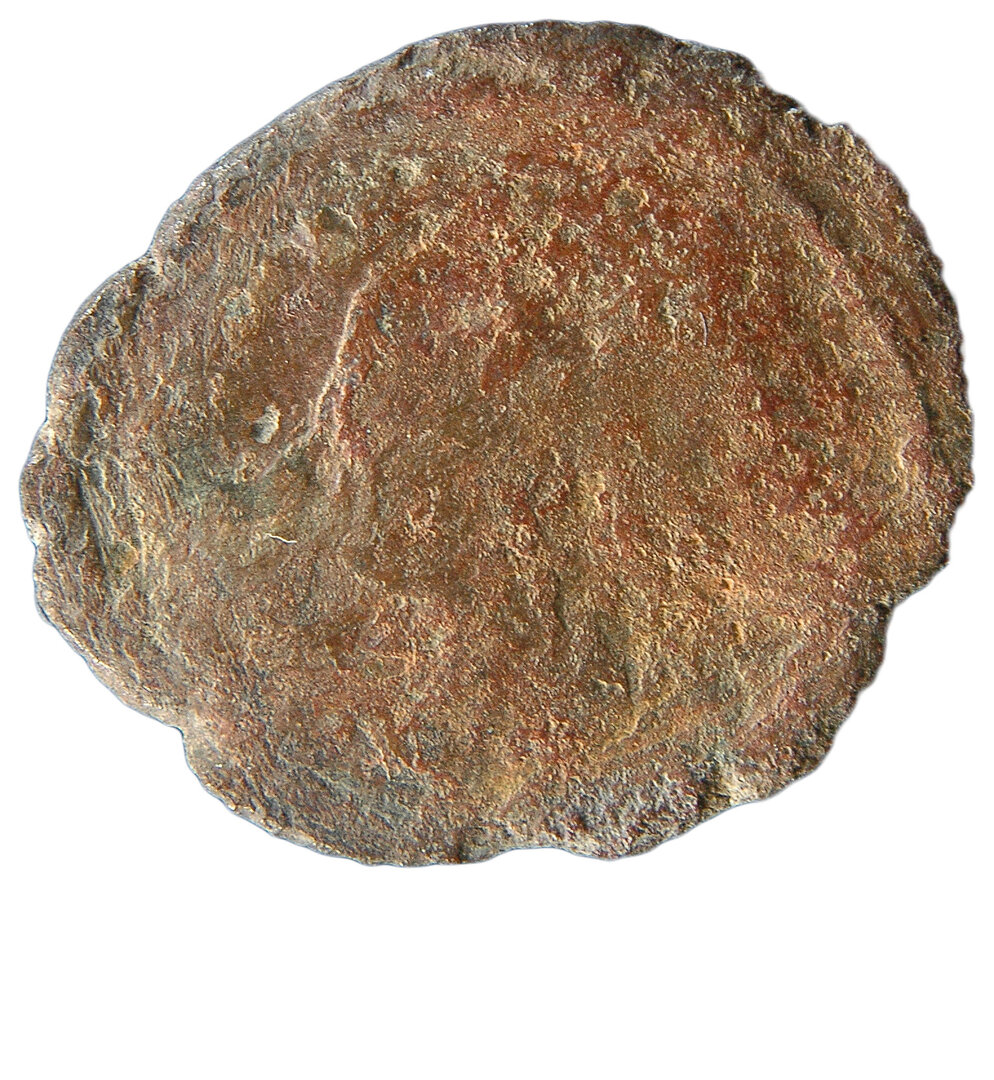
122
Inventory Number 1095
Context Area B, room B15, DSU86 (FN80)
Material AE
Diam. 17 mm
Weight 1.3 g
Axis 10h?
Module/Denom. AE3/Nummus centenionalis?
Obv. Imp. bust, R; diadem. Traces of legend
Rev. Two soldiers, standing looking at one another, holding spear and resting hand on shield; between them one standard. Legend: [GLOR] – IA EXER [CITVS]
Mint Most likely Heraclea or Nicomedia
Mint Mark -/-//[S]MHA or -/-//[S]MNA?
Date 335–341
Ref. NA
Note Possibly cast
p. 499
123
Inventory Number 1008
Context Area B, room B15, DSU129 (FN70)
Material AE
Diam. 16 mm
Weight 2.7 g
Axis 12h
Module/Denom. AE3/Centenionalis?
Obv. Imp. bust, R; cuirassed, draped, diadem. Legend: [D N VALE]N – S P F AUG
Rev. Victory adv. L with wreath and palm. Legend: SECURITA[S –REI PUBLICAE]
Mint Alexandria
Mint Mark -/-//ALEẠ
Date 364–375
Ref. NA
Image Ref. to the Database OBV: 01008-AG10--0024; REV: 01008-AG10--0025
124
Inventory Number 1033
Context Area B, room B15, DSU129 (FN74)
Material AE
Diam. 14 mm
Weight 1.6 g
Axis NA
Module/Denom. AE4
Condition Illegible; broken (not fully cleaned)
Date ND
125
Inventory Number 1041
Context Area B; room B15, DSU129 (FN67)
Material AE
Diam. 9 mm
Weight 0.3 g
Axis NA
Module/Denom. AE4
Obv. Imp. bust, R
Rev. Victory adv. L with wreath and captive? Crudely executed
Mint NA
Mint Mark illegible
Date Late 4th–5th c.
Ref. NA
Note “Barbarous” imitation. Cf. 104
Image Ref. to the Database OBV: 01041-AG10–0236; REV: 01041-AG10–0235)
p. 500
126
Inventory Number 1060
Context Area B, room B15, DSU129 (FN69)
Material AE
Diam. 8 mm
Weight 0.5 g
Axis NA
Module/Denom. AE4
Condition Illegible (not fully cleaned)
Date ND
127
Inventory Number 1061
Context Area B, room B15, DSU129 (FN83)
Material AE
Diam. 13 mm
Weight 1.0 g
Axis NA
Module/Denom. AE4
Obv. Traces of imp. bust, R
Rev. Illegible
Mint NA
Mint Mark illegible
Date 4th c.
Ref. NA
128
Inventory Number 1077
Context Area B, room B15, DSU129 (FN68)
Material AE
Diam. 18 mm
Weight 3.2 g
Axis NA
Module/Denom. AE3
Condition Illegible; fragmentary (not fully cleaned)
Date ND
129
Inventory Number 1063
Context Area B, room B15, DSU132 (FN78)
Material AE
Diam. 13 mm
Weight 0.3 g
Axis NA
Module/Denom. AE4
Condition Fragmentary (not fully cleaned)
Date ND
p. 501
130
Inventory Number 1064
Context Area B, room B15, DSU132 (FN79)
Material AE
Diam. 11 mm
Weight 0.3 g
Axis NA
Module/Denom. AE4
Obv. Imp. bust, R.; diadem
Rev. Illegible
Mint NA
Mint Mark illegible
Date Late 4th–5th c.
Ref. NA
131
Inventory Number 1065
Context Area B, room B15, DSU132 (FN76)
Material AE
Diam. 11 mm
Weight 0.7 g
Axis NA
Module/Denom. AE4
Condition Illegible
Date ND
132
Inventory Number 1093
Context Area B, room B15, DSU132 (FN77)
Material AE
Diam. 13 mm
Weight 1.3 g
Axis 6h
Module/Denom. AE3/AE4
Obv. Possible traces of imp. bust, R
Rev. Victory adv. L?
Mint NA
Mint Mark illegible
Date 4th c.
Ref. NA
133
Inventory Number 1066
Context Area B, room B15, DSU137 (FN82)
Material AE
Diam. 13 mm
Weight 1.6 g
Axis NA
Module/Denom. AE4/Fraction of centenionalis?
Obv. Illegible
Rev. Victory adv. L with captive. Sal Reip type
Mint NA
Mint Mark illegible
Date 383–403
Ref. NA
Image Ref. to the Database OBV: 1066-AG08--3715; REV: 1066-AG08--3718
134
Inventory Number 1096
Context Area B, room B15, DSU137 (FN85)
Material AE
Diam. 13 mm
Weight 1.1 g
Axis 12h
Module/Denom. AE3?
Obv. Imp. bust, R.; cuirassed, draped, diadem
Rev. Victory adv. L with wreath, but arm down? SecReip type?
Mint NA
Mint Mark illegible
Date Late 4th c.
Ref. NA
Note Coin seems to have lost a good deal of its circumference; may be cast imitation
Image Ref. to the Database OBV: 1096-AG08--3754; REV: 1096-AG08--3751
p. 502
135
Inventory Number 1097
Context Area B, room B15, DSU137 (FN84)
Material AE
Diam. 18 mm
Weight 4.6 g
Axis 1h?
Module/Denom. AE2/Maiorina
Obv. Imp. bust, cuirassed, draped. Traces of legend
Rev. FTR, FH. Legend: [FEL] TEMP …
Mint NA
Mint Mark illegible
Date 348–355
Ref. NA
136
Inventory Number 1034
Context Area B, room B17, DSU152 (FN100)
Material AE
Diam. 14 mm
Weight 1.1 g
Axis NA
Module/Denom. NA
Condition Illegible; fragmentary (not fully cleaned)
Date ND
137
Inventory Number 1078
Context Area B, room B17, DSU152 (FN101)
Material AE
Diam. 11 mm
Weight 0.8 g
Axis NA
Module/Denom. AE4
Condition Illegible (not fully cleaned)
Date ND
138
Inventory Number 1203
Context Area B, room B17, DSU152 (FN98)
Material AE
Diam. 15 mm
Weight 1.7 g
Axis NA
Module/Denom. AE4/Nummus centenionalis
Obv. Imp. bust, R; head only, diadem. Legend most likely: D N CONSTA – NS P F AUG.
Rev. Votive wreath inscribed: VOT / XX / MULT / XXX
Mint Heraclea, Constantinople, Nicomedia, Cyzicus, or Antioch
Mint Mark Illegible
Date 347–348
Ref. NA
p. 503
139
Inventory Number 1074
Context Area B, room B18, DSU156 (coin from sieving)
Material AE
Diam. 15 mm
Weight 1.4 g
Axis NA
Module/Denom. AE3/AE4
Condition Illegible; fragmentary (not fully cleaned)
Date ND
140
Inventory Number 1202
Context Area B, room B18, DSU156 (FN99)
Material AE
Diam. 12 mm
Weight 0.6 g
Axis NA
Module/Denom. AE4
Condition Illegible (not fully cleaned)
Date ND
141
Inventory Number 1081
Context Area B, room B19, DSU171 (coin from sieving)
Material AE
Diam. 13.5 mm
Weight 1.4 g
Axis 10h?
Module/Denom. AE3/Centenionalis?
Obv. Imp. bust, R; cuirassed, draped, diadem
Rev. Victory adv. L with wreath and palm; SecReip type
Mint NA
Mint Mark illegible
Date 364–378
Ref. NA
Note Possibly cast
Image Ref. to the Database OBV: 1081-AG08--3679; REV: 1081-AG08--3682
142
Inventory Number 1201
Context Area B, room B19, DSU171 (FN105)
Material AE
Diam. 13 mm
Weight 1.0 g
Axis 6h
Module/Denom. AE4/Fraction of centenionalis?
Obv. Imp. bust, R; cuirassed, draped, pearl diadem. Legend: [D N AR]CAD – IUS P F AUG
Rev. Votive wreath, inscribed: VOT / X / MVLT / XX
Mint Alexandria
Mint Mark -/-//ALEA or -/-//ALEΔ
Date 383–393
Ref. RIC IX Alexandria 19d
Image Ref. to the Database OBV: 01201-AG10--0036; REV: 01201-AG10--0037
p. 504
143
Inventory Number 693
Context Area B, room B19m DSU173 (FN107)
Material AE
Diam. 12 mm
Weight 1.0 g
Axis NA
Module/Denom. AE4
Condition Illegible; fragmentary (not fully cleaned)
Date ND
144
Inventory Number 1062
Context Area B, room B19, DSU173
Material AE
Diam. 10 mm
Weight 0.7 g
Axis NA
Module/Denom. AE4
Obv. Imp. bust, R; wreath or diadem. Traces of legend L
Rev. Illegible traces
Mint NA
Mint Mark illegible
Date Late 4th–5th c.
Ref. NA
Note Possibly an imitation, based on the obverse portrait
Image Ref. to the Database OBV: 1062-AG08--3707; REV: 1062-AG08--3704
145
Inventory Number 1086
Context Area B, room B19, DSU173 (FN106)
Material AE
Diam. 14 mm
Weight 1.4 g
Axis 12h
Module/Denom. AE3/Nummus centenionalis?
Obv. Imp. bust, R; head only, rosette or laurel and rosette diadem. Legend: [D N CO]NSTA – NS P F [AVG]
Rev. Two soldiers, standing looking at one another, holding spear and resting hand on shield; between them one standard. Legend: GLOR - IA EXERC – [ITUS]
Mint Constantinople
Mint Mark -/-//CONS[ . ]
Date 337–340
Ref. RIC VIII Constantinople 29, 30, 45
Image Ref. to the Database OBV: 1086-AG08--3697; REV: 1086-AG08--3700
146
Inventory Number 1094
Context Area B, room B19, DSU173 (FN108)
Material AE
Diam. 14 mm
Weight 1.4 g
Axis NA
Module/Denom. AE3/AE4
Obv. Imp. bust, R; diadem. Traces of legend
Rev. Illegible
Mint NA
Mint Mark illegible
Date 4th c.
Ref. NA
p. 505
147
Inventory Number 1045
Context Area B, room B19, F180 (FN88)
Material AE
Diam. 14 mm
Weight 2.6 g
Axis NA
Module/Denom. AE3?
Obv. Imp. bust, R. Traces of legend
Rev. Traces of stg. or adv. figure and legend
Mint NA
Mint Mark illegible
Date 4th c.
Ref. NA
Note Weight seems heavy for module
Image Ref. to the Database OBV: 1045-AG08--3366; REV: 1045-AG08--3369)
148
Inventory Number 1092
Context Area B, room B20, DSU143 (FN91)
Material AE
Diam. 15 mm
Weight 1.6 g
Axis NA
Module/Denom. AE3/AE4
Condition Illegible
Date ND
149
Inventory Number 1056
Context Area B, room B21, DSU138 (FN86)
Material AE
Diam. 19 mm
Weight 3.1 g
Axis NA
Module/Denom. AE3/Nummus
Obv. Imp. bust, R; cuirassed, draped, rosette diadem. Legend: CONSTAN - TINVS AVG
Rev. Camp gate, door, two turrets, star above. Legend: PROVIDEN - TIAE AVGG
Mint Thessalonica
Mint Mark -/A//SMTS
Date 328
Ref. RIC VII Thessalonica 169
Image Ref. to the Database OBV: 01056-AG10--0030; REV: 01056-AG10--0031
150
Inventory Number 1038
Context Area B, room B23, DSU147 (FN97)
Material AE
Diam. 21 mm
Weight 2.5 g
Axis 6h
Module/Denom. AE3/Nummus
Obv. Imp. bust, R; laureate, cuirassed, draped. Legend: IMP CONSTANTINUS P F AUG
Rev. Sol radiate, stg. L, raising R hand, globe in L, chlamys across L shoulder. Legend: SOLI IN – VI – CTO COMITI
Mint Rome
Mint Mark (R on X)/F//RT
Date 314–315
Ref. RIC VII Rome 27
Image Ref. to the Database OBV: 01038-AG10--0026; REV: 01038-AG10--0027
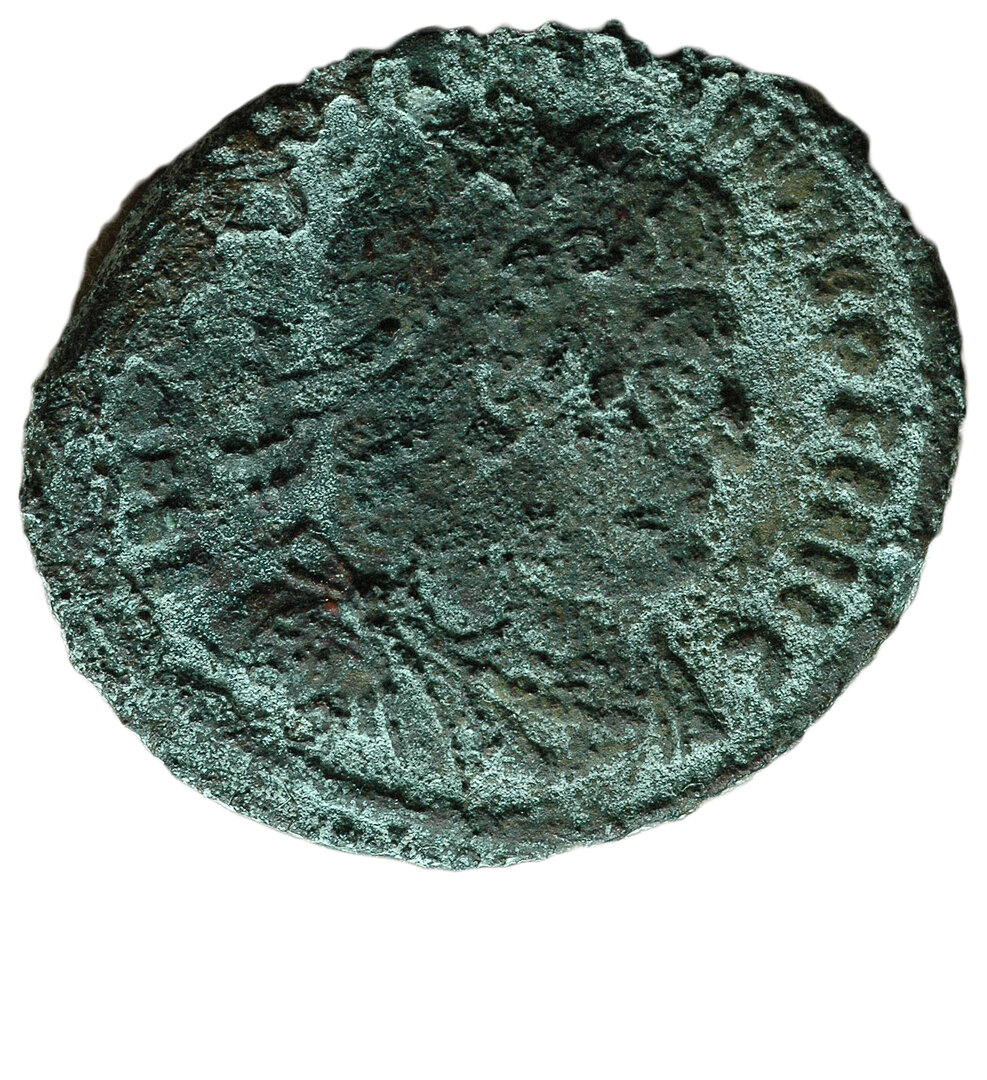
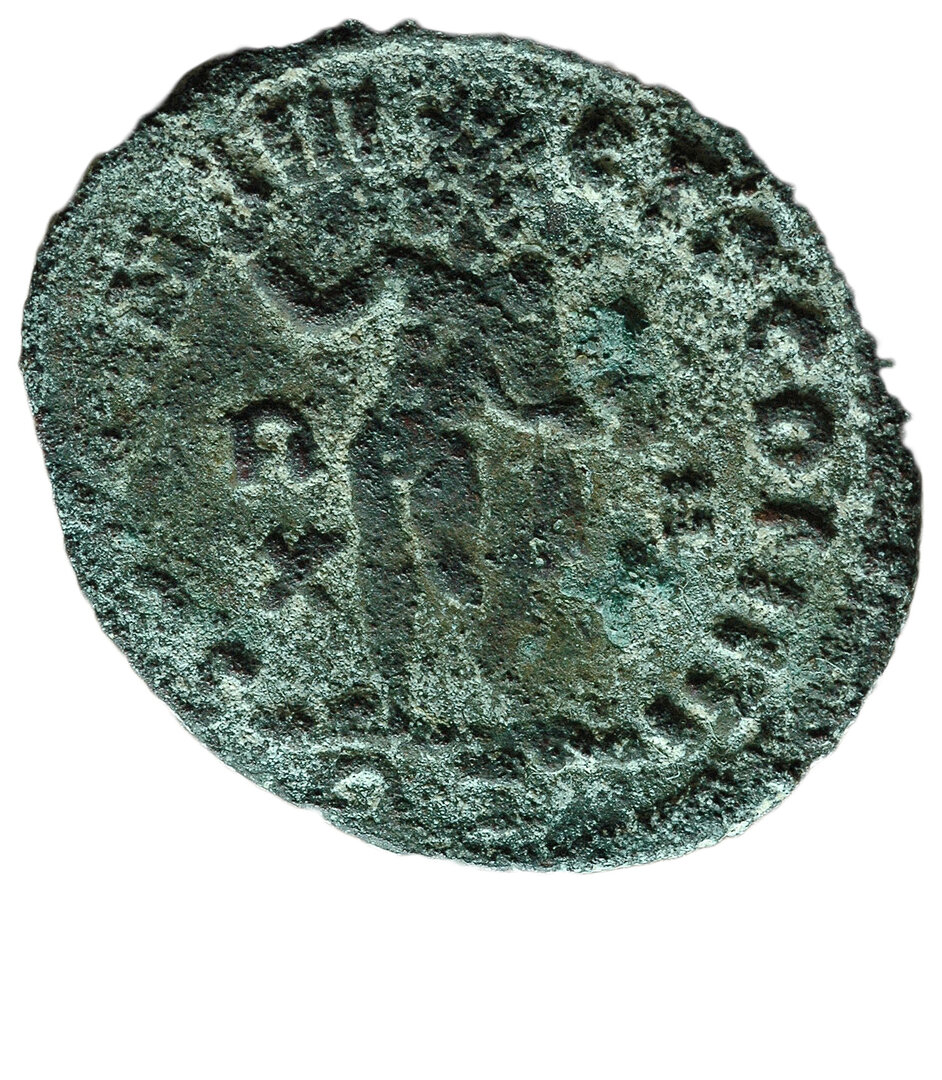
p. 506
151
Inventory Number 1044
Context Area B, room B23, DSU147 (coin from sieving)
Material AE
Diam. 20 mm
Weight 2.2 g
Axis 12h
Module/Denom. AE3/Nummus
Obv. Imp. bust, R; cuirassed, laureate. Legend: IMP CONSTANTINUS AU[G]
Rev. Sol, stg. R, looking L, raising R hand, globe in L, chlamys across L shoulder. Legend: SOLIINVIC – TO [COMI]TI
Mint Lyons
Mint Mark A/S//PLG
Date 316
Ref. variant of RIC VII Lyons 53 (obv.) and 62 (rev.)
Image Ref. to the Database OBV: 1044-AG08--3348; REV: 1044-AG08--3351
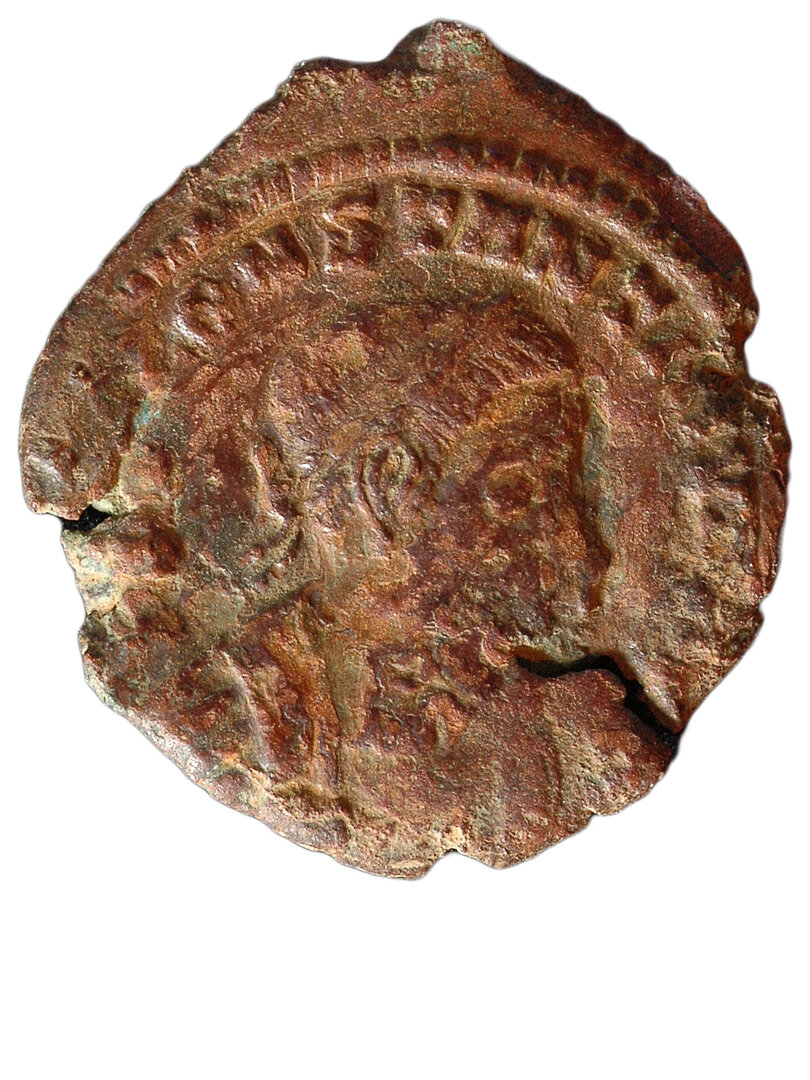
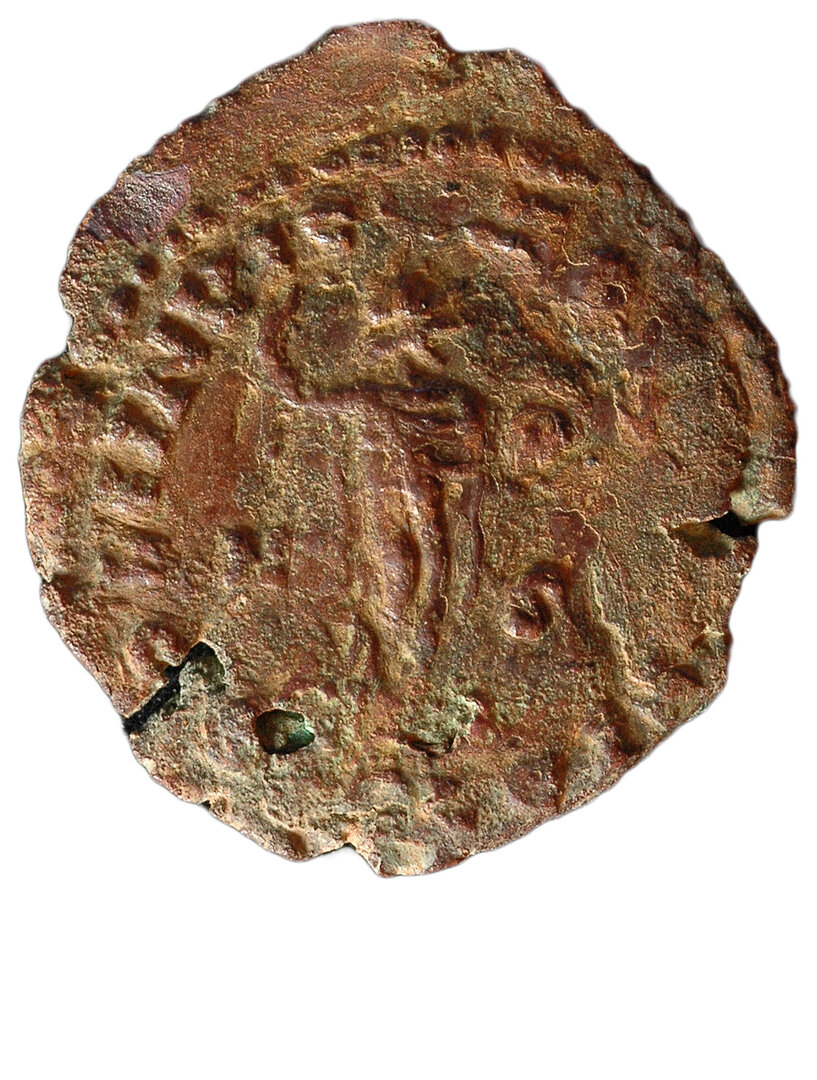
152
Inventory Number 1098
Context Area B, room B24, DSU174 (FN109)
Material AE
Diam. 13 mm
Weight 1.1 g
Axis 6h
Module/Denom. AE3/Centenionalis?
Obv. Imp. bust, R; diadem
Rev. Sec Reip, Victory adv. L with wreath and palm, no extant legend
Mint NA
Mint Mark illegible
Date 364–378
Ref. NA
9.7 Notes
Marcellesi 2012: 266–77; cf. Bowen 2012a, for some of the underlying hoard evidence.↩︎
The precise year Diocletian instituted his reform in Egypt is debated. See Metcalf 1987; cf. Christiansen 2004: 133.↩︎
There is some uncertainty as to when this issue came to an end: cf. Marcellesi 2012: 433; Bruun 1966: 535.↩︎
Casey 1986: 68–113.↩︎
Marcellesi 2012: 266; cf. Bowen 2010a: 458.↩︎
Marcellesi 2012: 266–77 and fig. 13, 289.↩︎
Cf. Lichocka 2005: 303–4.↩︎
Bowen 2001a; Bowen 2010a; Van Heesch 2012: 122. Compare Abu Mina (Noeske 2000: I: 167–79, III, plates 33–34), Karanis (Noeske 2000: I: 190–91, III, plates 42, 47), and Oxyrhynchus (Noeske 2000: I: 191–92, III, plates 45). Some early fifth-century coins were discovered at Douch in the Kharga Oasis, which seems to have been abandoned somewhat later (Noeske 2000: II: 411–14; Bowen 2010a: 479).↩︎
This is also true of the coins studied thus far at Amheida and for those reported from the excavations at Kellis (Bowen 2010a). Sixth and seventh-century finds have been reported from elsewhere in Dakhla (Noeske 2000: II: 410).↩︎
Guest 2012. The Alexandrian mint shrunk to two officinae under Arcadius (Kent 1994: 41).↩︎
Bagnall 1985a: 51–52; Bowen 2001a; Marcellesi 2012: 277–78; cf. Noeske 2000: III: plates 92–102.↩︎
Cf. Bowen 2010a: 480–81.↩︎
Bowen 2010a: 480–81 (Kellis, Dakhla); Bowen 2016 (ʿAin es-Sabil, Dakhla); Van Heesch 2012: 122 and inv. 23–25 (Bahariya); Marcellesi 2012 (Alexandria); Buttrey et al. 1981 (Sardis).↩︎
Grierson 1956; King 1996; Noeske 2000: I:, 115.↩︎
Bastien 1985: 158; cf. the self-assurance (and contempt) of Milne 1926. See Noeske 2000: I: 116–17 for a critique of Milne’s classification.↩︎
Gara 1978; King 1996; Barakat and Picard 2002; Carrié 2003: 194–95; Andrieux et al. 2005; Barakat 2005; Noeske 2006: 357–58.↩︎
Milne 1926: 48–53; Noeske 2000: I:, 117.↩︎
So-called “barbarous” imitations: Milne 1926: 50; cf. Hill 1950; Noeske 2000: I: 116–17.↩︎
Marcellesi 2012: 278–79 and fig. 12, 288.↩︎
E.g., Karanis and Abu Mina (Noeske 2000: I: 271–77; Noeske 2006: 276–78); Oxyrhynchus (Milne 1933: xv); Kom al-Dikka, Alexandria (Lichocka 2005).↩︎
Published notices of the presence of imitations in the oases: Hope, Kaper, and Bowen 1992: 48 (Kellis); Noeske 2000: II: 410 (Dakhla); Gascou et al. 1980: 336–37; Gautier 1981: 112; Noeske 2000: II: 412–14 (Douch, Kharga).↩︎
See, in general, for this section: Casey 1986; Reece 2003, esp. chs. 12 and 13.↩︎
Bowen 2012a: 423.↩︎
Bowen 2012a: 423.↩︎
Bowen 2012a: 423.↩︎
Amheida: Faucher 2015; Kellis: Hope 1991: 47–48; Hope, Kaper, and Bowen 1992: 47–48; Bowen, Hope, and Kaper 1993: 27; Hope 1995: 52–55; Hope 2001a: 42 (money boxes in the shape of Egyptian temples).↩︎
See Sections 3.1.3–6 (Section 3.1.3, Section 3.1.4, Section 3.1.5, Section 3.1.6) in this volume.↩︎